

Choosing workout gear is more than just picking a size. It’s a way of thinking. A too-tight legging or an oversized hoodie says something about how you’ll perform and look. It’s not just about getting dressed; it’s about making a choice that affects your support, movement, and how you feel.
Forget the idea of a single, “correct” fit. The real question is, “What does my activity need from me today?” Do you need the tight, second-skin fit for intense workouts, or the breathable, forgiving fit for a chill day? It’s not just about feeling good; it’s about choosing the right tool for the task.
The fit debate centers on three main ideas. Compression helps by supporting muscles and improving blood flow for better performance and recovery. The compression-adaptive fit is like a second skin that moves with you, giving you the right amount of support and freedom. And then there’s the relaxed fit, which focuses on comfort and range, perfect for casual days. Knowing these options is the first step to finding the perfect fit for you.
Before you buy, think about the physics of your workout. The answer isn’t in a size chart; it’s in finding the perfect mix of science, support, and style that works for you.
Measuring guide
Finding the right fit for workout clothes is about movement and honesty. Forget the tag size. The secret is your measurements plus the brand’s size chart. This guide helps you understand sizing in a new way.
How to Measure: The “Know Thyself” Workout
Start with your raw data before looking at size charts. Use a soft measuring tape and wear your workout undergarments. Stand naturally and let the tape measure your true size.
For Tops
For tops, jackets, and sports bras, measure your chest. Wrap the tape around the fullest part, keeping it parallel to the floor. Make sure it’s snug but not too tight. This is your band measurement for sports bras.
For Bottoms
Bottoms need waist and hip measurements. Find your narrowest waist, just above the navel. For leggings or shorts, measure your hips. This ensures a good fit during exercise.
With your measurements, you can decode any size chart. Think of it as a decoder ring. Below is a simple example. Remember: Always check the specific brand’s chart.
| Size | Chest (in) | Waist (in) | Hip (in) | Intended Fit Note |
|---|---|---|---|---|
| Small (S) | 34-36 | 28-30 | 36-38 | Fitted, compression feel |
| Medium (M) | 38-40 | 32-34 | 40-42 | Classic athletic fit |
| Large (L) | 42-44 | 36-38 | 44-46 | Relaxed, full range of motion |
| X-Large (XL) | 46-48 | 40-42 | 48-50 | Comfort and mobility focus |
This table is a guide, not a final answer. It helps translate sizes into inches. The “Intended Fit” column shows the brand’s style. Choose based on your activity.
First, measure yourself. Then, find the brand’s chart. Buy with confidence. Your future self will thank you.
Fit by workout type
Choosing the right gear is about performance, not looks. The wrong fit can slow you down and hurt. Think of your activewear as your gear for the task at hand.
The right fit can make all the difference. It can turn a bad day into a great one. Whether it’s yoga, running, or weightlifting, the right fit matters.

Choosing the right gear is smart and strategic. It boosts your performance and lowers injury risk. Plus, it makes you look good.
For more on finding the perfect fit, check out activewear for different body types.
For Running
Running is tough on your body. You need a compression fit that’s like a second skin. It should support your muscles and keep you dry.
Look for a compression fit that wicks sweat fast. It should also prevent chafing with flat-lock seams and a secure waistband.
For Yoga & Pilates
Yoga and Pilates need four-way stretch. Your clothes should move with you, not restrict you. They should be supportive but unrestrictive.
Choose fabrics with lots of spandex for a second-skin feel. This lets you focus on your practice, not your clothes.
For Weightlifting
Weightlifting needs durable, non-restrictive clothes. You don’t need tight compression fit here. Instead, look for clothes that can handle the gym’s rigors.
The fit should be free across your shoulders and back. It should also let you move fully in squats and deadlifts.
For High-Intensity Training (HIIT)
HIIT is the ultimate test. Your clothes need to be versatile and perform well. They should wick moisture, fit tightly for support, and stretch for movement.
The fit must be secure but breathable. It should handle sweat and support your muscles during intense moves.
Common sizing mistakes
Finding the right athletic wear is more than just picking clothes. It’s about finding the perfect mix of fabric, fit, and function. Yet, we often make simple mistakes when choosing our sportswear. These errors can lead to discomfort, poor performance, and gym floor fashion fails.
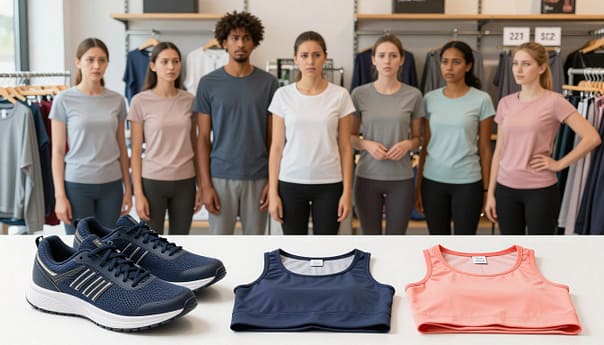
Ignoring Size Charts: The Map You Refuse to Read
In today’s world, we often skip over size charts. This is a big mistake. Brands have different sizes, so a medium in one brand might be a large in another. The sportswear sizing guide is essential, not just a suggestion.
Ignoring the size chart is like using a map of Paris to navigate Tokyo. You’ll end up lost, likely in clothes that are too small. It’s not just about the size of your chest and waist. It’s about understanding the brand’s fit model.
What one brand calls “slim fit,” another might call “compression.” This can lead to clothes that are too tight. You might need a team to get them off.
Fabric Composition Ignorance
Choosing activewear is a science, not just a fashion choice. We often think all fabrics are the same. But, wearing a 100% cotton tee for a workout is a big mistake.
Technical fabrics like nylon-spandex or polyester-polyamide blends are made for a reason. They wick, stretch, and breathe. Wearing cotton for a run is like trying to win a race in a vintage car. It might look good, but it won’t perform well.
The fabric is key to a good workout. It protects you from discomfort and poor performance.
The “Vanity Sizing” Trap
Vanity sizing tricks us into thinking we’re smaller than we are. This is a marketing trick that makes us feel good but doesn’t fit well. We’ve all tried wearing clothes that are too small, feeling proud for a moment.
But, this isn’t a victory. Clothes that are too small restrict movement and performance. True confidence comes from wearing clothes that fit perfectly, allowing you to move freely.
The goal is to find the right size that boosts your performance. It’s not about wearing the smallest size.
These mistakes show we don’t communicate well with our sportswear. It’s like using a sledgehammer for a small job. Understanding size charts, fabric technology, and avoiding vanity sizing are key to good activewear. Master these, and you’ll be ready for success, not just for social media.
Brand-to-brand fit differences
So, you’ve got your measurements down. You’ve picked your fit. But, things change when you go to a different store. The key is realizing that a “medium” isn’t the same everywhere.
It’s more like a social idea, not set in stone. What one brand calls a Medium, another might call a Small. Each brand has its own idea of what fits right.
The Vanity Sizing Conundrum
Vanity sizing is a clever trick. Brands make a “Medium” that feels like a “Large” to make you happy. It’s all about how it makes you feel. The label “M” is just a guess, not a fact.
A Medium from one brand might be the same as a Large from another. The answer? Look at the size chart, not the label.
Decoding the Size Chart Hieroglyphics
The size chart is your guide. It turns brand speak into real numbers: inches and centimeters. You need to know these numbers.
For example, RVCA gives you a detailed size chart. This is what you should follow, not just the tag.
Here’s what you do: measure your best-fitting clothes. Then, compare those measurements to the brand’s size chart. Does your 40″ chest match their “Large” or “X-Large”? The chart is the truth, not the label.
This way, you’re not just guessing. You’re using the brand’s own data to find what fits you best.