

Outdoor workout clothing during a heat dome should be lightweight, loose enough for airflow, light-colored, quick-drying, and comfortable across every moving seam. A breathable top, low-compression shorts or leggings, moisture-managing socks, sun-protective accessories, and properly fitted shoes form a sensible starting outfit.
No shirt, pair of shorts, or “cooling” fabric can make dangerous heat safe. Clothing is one part of heat-risk management, alongside checking the forecast, moving exercise to a cooler hour, reducing intensity, drinking fluids, taking shade breaks, and knowing when to stop.
That distinction matters during the late-July 2026 heat dome. On July 26, at least 40 million people were under extreme-heat warnings across the central and southern United States. Heat indexes above 100°F extended from Minnesota to Mississippi, parts of the Southwest faced temperatures near 120°F, and Rapid City, South Dakota, recorded an all-time high of 112°F. The continental United States had already experienced its second-hottest first half of a year on record. (Associated Press)
Why the 2026 Heat Dome Changes the Clothing Question
The usual question is whether workout clothing feels comfortable. During extreme heat, the better question is whether the full outfit helps sweat evaporate, limits unnecessary insulation, protects exposed skin, and avoids friction as the fabric becomes damp.
A heat dome occurs when atmospheric conditions trap hot air over a broad region for an extended period. The July event affected communities from the desert Southwest and Gulf Coast through the Great Plains and Midwest. On July 25, roughly 80 million people faced heat advisories, with temperatures forecast at 10°F to 15°F above normal in parts of the central United States. Western Nebraska was expected to reach 108°F, and the Las Vegas Valley reached about 114°F. (AP heat-dome report)
High humidity creates another challenge. Sweat cools the body most effectively when it evaporates. Humid air slows that evaporation, leaving skin and clothing wetter and making the temperature feel hotter. Warm overnight lows can add strain by limiting the body’s chance to recover between hot days.
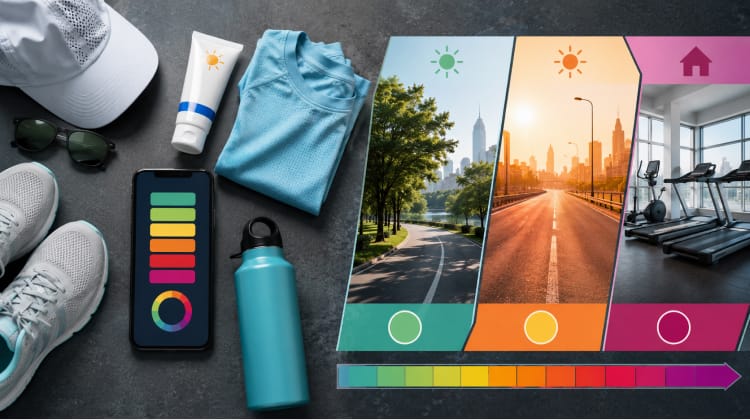
The safest outfit may sometimes be indoor workout clothing. A red or magenta HeatRisk forecast, an extreme-heat warning, poor air quality, or a route without shade can make an air-conditioned gym, home routine, or rest day the better choice.
Wear Lightweight, Loose, Light-Colored Layers
The Centers for Disease Control and Prevention recommends loose, lightweight, light-colored clothing for people exercising on hot days. The agency pairs that clothing advice with cooler workout times, gradual pacing, extra water, and stopping immediately when faintness or weakness develops. (CDC heat guidance for athletes)
“Loose” does not need to mean oversized. A shirt should sit away from the torso enough to permit air movement without flapping into the face, catching on equipment, or shifting during running. Armholes should allow a full stride or overhead reach without cutting into the underarm area.
For bottoms, choose the least compression that still keeps the garment secure. Lightweight running shorts, relaxed training shorts, bike shorts, and thin leggings can all work. The right choice depends on the activity, personal comfort, chafing history, sun exposure, and how securely the garment stays in place.
Light colors reflect more sunlight than very dark colors, yet color is only one factor. A thick, pale sweatshirt is still a poor heat-wave layer. A light-colored garment needs a low fabric weight, useful ventilation, and a fit that does not trap an unnecessary pocket of hot air.
Extra layers worn only for sweating or rapid weight change should stay out of a heat-dome workout. Plastic suits, heavy hoodies, multiple leggings, and non-breathable waist coverings increase insulation and fluid loss without making the training session more effective.
Choose Fabric Construction Over Marketing Labels
Activewear labels often feature terms such as cooling, breathable, sweat-wicking, dry-fit, or temperature regulating. Those claims do not follow one universal performance standard, so the garment’s actual construction deserves more attention than the front-of-package wording.
Hold the fabric up to light. A thin knit or strategically placed mesh panel often permits more air movement than a dense, brushed, or double-layered fabric. Check whether the garment dries quickly after being dampened. Feel the inner surface for rough printing, thick elastic, raised seams, or bonded areas that may become irritating after prolonged sweating.
Technical polyester, nylon, and blended fabrics often dry faster than a typical cotton T-shirt. Cotton can feel soft at the start of a workout, yet it may absorb substantial moisture, become heavy, and cling to the body. That does not make cotton universally unsuitable. A short walk in a loose cotton shirt may feel comfortable, whereas a long run in high humidity may expose its limitations.
Fabric weight can matter more than fiber name. A thin, open-knit blend may feel cooler than a thick “performance” fabric with a brushed interior. Elastane adds stretch, but a high-stretch garment with strong compression may reduce airflow and feel warmer than a relaxed design.
Test new activewear during an easy session rather than a long run or exposed hike. Heat, sweat, repetitive movement, and swelling can change how a waistband, hem, or seam feels after 20 or 30 minutes.

Reduce Pressure, Friction, and Front-Seam Discomfort
Sweat softens the skin and increases the chance that repeated rubbing will become uncomfortable. Heat-dome clothing should stay in place without digging, folding, or pulling fabric into sensitive areas.
A comfortable waistband should remain level during squats, walking, and running. Constant rolling or sliding usually signals a mismatch in rise, size, stretch recovery, or waistband construction. Sizing down to stop movement can create more pressure and warmth rather than solving the fit problem.
Front seams deserve the same practical attention. A raised seam that presses into sensitive anatomy can become more noticeable once the fabric is wet. A flat-front design, a wider gusset, flatter stitching, or a less compressive fit may reduce pressure. No garment construction works for every body, so comfort during movement is a more useful test than appearance in a dressing-room mirror.
Inner-thigh friction can occur with loose shorts, fitted shorts, or leggings. Longer inseams may prevent skin-on-skin rubbing. Flat seams and smooth gussets may reduce fabric-on-skin friction. A garment that repeatedly rides upward is unlikely to become more comfortable in severe heat.
Sports bras and fitted tops need enough support for the activity without restricting breathing or creating deep pressure marks. Mesh panels can improve ventilation, but mesh placed under a high-friction strap or along a sensitive seam may irritate some wearers. Support level, band fit, strap placement, and fabric softness should be considered together. (Activewear Fabric Guide)
Balance Heat Relief With Sun Protection
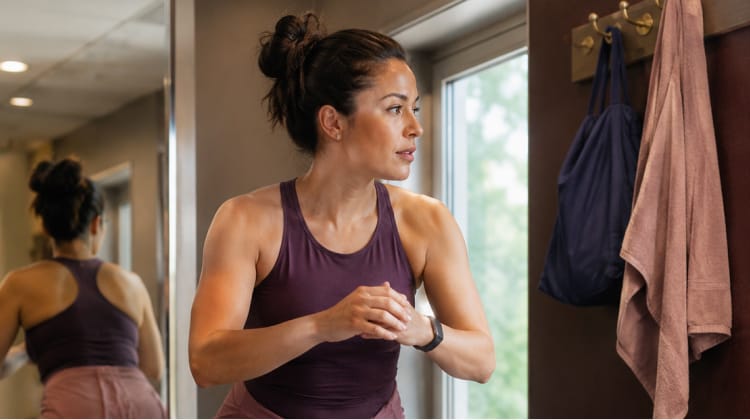
Minimal clothing can increase exposed skin without providing a meaningful safety advantage. A loose, lightweight long-sleeved top may offer better sun protection than a tank top, provided the fabric is thin enough and the design allows airflow.
Ultraviolet protection factor, or UPF, describes how much ultraviolet radiation a fabric allows to reach the skin. The American Academy of Dermatology recommends looking for a UPF label and using broad-spectrum, water-resistant sunscreen with SPF 30 or higher on exposed skin. Clothing can lose some sun protection when it becomes wet, stretched, or worn thin. (AAD sunscreen and clothing guidance)
There is a practical color tradeoff. Dark, tightly woven fabric can block more ultraviolet radiation, yet it may absorb more solar heat. A light-colored garment with a verified UPF rating can offer a more predictable balance for hot-weather exercise.
A vented cap or lightweight wide-brimmed hat can protect the scalp and face. The hat should fit securely enough for the activity without using a tight band that traps sweat. Sunglasses should provide ultraviolet protection and remain stable when the wearer sweats.
Sunscreen should cover skin not protected by clothing. Heavy sweating, toweling, and water exposure can remove sunscreen, so follow the product’s reapplication directions rather than assuming one morning application lasts through a long outdoor session.
Match the Outfit to the Workout
Different activities create different airflow, friction, equipment, and visibility needs. The table below provides a practical starting point rather than a universal dress code.
| Outdoor Activity | Practical Heat-Dome Outfit | Fit Detail to Check |
|---|---|---|
| Walking | Loose light-colored T-shirt or tank, lightweight shorts, vented hat, cushioned socks | Waistband stays level and armholes do not rub |
| Running | Quick-drying singlet or thin T-shirt, light running shorts or low-compression fitted shorts, breathable socks | Seams remain flat and fabric does not ride into sensitive areas |
| Cycling | Lightweight jersey, padded cycling shorts, moisture-managing socks, properly fitted helmet | Waist and leg bands stay secure without excessive pressure |
| Outdoor Strength Circuit | Loose training top, light shorts, stable athletic shoes, small towel | Clothing permits full squats, hinges, presses, and lunges |
| Hiking | Lightweight UPF shirt, ventilated shorts or thin trail pants, brimmed hat, hiking socks | Pack straps do not trap thick layers or create rubbing points |
Cyclists still need a properly fitted helmet, even in extreme heat. Runners and walkers exercising near traffic may need reflective details or a lightweight visibility layer during early-morning and evening sessions. Safety equipment should not be removed to make an unsafe temperature feel more manageable.
For hiking, extra coverage may protect against sun, brush, insects, and contact with hot surfaces. The fabric should remain light and easy to ventilate. Carrying a dry replacement shirt can help on longer outings, especially when the return trip follows a shaded climb or a windy exposed ridge.
Check HeatRisk, Heat Index, and Air Quality
Air temperature alone does not describe the full workout environment. The National Weather Service heat index combines temperature and relative humidity to estimate how hot conditions feel. Published heat-index values are calculated for shaded conditions; direct sun can make exposure feel markedly hotter. (National Weather Service heat-index guidance)
The experimental National Weather Service HeatRisk viewer provides a seven-day, color-coded forecast. It considers how unusual the temperature is for the location and season, the duration of daytime and nighttime heat, and heat-health data. Green represents little or no expected heat risk, followed by yellow, orange, red, and magenta as risk rises.
Check the hourly forecast for the precise location and planned workout time. A 7 a.m. run may face much lower solar exposure than a noon run, yet humid mornings can still carry a high heat index. A late-evening workout can remain dangerous after pavement and buildings have stored heat throughout the day.
Air quality deserves a separate check. Canadian wildfire smoke affected parts of the United States during July 2026, and heat can overlap with ozone or particle-pollution problems. EPA’s AirNow air-quality map provides current and forecast AQI information by location. Clothing cannot filter wildfire smoke, so a smoky day may call for a shorter indoor workout rather than a different shirt.
Acclimatization Matters More Than a New Outfit
A person returning from a cool climate, an air-conditioned routine, illness, vacation, or training break may tolerate heat differently from someone who has trained in warm conditions for weeks.
The National Institute for Occupational Safety and Health describes acclimatization as the body’s beneficial adaptation to repeated heat exposure. Its March 2026 guidance recommends gradually increasing heat exposure over seven to 14 days. Adaptations can include earlier and more efficient sweating, lower cardiovascular strain, and a lower core temperature at a given workload.
That workplace guidance should not be treated as a personal exercise prescription, but the principle transfers well: do not take a new lightweight outfit as permission to resume full-speed outdoor training on the hottest day of the month. Shorten the session, lower the pace, choose a shaded route, and build exposure gradually.
People who are pregnant, older, taking certain medications, living with heart, lung, kidney, or metabolic conditions, or recovering from illness may face added heat risk. A qualified healthcare professional can provide guidance that accounts for personal health, medication use, and local conditions. Medication should not be stopped or changed solely to accommodate a workout.
Know When Clothing Cannot Make the Workout Safe
The CDC advises athletes who feel faint or weak to stop all activity and move to a cool place. Other possible signs of overheating include headache, dizziness, nausea, unusual weakness, heavy sweating, muscle cramps, shortness of breath, and reduced coordination. These symptoms should not be treated as evidence that a person simply chose the wrong fabric.
Confusion, altered behavior, slurred speech, loss of consciousness, seizures, or a very high body temperature can indicate a medical emergency. Call 911 and begin rapid cooling as directed by emergency professionals. Heat stroke can cause permanent disability or death when treatment is delayed.
Use a simple stop rule during extreme heat:
- Stop for faintness, dizziness, unusual weakness, nausea, confusion, loss of coordination, chest discomfort, or breathing that feels out of proportion to the activity.
- Do not try to “finish the mile” or reach a planned calorie target.
- Move to a cool or shaded place and seek medical help when symptoms are severe, worsening, or not resolving.
- Call emergency services for confusion, collapse, seizures, loss of consciousness, or suspected heat stroke.
Build a Heat-Ready Outfit Before You Leave
A sensible heat-dome outfit starts with a lightweight, light-colored top that allows airflow. Pair it with secure, low-compression bottoms that do not roll, ride up, or place pressure on sensitive anatomy. Add moisture-managing socks, activity-appropriate shoes, a vented hat, ultraviolet-protective eyewear, and sunscreen on exposed skin.
Check seams, gussets, waistbands, bra bands, hems, and straps through a full range of motion. The garment should feel secure without squeezing. Fabric should dry reasonably quickly and should not become transparent, heavy, or abrasive when wet.
Then check the conditions. Review the hourly heat index, NWS HeatRisk level, local warnings, route shade, water access, and AirNow AQI. Move the workout, reduce it, or take it indoors when the environment is unsafe.
The best outdoor workout clothing during the 2026 U.S. heat dome is clothing that supports cooling and comfortable movement without creating false confidence. A practical outfit can reduce avoidable discomfort. It cannot cancel an extreme-heat warning.