

The new U.S. microplastics report does not establish that wearing polyester leggings, nylon shorts, or other synthetic workout clothes causes disease. It identifies synthetic fabrics as an important source of environmental microplastics and describes growing evidence that very small plastic particles can enter the human body. At the same time, the report repeatedly emphasizes that scientists have not determined how much exposure causes harm—or how much exposure comes directly from wearing a particular garment.
That distinction matters for fitness readers. Polyester, nylon, acrylic, and elastane are common in activewear because they can provide stretch, moisture management, support, and durability. These materials can also release plastic microfibers during manufacturing, normal wear, washing, and drying.
The responsible takeaway is neither “synthetic workout clothes are completely harmless” nor “throw out every pair of leggings.” The current evidence supports reducing unnecessary microfiber pollution while recognizing that direct health risks from wearing ordinary synthetic activewear have not been quantified.
What the July 2026 U.S. Report Actually Found
On July 15, 2026, the U.S. Government Accountability Office published Science & Tech Spotlight: Microplastics in the Body and Environment, report number GAO-26-109098. The two-page assessment came from GAO’s Science, Technology Assessment, and Analytics team, with Karen L. Howard, PhD, listed as the primary contact. The document was reviewed by GAO Chief Scientist Sterling Thomas, PhD.
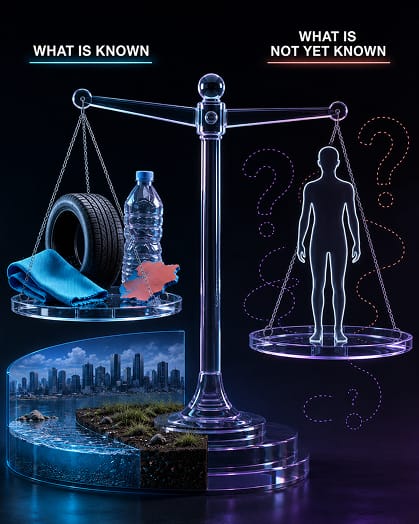
According to the GAO microplastics report, more than 24 million tons of plastic—an amount GAO compares with the weight of 12 million cars—enter the global environment each year. It identifies vehicle tires, synthetic fabrics, plastic bottles, and paint as major sources of microplastics.
GAO defines microplastics as plastic particles smaller than 5 millimeters, or 5,000 micrometers. Nanoplastics are the smallest category described in the report, measuring less than 1 micrometer.
The report’s central health statement is carefully worded: exposure to microplastics has been associated with health problems in humans and other organisms, but researchers have not established the extent to which the particles cause those problems.
That is not a minor disclaimer. Association means that two findings occurred together in a study. It does not automatically show that one caused the other, identify where the particles originated, or establish the exposure level at which a measurable health effect begins.
Why Synthetic Workout Clothes Are Part of the Discussion
Polyester, nylon, acrylic, and elastane are polymers, meaning they are forms of plastic. When tiny fragments break away from these materials, they may become plastic microfibers.
Workout clothes can release fibers at several points in their life cycle. Cutting, brushing, dyeing, and sewing can leave loose manufacturing debris. Friction during running, cycling, weight training, and everyday wear can abrade the fabric. Washing and tumble drying can then detach additional fibers.
NOAA explains that synthetic clothing may release microfibers through normal wear as well as washing and drying. Those fibers have been found in water, air, soil, and shorelines across the United States. On 37 National Park beaches studied by researchers, fibers appeared at every sampling location and accounted for 97% of the microplastic debris collected. (NOAA microplastics information)
This establishes an environmental pathway. It does not establish that a person wearing a polyester shirt for a one-hour workout receives a harmful dose through the skin or lungs.
The GAO assessment discusses exposure through inhalation, ingestion, and skin absorption in broad terms. It does not calculate how much exposure comes from tight clothing, loose clothing, sports bras, leggings, indoor cycling apparel, running gear, or any other activewear category.
What the Report Does Not Prove About Wearing Activewear
The GAO report is a technology spotlight, not a clinical trial of workout clothing. It is also not an audit product and states that it may be revised as science develops.
It did not compare people who wear polyester with people who wear cotton. It did not measure particles released against sweaty skin, examine whether exercise changes absorption, or determine whether compression clothing presents a different exposure level from relaxed garments.
It also did not conclude that:
| Claim | What the Evidence Currently Supports |
|---|---|
| Polyester leggings cause heart disease | No clothing-specific causal evidence establishes this |
| Sweat pulls dangerous amounts of plastic through the skin | Real-world exposure from sweaty activewear has not been quantified |
| Natural fibers eliminate microfiber pollution | Cotton, wool, and rayon also shed fibers, although they behave differently in the environment |
| Recycled polyester is always safer | Shedding varies by yarn, construction, finishing, thickness, and washing conditions |
| Throwing away synthetic clothes reduces personal risk | The report makes no such recommendation, and disposal creates additional textile waste |
| A “non-toxic” label proves a garment is microplastic-free | Broad marketing terms do not establish fiber composition, shedding rate, or health risk |
The report does say that smaller particles, including nanoplastics, may cross biological barriers more readily than larger particles. However, identifying a possible pathway is different from showing that an ordinary garment produces a clinically important exposure through that pathway.
A 2026 dermatology review found that some very small particles may penetrate skin, particularly when the skin barrier is compromised. Much of the supporting work involved laboratory models, and the review did not establish a disease risk from wearing standard fitness apparel. (Microplastics and skin evidence)
Microplastics and Textile Chemicals Are Different Questions
Online discussions often combine three separate subjects: plastic fibers, chemical additives, and ordinary skin irritation. They should not be treated as interchangeable.
A microfiber is a physical strand shed from a textile. Chemical concerns can involve dyes, waterproofing agents, plasticizers, metals, flame retardants, or per- and polyfluoroalkyl substances. Chafing and irritation, meanwhile, can result from friction, retained sweat, rough seams, detergent residue, elastic pressure, or sensitivity to a particular material.
GAO notes that microplastics can carry substances such as phthalates, PFAS, and heavy metals. That does not mean every synthetic garment contains those substances at the same level or that every wearer absorbs them in a harmful dose.
A waterproof outdoor jacket, for example, may involve different finishes and exposure questions from plain polyester running shorts. A brightly printed garment may have a different chemical profile from an undyed knit. Product design and manufacturing practices matter in addition to the fiber listed on the care label.
This is why a headline claiming that “polyester is toxic” goes beyond the evidence. Polyester describes a broad material category, not one standardized garment with one consistent chemical composition or shedding rate.
How Much Fiber Do Clothes Release?
There is no single shedding rate that applies to all synthetic workout clothing.
A 2021 study of consumer textiles found microfiber losses ranging from 9.6 to 1,240 milligrams per kilogram of fabric in one wash. Estimated fiber counts ranged from 8,809 to more than 6.8 million. The difference between the lowest- and highest-shedding textiles exceeded 850-fold, showing how strongly fabric design can influence the result. Mechanically treated polyester materials, including fleece and jersey fabrics, shed more on average than the woven nylon samples tested. (Consumer textile shedding study)
A separate study published in 2024 compared acrylic, polyamide, virgin polyester, recycled polyester, and polypropylene fabrics under controlled washing conditions. The researchers counted 1,193 fibers from the recycled-polyester sample and 908 from the comparable virgin-polyester sample. Woven acrylic produced the highest count in that experiment, at 2,405 fibers.
Those numbers should not be used to declare that every recycled-polyester garment sheds more. The researchers tested defined samples under laboratory conditions, and results can change with garment construction, thickness, weight, yarn type, surface treatment, detergent, temperature, and washing method. (Synthetic textile washing study)
Research is also exploring lower-shedding textile treatments. A study published online on June 4, 2026, tested plasma-assisted surface modifications on polyester. Its most effective chitosan treatment reduced fiber counts by approximately 63% compared with untreated fabric under the study protocol. That is a materials-science result, not evidence that similarly treated commercial activewear has been proven to improve human health.
What Human Health Research Can Tell Us
Microplastics and nanoplastics have been detected in human blood and tissues. Researchers are investigating whether particular polymers, particle sizes, shapes, concentrations, and chemical additives affect the body differently.
The cardiovascular study highlighted by GAO was led by Raffaele Marfella, MD, PhD, and published in the New England Journal of Medicine in March 2024. It enrolled 304 patients undergoing surgery for carotid artery disease, with 257 completing an average follow-up of almost 34 months.
Polyethylene was detected in plaque from 150 patients, or 58.4%, while polyvinyl chloride was detected in 31 patients, or 12.1%. Patients whose plaque contained detected particles had a higher rate of heart attack, stroke, or death during follow-up.
The study is important, but it does not show where the particles came from. It cannot attribute them to leggings, food packaging, water bottles, tires, indoor dust, or any other single source. It was observational and involved patients who already had carotid artery disease. Subsequent correspondence also raised questions about possible sample contamination, illustrating the measurement challenges GAO emphasized.

A 2025 review in The Lancet Planetary Health similarly concluded that direct evidence linking microplastic exposure to specific human diseases remains scarce, even though animal and laboratory studies raise legitimate biological concerns.
Why Federal Agencies Are Acting Before Every Question Is Answered
Scientific uncertainty does not require policymakers to ignore a widespread pollutant. It means that research, measurement, and risk communication need to distinguish confirmed findings from unresolved questions.
On April 2, 2026, the Environmental Protection Agency added microplastics as a contaminant group in its draft Sixth Contaminant Candidate List. The draft contains 75 individual chemicals, four chemical groups, and nine microbes. Placement on the list means a contaminant may warrant further evaluation under the Safe Drinking Water Act; it does not mean EPA has already established a federal drinking-water limit or concluded that every exposure causes harm.
The same day, the Advanced Research Projects Agency for Health announced STOMP, or Systematic Targeting Of MicroPlastics. The $144 million program is intended to improve measurement, identify which particles are most biologically important, and investigate ways to remove potentially harmful particles from the body.
Program managers Ileana Hancu, PhD, and Shannon Greene, PhD, are leading the effort. HHS said the Centers for Disease Control and Prevention would independently validate measurement methods developed through the first phase.
The existence of a $144 million research program is evidence that federal officials consider the knowledge gaps important. It is not proof that scientists already know which garment, polymer, or exposure pathway presents the greatest personal risk.
Should You Replace Polyester Leggings With Cotton?
Replacing every synthetic garment is not a recommendation supported by the GAO report.
Synthetic fabrics offer practical benefits for many activities. Polyester and nylon can dry quickly, maintain shape, reduce the weight of sweat-soaked clothing, and provide the stretch required for running tights, sports bras, swimwear, and compression garments. Elastane allows clothing to move with the body and recover after stretching.
Natural fibers have different tradeoffs. Cotton can feel soft and breathable during low-intensity activity but may retain moisture and become heavy. Merino wool can manage odor and moisture well but may cost more and require careful washing. Natural materials can also contain synthetic elastic, sewing thread, mesh, coatings, or trims even when the primary fabric is cotton or wool.
All textiles shed fibers. One laundering study found that cotton and rayon released substantial quantities of microfibers, sometimes more by mass than polyester under the tested conditions. The environmental difference is that polyester fibers are plastic and are expected to persist much longer, while untreated cellulose-based fibers generally degrade more readily.
A practical wardrobe may therefore contain a mixture of materials selected by activity, fit, durability, skin comfort, climate, and care requirements. Keeping a functional garment in use can be more reasonable than discarding it solely because polyester appears on the label.
Lower-Regret Ways to Reduce Microfiber Release
Reducing microfiber pollution does not require panic purchasing or an immediate plastic-free wardrobe. Several steps address environmental release without making unsupported promises about disease prevention:
- Keep serviceable workout clothing in use rather than replacing it with every trend cycle.
- Prefer durable, tightly constructed garments over fabrics that visibly pill, fuzz, or break down quickly.
- Wash activewear when hygiene and odor require it, but avoid washing clean items automatically after brief, low-sweat use.
- Use full loads, cooler water, shorter or gentler cycles, and air drying when those methods suit the care label.
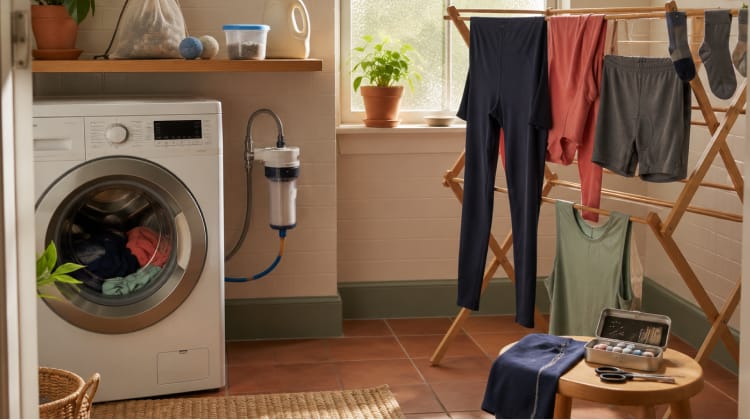
- Consider a microfiber-catching laundry bag, ball, or external washing-machine filter.
- Remove captured fibers according to the device instructions and place them in household trash rather than rinsing them down a drain.
- Repair loose seams and retire garments that are extensively degraded or continuously shedding visible fibers.
NOAA specifically identifies laundry bags, balls, and filters as tools that may reduce the fibers leaving a washing machine. EPA also recommends washing full loads, using colder and shorter cycles, and considering an external microfiber filter. These measures are aimed primarily at reducing environmental discharge; they have not been proven to lower an individual’s disease risk. (NOAA microfiber reduction guidance)
Do not deliberately leave damp, heavily soiled workout clothing unwashed simply to avoid microfiber release. Sweat, skin oils, odor, and friction still affect comfort and garment care. The goal is thoughtful laundering, not poor hygiene.
When the Immediate Problem Is Fit or Skin Irritation
A person experiencing burning, itching, chafing, or a rash after exercise should not automatically assume microplastics are the cause.
More immediate possibilities include excessive compression, a rough front seam, a narrow gusset, retained moisture, repeated inner-thigh friction, detergent residue, fragranced laundry products, dyes, or sensitivity to an elastic component. Similar symptoms can occur in natural and synthetic fabrics.
A body-neutral fit check can be more useful than focusing on the material name alone. The waistband should remain secure without digging. Seams should stay flat during squats, running, and cycling. Fabric should not repeatedly pull into sensitive anatomy or create concentrated pressure when damp.
Changing into dry clothing after exercise and washing garments according to their care instructions may help reduce routine irritation. Persistent, severe, spreading, blistering, or recurrent skin symptoms deserve evaluation by a qualified healthcare professional. An article about textiles cannot diagnose the cause of a rash or replace dermatological care.
What Consumers Should Avoid Assuming
The July 2026 report justifies attention, but it does not support fear-based activewear marketing.
A brand should not claim that its cotton leggings prevent disease merely because they contain less synthetic fiber. A “microplastic-free” claim deserves scrutiny if the garment still contains elastane, synthetic thread, elastic bands, coatings, prints, labels, or plastic trims. A “detox” product cannot be assumed to remove particles from the body without credible clinical evidence and appropriate regulatory support.
Consumers should also avoid treating one fiber as the only meaningful source of exposure. GAO lists tires, bottles, paint, and synthetic textiles together, while food, water, air, and indoor dust can contribute to overall exposure. The report does not rank workout clothing as the dominant source for the average American.
The most defensible approach is to separate three decisions:
The first is personal comfort: does the garment fit, breathe, dry, and move appropriately?
The second is environmental responsibility: is it durable, used for a reasonable lifespan, and washed in a way that limits shedding?
The third is health interpretation: what has actually been demonstrated in humans, and what remains a hypothesis or association?
Blending those decisions into one frightening claim creates more confusion than protection.
The Practical Meaning for Activewear Users
Synthetic workout clothes are a real source of plastic microfiber pollution. The new GAO report strengthens the case for better textile design, more reliable particle measurement, improved laundry filtration, and further research into human exposure. (The Hidden Impact of Fabric Softener on Activewear)
It does not establish that wearing synthetic activewear causes a particular disease, that sweat makes polyester dangerous, or that consumers should discard their current workout wardrobes.
A reasonable response is to buy fewer garments, prioritize durable construction, keep useful clothing in service, reduce avoidable laundering friction, and use microfiber-capture tools where practical. People can also select natural or lower-synthetic options when those garments provide the fit, support, and performance their activity requires.
The most important sentence in the federal report is also the least sensational: scientists have not yet determined the extent to which microplastics cause the health problems with which they have been associated.
That uncertainty should lead to better research and sensible exposure reduction—not unsupported medical claims or shame about what someone wears to exercise.