

A Pilates class, heavy strength session, treadmill interval workout, and low-intensity recovery day do not place identical demands on clothing. NikeSKIMS is now making that difference unusually visible by organizing much of its activewear around distinct material families rather than presenting one fabric as the answer to every workout.
The current U.S. NikeSKIMS collection guide separates its apparel into Studio Stretch, Matte, Airy, Shine, Weightless, and Ribbed Seamless collections. Studio Stretch is described as buttery-soft, breathable, and light. Matte adds mid-level compression. Shine combines four-way stretch with quick-drying properties. Weightless prioritizes ultra-light construction. Ribbed Seamless focuses on stretch and moisture management, while Airy is designed as breathable layering apparel.
The differences are real enough to matter, but they do not mean a gym-goer needs six separate wardrobes.
A better way to interpret the NikeSKIMS system is that fabric properties should match the demands of the activity. Pilates may reward softness and unrestricted stretch. Strength training may benefit from more stability and opacity. HIIT raises the importance of drying speed and moisture movement. A low-intensity warmup layer can prioritize comfort and airflow instead.
The challenge is separating useful material engineering from the idea that every workout requires a new outfit.
Why NikeSKIMS Is Organizing Activewear Around Materials
Nike and SKIMS formally introduced NikeSKIMS in 2025 as a women’s training and fitness brand combining Nike’s sports research with SKIMS’ approach to fit and form. Its first major apparel release arrived in September 2025 with seven collections and 58 silhouettes, including bras, leggings, tops, and layering pieces. Nike said the debut was intended to move from studio training through gym activity and everyday wear. Nike’s original NikeSKIMS launch featured athletes including Sha’Carri Richardson, Jordan Chiles, Chloe Kim, Nelly Korda, Madisen Skinner, Serena Williams, Romane Dicko, and Beatriz Hatz.
The material strategy has become easier to see in the current assortment.
As of August 2026, Nike lists Studio Stretch leggings at $108, including 26-inch and 29-inch lengths. Shine includes a 26-inch bonded legging at $108 and a cropped 17-inch version with a drawcord at $94. Weightless includes V-panel leggings at $84. Bra prices vary across the collections, with several Studio Stretch and Shine options between roughly $48 and $68.
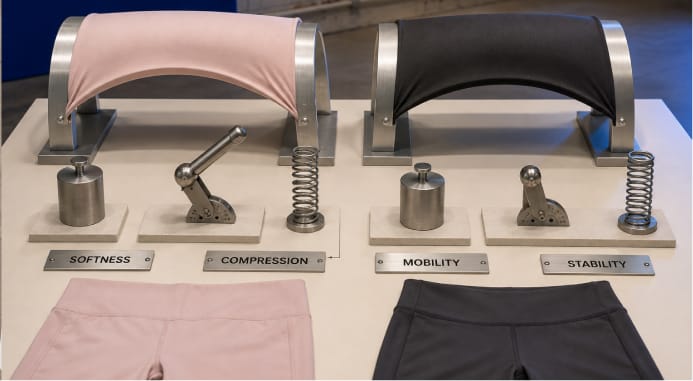
Those price differences do not prove one fabric performs better. They show that NikeSKIMS is selling a system of material choices, not one universal textile.
That makes the collection a useful case study for a broader gym-clothing question: what should actually change when the workout changes?
Studio Stretch Makes The Strongest Case For Pilates And Mobility
NikeSKIMS describes Studio Stretch as a buttery-soft Dri-FIT material with a breathable, lightweight feel. Nike’s May 2026 launch announcement says the collection was developed specifically around yoga and Pilates, combining softness with adaptive stretch and gentle compression. Nike’s Studio Stretch announcement describes it as a studio-first material rather than high-compression training fabric.
That design logic makes sense.
Pilates and yoga involve repeated spinal flexion, hip rotation, kneeling, deep bending, and long ranges of motion. A fabric does not need to feel aggressively compressive to perform those movements well. It needs enough stretch to avoid pulling across the hips and knees, enough recovery to return to shape, and a surface that remains comfortable during sustained contact with mats and equipment.
Softness can therefore be a functional property rather than simply a luxury feature.
The tradeoff is that a very soft, lightly compressive legging may not provide the same locked-in sensation some people prefer for sprinting, jumping, or heavy training.
That does not make Studio Stretch inferior. It means the fabric has a different job.
Matte Shows Why Compression Should Match The Workout
The Matte collection moves in another direction.
Nike currently describes it as smooth and sculpting, with Dri-FIT technology and mid-level compression.
Compression can make leggings feel stable during squats, lunges, loaded carries, and other gym movements because a firmer textile may move less around the body. A waistband may also feel more secure when the underlying fabric has stronger recovery.
But compression should not automatically be interpreted as improved athletic performance.
A 2025 systematic review and meta-analysis examined randomized trials of compression garments during running and concluded that evidence for direct improvements in running performance remains inconclusive. The compression-garment review is a useful reminder that a tight garment can feel supportive without necessarily making someone faster.
Pressure can also become excessive.
Research published in Medicine & Science in Sports & Exercise found that overly tight sports-bra underbands can alter breathing mechanics during exercise. Loosening the band reduced the work of breathing in the study participants. Although a sports bra is different from a pair of leggings, the broader lesson is relevant: more compression is not automatically better compression. Sports-bra pressure research reinforces the importance of fit rather than maximum tightness.
For lifting and mixed gym work, Matte may therefore make sense for someone who prefers a more secure sensation—as long as the waistband, seams, and overall pressure remain comfortable through movement.
HIIT Puts More Pressure On Moisture Management
A hard interval class changes the priority list.
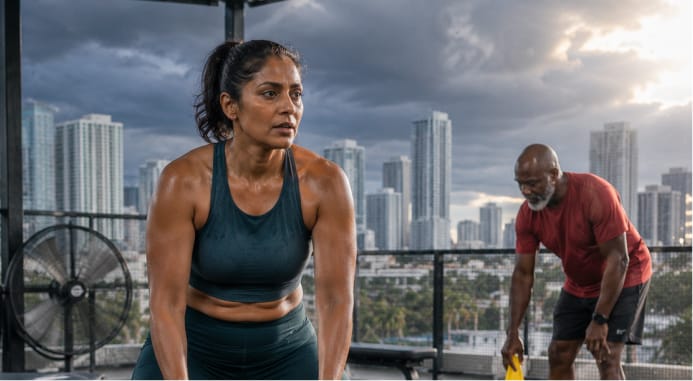
During HIIT, rowing intervals, stair work, or treadmill sessions, heat production and sweat rise quickly. The clothing needs to move moisture while remaining light enough that it does not become distracting as it gets damp.
Nike describes Shine as a lightweight, four-way-stretch material with quick-drying properties. Weightless goes further toward minimal mass, using semi-sheer, ultra-light construction with quick-dry technology.
The reason quick drying matters is supported by textile research.
A review of active-sportswear drying performance identified moisture transport, air permeability, fabric weight, thickness, yarn structure, and surface characteristics as important contributors to workout comfort. It also emphasized that fiber name alone does not determine drying behavior; the complete fabric structure matters. Research on activewear drying performance provides a detailed overview.
A newer 2026 textile study reached a similar conclusion. Researchers evaluated polyester and cotton-lyocell-elastane sports fabrics before and after a functional textile treatment. Some properties, including air permeability and aspects of moisture spreading, improved, while others changed little. The researchers cautioned that laboratory fabric measurements still need wearer trials before assuming physiological or performance benefits. The 2026 sports-fabric study illustrates why broad claims such as “cooling fabric” or “high-performance fabric” deserve context.
For HIIT, that makes quick drying and moisture movement more relevant than whether a fabric feels exceptionally soft when dry.
What Dri-FIT Actually Does
Several NikeSKIMS families use Nike’s Dri-FIT technology, so it is useful to separate that term from general marketing language.
Nike’s updated July 2026 moisture-wicking fabric guide explains that wicking fabric moves liquid sweat from the skin toward the outer surface of the textile, where it can spread and evaporate. Nike describes the mechanism in terms of capillary action through small channels in the fabric structure.
That process is not the same as stopping sweat production.
It also does not mean the garment will always look dry.
A textile can transport perspiration effectively and still show a darker damp patch. Nike itself now distinguishes conventional moisture-wicking fabrics from its separate Stealth Evaporation technology, which is engineered partly to reduce the visible appearance of sweat.
This distinction matters when evaluating NikeSKIMS or any other activewear brand.
Sweat transport, drying speed, visible sweat, ventilation, and subjective coolness are different properties.
One garment does not necessarily optimize all of them.
Airy Makes More Sense As A Layer Than A Hard-Training Base
NikeSKIMS positions Airy as a breathable Dri-FIT layering collection. Current pieces include oversized T-shirts, relaxed shorts, wide-leg pants, a track jacket, mini shorts, and long-sleeved tops.
That product mix reveals the intended role.
A loose shirt or wide-leg pant may feel useful before and after training, during walking, or for lower-intensity movement. The same garment may be less suitable around certain gym equipment or during activities where loose fabric can interfere with movement.
A wide-leg pant, for example, deserves extra caution around exercise bikes, moving treadmill components, and machines where excess fabric could approach mechanical parts.
Breathability alone does not make a silhouette appropriate for every workout.
For a warmup, cooldown, walk, mobility session, or trip to and from the gym, an airy layer can make sense. For a hard indoor cycling session, fitted shorts or leggings may be more practical.
The distinction comes from activity plus garment design, not fabric name alone.
Ribbed Seamless Trades Smoothness For Texture And Stretch
The Ribbed Seamless collection adds another material approach.
Nike describes it as soft, stretchy, moisture-wicking ribbed apparel with a vintage wash.
Ribbing changes how a fabric stretches because alternating raised and recessed structures can provide mechanical elasticity in addition to the stretch supplied by the fibers themselves.
That can make ribbed pieces comfortable during mobility work and casual training.
Texture also changes how fabric contacts the skin. For some wearers, a ribbed construction feels soft and flexible. For others, raised texture can become more noticeable once sweat and repeated movement increase friction.
That is particularly relevant at waistbands, under bra bands, between the thighs, and anywhere the garment repeatedly moves against skin.
There is no universal answer.
The useful fitting-room question is not “Is ribbed fabric good for the gym?” but “Does this ribbed fabric remain comfortable during the movement I actually do?”
Weightless Fabric Comes With An Obvious Tradeoff
The name Weightless captures one genuine performance priority: reducing material mass.
Nike describes the collection as semi-sheer, ultra-lightweight, and quick drying. Current U.S. listings include a long-sleeved layer and V-panel leggings.
Ultra-light clothing can feel appealing during hot or high-output exercise because less material may retain less heat and moisture.
But “semi-sheer” deserves attention in leggings.
Opacity changes when fabric stretches. A garment that appears adequately covered while standing can behave differently during squats, lunges, cycling, or deep hip flexion.
That does not make semi-sheer activewear inherently inappropriate. Some pieces may be intentionally designed for layering.
It does mean shoppers should perform a movement and lighting test before assuming that an ultralight fabric provides the same coverage as a denser training legging.
A lower fabric weight creates a tradeoff between minimal feel and coverage.
One Fabric Cannot Maximize Every Property At Once
This is the larger lesson behind NikeSKIMS’ material strategy.
Sportswear designers are constantly balancing properties that can conflict.
A denser fabric can provide more coverage and compression but may trap more heat. An extremely light fabric can dry quickly but offer less opacity. A brushed textile can feel exceptionally soft while retaining more warmth. Strong compression can provide stability but become uncomfortable if pressure is excessive.
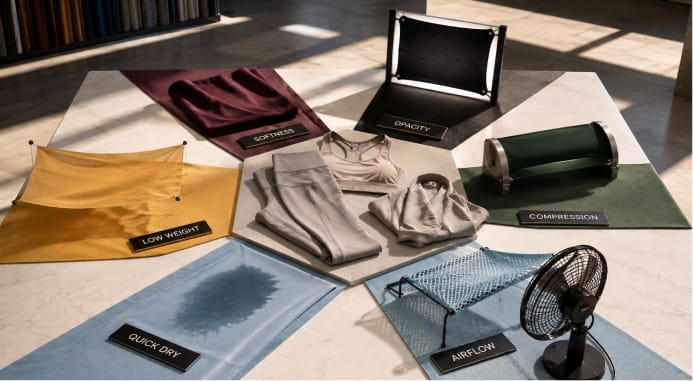
Modern textile engineering can improve those tradeoffs, but it cannot eliminate them entirely.
Research into sportswear repeatedly shows that performance depends on interacting variables including fabric mass, thickness, knit structure, porosity, air permeability, moisture spreading, evaporation, surface texture, and fiber content.
That makes a “perfect gym fabric” unlikely.
The better question is which compromise makes sense for the activity.
A Practical Fabric Guide By Workout
The following is a functional starting point rather than a prescription for buying NikeSKIMS specifically.
| Workout | Fabric Properties Worth Prioritizing | NikeSKIMS Example |
|---|---|---|
| Yoga / Pilates | Softness, high stretch, low distraction, gentle compression | Studio Stretch |
| Strength Training | Opacity, recovery, stable waistband, moderate compression | Matte |
| HIIT / Intervals | Quick drying, moisture movement, low weight, secure fit | Shine |
| Hot / High-Sweat Training | Low weight, fast drying, ventilation | Shine or selected Weightless layers |
| Walking / Warmup | Breathability, easy layering, relaxed comfort | Airy |
| Mobility / Casual Studio Work | Stretch, softness, flexible construction | Ribbed Seamless |
| All-Day Athleisure | Comfort and pressure tolerance over many hours | Studio Stretch or Airy |
The table does not mean each NikeSKIMS collection has been independently proven superior for that activity. It maps the properties Nike says each material emphasizes against the general demands of different workout types.
Individual fit still matters more than the category name.
Sports Bras Need A Different Decision Than Leggings
Fabric matching becomes even more important when the garment is a sports bra.
A soft Studio Stretch bra may be comfortable for Pilates while providing light support. A runner or someone doing repeated jumps may need a different support construction even if they love the fabric.
The NikeSKIMS collection guide now directs shoppers toward bras by support level rather than implying that one fabric determines support.
That is a useful distinction.
Support comes from the entire garment: underband tension, cup or panel construction, straps, coverage, closures, fabric recovery, and individual fit.
Research involving recreational cyclists found that high-support and low-support bras did not produce meaningful differences in 10-kilometer cycling performance, but the high-support condition produced stronger chest-tightness symptoms in some participants. The cycling and sports-bra study reinforces that the most supportive-feeling option is not always the most comfortable one for every activity.
A matching NikeSKIMS set should therefore be evaluated as two products.
The leggings need to pass the squat, waistband, opacity, and stretch test. The bra needs its own support, band, strap, and breathing test.
You Probably Do Not Need A Different Outfit For Every Workout
NikeSKIMS makes a persuasive case for thinking about gym clothes by material.
It does not make a persuasive case that the average person needs a dedicated fabric system for every exercise class.
A good pair of moderately compressive, opaque, moisture-managing leggings may work for lifting, Pilates, walking, and moderate cardio. A well-fitted medium-support bra may cover several activities depending on the wearer.
The benefit of understanding fabric properties is not buying more clothing.
It is making fewer bad purchases.
Someone who primarily does Pilates may have little reason to pay for an ultra-light high-sweat fabric if softness is their priority. Someone who runs intervals three times a week may regret buying leggings mainly because they feel buttery in a fitting room.
A mixed routine may justify two systems: one softer, lower-compression option and one more sweat-oriented training set.
That is very different from needing six.
How To Test A Fabric Before Keeping It
Product descriptions tell you what a fabric is intended to do. Movement tells you whether it works on your body.
For leggings, perform deep squats, lunges, a seated position, high-knee movements, and several minutes of brisk movement if possible. Look for waistband rolling, transparency, front-rise pressure, excessive heat, or fabric that needs constant adjustment.
For a bra, move the arms overhead, rotate the torso, jog or perform controlled hops, and take several deep breaths. Check whether the lower band remains secure without creating uncomfortable pressure.
Pay attention to recovery after stretching. Knees and waistbands should return toward their original shape rather than remaining visibly distorted.
Also consider laundering. Sports-bra research has shown that repeated washing and wearing can alter garment properties, another reason activewear should be judged over time rather than only when new. Research on sports-bra washing and wear examined how use and laundering affect sports-bra function.
If clothing causes persistent pain, significant skin irritation, numbness, or other unusual symptoms, changing fabric may not identify the cause. A qualified healthcare professional can assess persistent symptoms rather than treating an activewear purchase as a medical solution.
What NikeSKIMS Really Gets Right About Gym Fabrics
NikeSKIMS’ current collection makes one useful idea unusually easy to understand: activewear fabric is equipment.
Studio Stretch emphasizes softness and movement. Matte emphasizes sculpting and moderate compression. Shine focuses more heavily on lightness and quick drying. Weightless pushes material mass even lower. Ribbed Seamless combines texture, stretch, and moisture management. Airy functions more naturally as breathable layering. Nike’s current collection guide lays those differences out directly.
Those properties align with real differences between workouts.
But a fabric family is not a prescription.
Pilates does not require Studio Stretch. Lifting does not require Matte. HIIT does not require Shine. The brand’s classifications are useful examples of material priorities, not scientific rules assigning one textile to one movement.
The smarter approach is to identify the hardest demand in your normal training.
If you sweat heavily, prioritize drying and moisture movement.
If deep flexion is central to your workouts, prioritize stretch, recovery, opacity, and seam comfort.
If you spend hours in the clothing, pressure and softness matter more.
If you jump or run, the bra requires enough support for your own body and activity.
Different workouts really can benefit from different fabrics.
Most people simply need the right few fabrics, not a separate wardrobe for every way they move.