

Sweat-Wicking Fabrics are often described as comfort technology, but the useful question is narrower: how well does a textile move moisture during the activity you actually do? A fabric tested in a laboratory may show fast liquid transport, a cooler skin-side measurement, or better diffusion than cotton. That does not mean every garment made with a similar idea will feel the same in a hot studio, on a treadmill, under a sports bra band, or after repeated washing.
For activewear shoppers, the evidence points toward a practical middle ground. Moisture management can matter, especially during high-sweat training, but it works through the whole garment rather than through a fiber name alone. Fit, knit structure, openings for airflow, garment pressure, and the amount of fabric against the skin all change the experience. This is general education about apparel, not medical advice.
How Sweat-Wicking Fabrics Move Moisture
What Wicking Means In Workout Clothing
Wicking refers to the movement of liquid sweat away from the skin-facing side of a textile and across the fabric. Once moisture spreads over a larger area, evaporation may occur more readily, depending on air movement, humidity, garment thickness, and how much sweat the fabric is holding. The aim is not to stop sweating. It is to reduce the clammy, heavy feeling that can happen when fabric remains saturated against the body.
Recent sports-uniform design shows how seriously major manufacturers treat this problem. Associated Press reporting on 2026 World Cup uniforms said Nike used thermal-chamber testing to assess breathability, wicking, and moisture performance while developing fabrics intended to be more breathable and better at moisture management for national-team kits AP uniform reporting. That example does not prove a retail gym top will perform identically, but it shows that moisture movement is tested as a measurable textile property, not only a marketing phrase.
Why Sweat-Wicking Fabrics Are Not All The Same
Two garments can both be sold as moisture managing and still behave differently. One may use a smooth knit that spreads liquid quickly. Another may rely on a textured structure, an asymmetric coating, or a blend that changes how moisture enters and leaves the fabric. A close-fitting top may move sweat efficiently but feel warmer if airflow is limited. A looser top may feel breezier but may not stay positioned during floor work or cycling.
The newer generation of Sweat-Wicking Fabrics also shows that design can happen at different levels: fiber shape, knit construction, coating, and surface chemistry. For shoppers, that means the care label and marketing claim are only a starting point. The better test is movement: raise the arms, bend, jog in place if possible, and check whether the garment stays comfortable when the fabric is stretched.
What The 2026 Textile Research Shows
Janus Coolmax Results In Context
A study published on 5 January 2026 reported a Janus Coolmax fabric made by asymmetrically spraying a thermoplastic polyurethane solution onto Coolmax fabric. In the reported tests, the material produced rapid one-way liquid transport in about 0.2 seconds. The sweat diffusion area was three times that of a Janus cotton fabric, and the measured skin temperature was sustained at 1.6 °C lower than the cotton comparison Janus Coolmax study.
Those numbers are meaningful as textile measurements. They suggest that asymmetric fabric design can change how quickly liquid moves and how widely it spreads. They should not be read as a guarantee that a finished shirt, legging, or sports bra will make every workout feel cooler. A garment includes seams, bands, foam, linings, dyes, trims, and body-contact pressure. Each can alter comfort.
Why Lab Findings Need A Careful Reading
Laboratory fabric tests often isolate one variable so researchers can compare materials. Real workouts do the opposite. Sweat rate, room temperature, humidity, wind or fan exposure, workout intensity, garment fit, and body position all overlap. A textile that performs well in a flat sample can still feel different when stretched across the chest, compressed under a waistband, or layered under another garment.
This is especially relevant for high-output exercise. During intervals, indoor cycling, circuit training, or summer running, a fabric may need to manage liquid, release vapor, and remain stable on the body. During Pilates, walking, warmups, or low-intensity strength work, softness and range of motion may matter more than the fastest possible drying rate. The best fabric choice depends on the activity demand, not on one laboratory number.
Matching Sweat-Wicking Fabrics To Activity
High-Sweat Sessions Prioritize Drying And Airflow
For workouts that produce heavy sweat, look first at moisture movement, fabric weight, and ventilation. A dense garment can feel secure, but it may also hold more warmth. A very light garment may dry faster, yet it may offer less coverage when stretched. Neither tradeoff is automatically better. The key is whether the garment remains comfortable through the hardest part of the session.
A practical fitting-room test can be more useful than a product label. If a top clings heavily after a small amount of moisture, if leggings need constant adjustment, or if a waistband rolls during repeated bending, the fabric technology is not solving the main comfort issue for that body and activity.
Lower-Impact Training Has Different Priorities
For yoga, Pilates, mobility work, and walking, wicking may still help, but stretch recovery, seam placement, opacity, and softness often move higher on the list. A lightly brushed or softer knit may feel better during mat work than a slick, highly compressive training fabric. That does not make one fabric category superior. It means comfort depends on movement pattern.
Readers comparing fiber types can pair this fit-based approach with material knowledge. For a related fabric discussion, see this analysis of nylon versus polyester activewear. For broader wellness education across the same network, insights and resources are available through HealthScope.
Sports Bra Support Is A Separate Fit Question
Support Comes From Structure, Not Fabric Alone
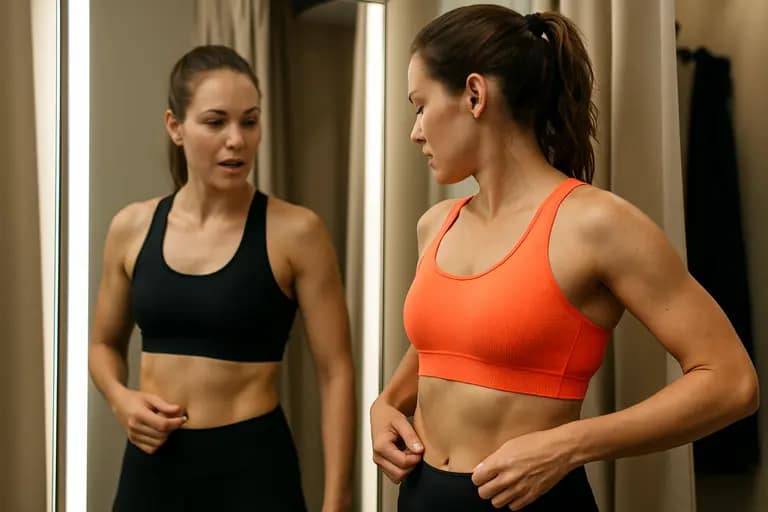
Sports bras deserve their own decision process. A moisture-managing fabric can help with surface comfort, but support comes from garment structure: the lower band, strap placement, cup or panel design, neckline coverage, fabric recovery, closures, and how the bra fits during motion. A bra that feels soft while standing may not control movement enough for running or jumping. A very firm bra may feel secure but may be too restrictive for long wear or breath-focused studio work.
For low-impact sessions, some people prefer lighter support with more stretch. For running, court sports, or repeated jumping, many people look for stronger support and less bounce. For cycling or strength training, the needs may sit between those points. The activity matters because the torso moves differently across workouts. So does personal comfort. There is no single support level that suits every body or every session.
A Movement Check Before Keeping A Bra
Before deciding that a sports bra fits, test it in the movements it will face. Raise both arms, rotate the torso, hinge forward, and perform a few controlled hops if that matches the planned activity. The lower band should feel secure without digging or shifting upward. Straps should stay in place without carrying all the load. The front panel or cups should contain movement without forcing the wearer to shorten breath or adjust constantly.
- For studio work, check stretch, strap comfort, and pressure during deep bends.
- For running or jumping, check bounce control, band stability, and coverage.
- For strength training, check whether straps and closures interfere with bars, benches, or overhead work.
- For long wear, check whether pressure increases after sitting, walking, or warming up.
If a bra or any activewear causes persistent pain, numbness, marked irritation, or unusual breathing discomfort, that is not a fabric-selection problem to troubleshoot alone. A qualified clinician can help assess symptoms in the context of health history and activity level.
Materials, Care, And Real-World Limits
Wicking Can Change With Garment Design
Sweat transport depends on the finished garment. A mesh panel may improve airflow in one zone. A double-layer front may add coverage but slow drying. A high-rise waistband may feel supportive but trap more heat. A sports bra with padding may manage sweat differently from an unpadded compression style. These design choices can be helpful or distracting depending on the workout.
Care also matters. Laundry routines, fabric softeners, heat exposure, and repeated wear can affect how activewear feels over time. The supplied research set points to innovation in finishes and fiber-level engineering, but shoppers still need to judge the garment they own after several uses, not only on the first try-on. If a piece starts retaining odor, losing recovery, or feeling rough at seams, comfort may decline even if the original fabric claim remains accurate.
Comfort Is Not A Medical Outcome
Textile studies may report cooler measured skin-side temperatures or faster moisture movement under defined conditions. Those outcomes are not the same as treating heat illness, preventing injury, improving fitness, or changing health status. Clothing can support comfort and reduce distraction during exercise, but it should not be treated as a medical solution.
People who are pregnant, taking medications that affect heat tolerance, managing a health condition, or returning to exercise after illness or injury may have individual considerations that go beyond apparel. In those situations, clothing choices should sit alongside professional guidance, hydration planning, appropriate pacing, and attention to the exercise environment.
Sweat-Wicking Fabrics In Workout Decisions
Sweat-Wicking Fabrics can be useful, especially for workouts where damp, heavy clothing becomes distracting. The strongest evidence in the supplied research shows that engineered structures can move liquid faster, spread sweat over a larger area, and produce cooler measured skin-side comparisons under test conditions. The cautious takeaway is that these results guide fabric design; they do not guarantee the feel of every finished garment.
A good choice starts with the activity. High-sweat training usually rewards quick drying, airflow, and secure fit. Studio movement often rewards stretch, softness, and low-friction seams. Sports bras require a separate support check because band tension, straps, panels, and coverage shape comfort as much as fabric does. If clothing-related discomfort is persistent, painful, or linked with skin or breathing symptoms, discuss it with a clinician rather than relying on a fabric change alone.