

Three-dimensional textured leggings are moving back into the activewear conversation, but the most visible feature may also be the easiest one to misunderstand.
On August 19, 2026, CalyraFit announced an expansion of its sculpting activewear collection with 3D Textured Sculpting Leggings. The Seattle-datelined release describes a high-waisted legging that combines dimensional knit texture, compression, flexible movement, a seamless front, and a contoured appearance. The company positions the garment for walking, light workouts, travel, errands, and casual everyday wear.
The launch raises a useful question for anyone shopping for gym clothes: does making the surface of leggings three-dimensional actually improve training, or does it mainly change how the garment looks and feels?
Based on current evidence, consumers should be cautious about assuming that visible texture itself improves athletic performance. Compression garments have been studied much more extensively than textured leggings, and even there the results are mixed and dependent on the outcome being measured. A major 2025 review found no significant improvement in running race time or time to exhaustion from compression garments.
Texture can still matter. It may change appearance, surface feel, fabric thickness, friction, stretch distribution, and how a garment visually interacts with the body. Those characteristics can influence whether someone enjoys wearing leggings during a workout.
They are not the same thing as making the workout itself more effective.
For readers comparing leggings from a body-neutral perspective, cameltoe.org focuses on how activewear construction, fabric, seams, and fit behave during movement rather than treating someone’s body as a problem the clothing needs to correct.
What Exactly Is A 3D-Textured Legging?
Most conventional performance leggings present a relatively smooth outer surface.
Three-dimensional leggings intentionally introduce variations into that surface.
Depending on the manufacturing method, a textile can use different knit structures, raised areas, recessed areas, ribbing, honeycomb-like structures, geometric patterns, or strategically varied tension to produce visible and tactile texture.
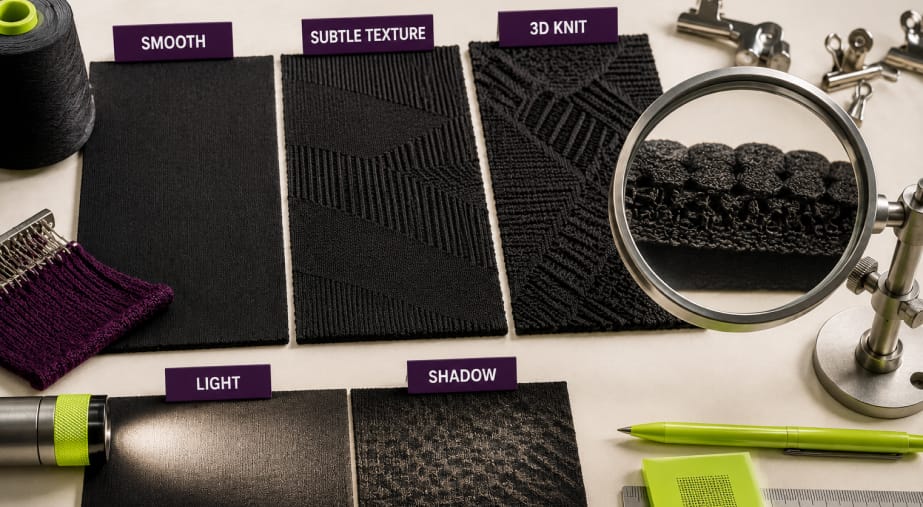
That is different from printing a pattern onto smooth fabric.
CalyraFit says the dimensional texture in its new leggings is integrated into the fabric rather than simply printed onto the surface. The August 19 announcement says the construction is intended to create visual contour while maintaining flexibility during activities such as sitting, walking, bending, and exercising.
That distinction is important because structural texture can affect how a textile behaves.
But “3D” by itself is not a performance specification.
Two textured leggings could use completely different yarns, knit densities, compression levels, thicknesses, and stretch characteristics.
The Most Obvious Effect Is Visual
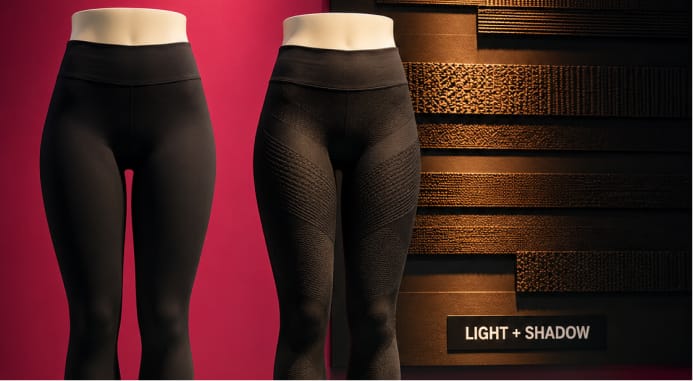
The clearest function of pronounced texture is appearance.
Light behaves differently across an uneven surface than across a completely smooth textile. Raised and recessed sections create small highlights and shadows, making the garment appear more dimensional.
Pattern placement can reinforce that effect.
Texture around the thighs, hips, or glute area can visually emphasize contours. Changes in knit direction can also make some regions appear more defined than others.
CalyraFit explicitly positions its new leggings around this idea, saying its dimensional knit is designed to create a contoured appearance. The company’s broader marketing also uses terms such as “sculpt,” “smooth,” and “shape.”
Those are primarily appearance-oriented concepts.
A leg looking more contoured while wearing textured leggings does not establish that the muscles are working harder, becoming stronger, or receiving a training benefit.
That distinction should remain clear.
“Sculpting” Is Not A Precise Exercise-Science Term
“Sculpting” has become common activewear language because it can describe several things without identifying exactly which one is happening.
A garment might visually sculpt through:
pattern placement,
compression,
seam positioning,
color blocking,
surface texture,
waistband construction,
or simply a close fit.
None of those automatically means physiological change.
Clothing can change the appearance of the body while it is being worn. That is fundamentally different from changing body composition, muscle development, or fitness.
The distinction becomes particularly important with textured leggings because their appearance can make the garment seem technologically sophisticated.
A complicated surface does not necessarily mean a complicated physiological effect.
Compression Is A Separate Feature From Texture
Texture and compression should not be treated as interchangeable.
A smooth legging can provide strong compression.
A highly textured legging can provide relatively little.
Compression depends on characteristics such as fabric elasticity, garment dimensions, material tension, and how tightly the finished garment fits the wearer.
CalyraFit describes its leggings as providing supportive compression, meaning the product combines two separate design elements: compression and a textured surface.
That makes it difficult to attribute any perceived support specifically to the texture.
If someone feels more held in while wearing the leggings, the explanation may simply be garment compression.
What Research Says About Compression And Performance
Compression clothing has a substantially larger research base than 3D sculpting textures, which gives us a useful comparison.
An updated systematic review and meta-analysis published in the Journal of Sport and Health Science examined 51 randomized controlled trials involving 899 participants. Thirty-three studies were included in the primary meta-analysis.
Researchers found no significant improvement in running race time or time to exhaustion among runners wearing compression garments. They did find reduced soft-tissue vibration, although the certainty of evidence across outcomes was generally low to very low.
Readers can examine the findings in the compression garment systematic review.
That does not mean compression clothing is useless.
It means claims need to match the evidence.
A garment can feel supportive or stable without making someone faster.
Recovery Research Is More Complicated
There is some evidence suggesting compression clothing may affect certain recovery outcomes.
A 2025 systematic review and meta-analysis examined 27 studies evaluating compression garments after exercise-induced muscle fatigue. The researchers reported small restorative effects on muscle strength and power, with results varying according to recovery interval and participant characteristics.
The complete study is available through the compression and muscle recovery research.
This should not be translated into a claim that textured leggings improve recovery.
The research examined compression garments, not the specific visual 3D textures used in fashion-oriented sculpting leggings.
That difference is crucial.
A manufacturer would need appropriate testing of its particular garment before broader compression research could establish a specific benefit for that product.
Does Texture Make Your Muscles Work Harder?
There is no good reason to assume that ordinary raised legging texture functions like resistance training.
Resistance training works because muscles produce force against external resistance.
Changing the surface appearance of clothing does not automatically create meaningful resistance to movement.
If a garment were intentionally engineered to resist joint movement, that would be a different technology—and it would need testing to determine the magnitude and consequences of that resistance.
CalyraFit’s August announcement focuses instead on flexibility, supportive construction, appearance, and everyday wearability.
Consumers should therefore be wary of interpreting a textured sensation as evidence that muscles are doing additional productive work.
Feeling something is not the same as measuring a training effect.
Be Careful With Circulation Claims
This is an area where activewear marketing requires particular restraint.
CalyraFit’s current website makes broader claims involving microcirculation and natural lymphatic flow for some of its textured compression products.
Consumers should not automatically interpret those marketing statements as established medical benefits of ordinary gym leggings.
Compression used in clinical contexts is a different subject and may involve specific pressure levels, garment designs, medical indications, and professional guidance.
A fashion or fitness legging should not be treated as a substitute for medically indicated compression equipment.
Someone with persistent swelling, circulation concerns, unexplained leg pain, numbness, or another health concern should speak with an appropriate healthcare professional rather than relying on activewear to address the underlying issue.
Texture Could Change How Leggings Feel When You Sweat
Where 3D construction becomes more practically interesting is the fabric-skin interface.
A textured garment does not contact the body in exactly the same way as a smooth one.
Raised sections may create different pressure and friction points. Recessed sections can alter how much textile surface directly touches skin.
Whether that feels better during exercise depends on the specific fabric.
One textured knit might feel airy.
Another might be thick and warm.
A third could become noticeably clingy once saturated with sweat.
That is why consumers should not assume that a more visually complex fabric automatically provides better ventilation.
Actual moisture behavior depends on fiber composition, knit construction, fabric thickness, treatments, fit, airflow, and the amount of perspiration being produced.
Raised Texture Could Also Increase Friction
Texture introduces another potential tradeoff.
A smooth fabric has a relatively uniform external face.
Raised fabric structures can create more points that interact with other surfaces.
That might matter during activities involving substantial contact with equipment.
Consider seated rowing.
The back of the leggings repeatedly contacts the seat.
During strength training, the garment may rub against benches.
During floor exercises, the knees, thighs, or seat can interact with mats.
During walking or running, the inner thighs may repeatedly contact each other depending on individual anatomy and movement.
A pronounced texture could theoretically change abrasion behavior in any of those situations.
Whether it improves or worsens durability has to be tested on the actual textile.
Texture alone cannot answer the question.
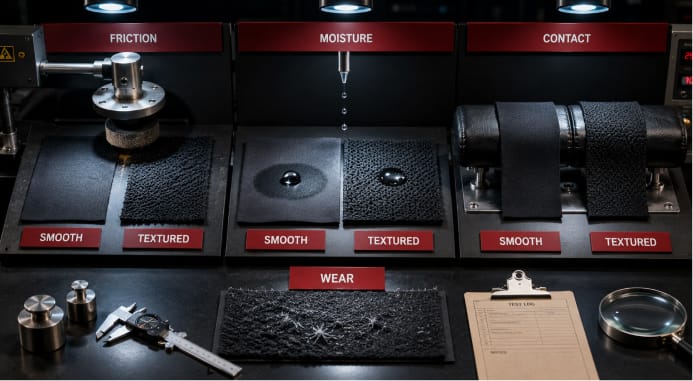
Pilling May Be Worth Watching
Pilling occurs when fibers loosen and become tangled into small balls on a textile surface.
Leggings can experience substantial repeated friction at the inner thighs, seat, knees, and areas touching gym equipment.
A 3D structure creates a different surface geometry from a smooth knit.
That does not mean textured leggings necessarily pill faster.
Some may be extremely durable.
Others may show surface wear more readily.
The useful question is whether the manufacturer has tested abrasion and whether independent long-term use confirms the result.
For consumers, the simplest approach is to inspect high-friction areas after repeated wear and laundering rather than assuming durability from how substantial the fabric initially feels.
Texture Can Help Hide Minor Surface Changes
There may also be a cosmetic advantage.
Small changes in a completely smooth legging can be easy to see because the surface is visually uniform.
Texture already contains intentional variation.
That can potentially make minor wrinkles, small surface irregularities, or certain types of wear less visually prominent.
Again, that is not improved performance.
But cosmetic longevity matters to people buying clothing.
A garment that continues looking acceptable after frequent wear can offer practical value even if its textured construction does nothing measurable to athletic output.
Seamless-Front Construction May Matter More Than The 3D Surface
One of the more practical features in CalyraFit’s announcement has little to do with texture.
The new leggings use a seamless-front construction, which the company says is intended to create a cleaner silhouette.
Removing a center-front seam can change fit and comfort for some wearers.
Traditional leggings frequently place a vertical seam through the front rise. Depending on patterning, fabric tension, movement, and individual anatomy, that seam can sometimes become noticeable.
A seamless front removes that particular seam interaction.
That does not guarantee perfect fit. The crotch gusset, rise dimensions, fabric recovery, and garment size still matter.
But for someone choosing between two pairs of leggings, seam placement may have a more obvious everyday effect than whether the outer fabric has a sculpting texture.
The High-Rise Waistband Is Another Separate Design Choice
CalyraFit also highlights its high-rise waistband as a source of structure and security.
Again, that benefit should not automatically be credited to 3D texture.
Waistband performance depends on:
| Feature | What It Can Affect |
|---|---|
| Waistband height | Coverage and pressure distribution |
| Fabric recovery | Whether the waistband returns to shape |
| Contouring | How closely it follows waist-to-hip proportions |
| Elastic structure | Resistance to sliding |
| Overall sizing | Amount of tension on the body |
| Torso proportions | Where the waistband actually lands |
A well-designed smooth legging can excel in all of those areas.
A textured legging can fail in all of them.
The surface is only one part of the garment.
Squat Opacity Still Has To Pass A Real Test
Three-dimensional texture can make fabric appear visually substantial, but it does not guarantee opacity.
Deep flexion stretches the textile across the hips, thighs, knees, and seat.
As a knit stretches, spaces within its structure can become larger.
Whether enough light passes through to become noticeable depends on fabric density, color, construction, stretch, and fit.
A useful squat test remains exactly the same for textured leggings as it is for smooth ones.
Wear the garment at its intended position.
Perform a deep squat.
Lunge.
Hinge forward.
Sit.
Check the material under realistic lighting.
Texture should not distract from basic performance requirements.
The Texture Should Not Be The Workout
Comfort is particularly important if the leggings have pronounced raised structures.
During a fitting-room test, perform movements that put the textured areas into contact with surfaces.
Sit on a bench.
Kneel on a mat.
Perform a deep squat.
Walk briskly.
If possible, jog.
Notice whether the fabric feels comfortable once stretched and compressed against the body.
A texture that looks impressive but becomes irritating during repeated movement is not an upgrade.
Conversely, someone may simply enjoy the tactile sensation of a dimensional knit.
That preference is valid without needing a physiological explanation.
Body “Sculpting” Language Deserves More Scrutiny
There is a broader issue surrounding this category of activewear.
Much of the marketing emphasizes what leggings supposedly do to the appearance of the body rather than what the garment does during exercise.
That can blur two very different purchasing decisions.
Someone shopping for training leggings might care about:
opacity,
sweat management,
waistband stability,
abrasion resistance,
pockets,
stretch recovery,
seam comfort,
and freedom of movement.
Someone shopping primarily for fashion might care more about texture, silhouette, contouring, and how the fabric looks under different lighting.
Neither goal is inherently wrong.
Problems arise when appearance-oriented features are presented as though they necessarily represent superior exercise technology.
They do not.
Cellulite Does Not Need To Be “Fixed” For Exercise
Textured leggings are frequently marketed using language about disguising or smoothing cellulite.
That should not be confused with a fitness requirement.
Cellulite is extremely common and its visibility can vary with skin structure, connective tissue, genetics, age, lighting, and other factors. A textured garment may make the skin beneath it less visible simply because the textile itself has a more visually complex surface.
That is a clothing effect.
People do not need smoother-looking thighs or glutes to exercise effectively.
A useful workout legging should fit comfortably, remain appropriately opaque, support the intended movement, and avoid unnecessary distraction.
Its ability to create a particular silhouette is optional.
Smooth And Textured Leggings Solve Different Problems
Neither construction is automatically superior.
| Feature | Smooth Technical Fabric | 3D-Textured Fabric |
|---|---|---|
| Visual appearance | Clean and uniform | More dimensional |
| Body contour effect | Depends on pattern and compression | Texture can emphasize contour visually |
| Surface feel | Usually consistent | Can range from subtle to pronounced |
| Compression | Construction-dependent | Construction-dependent |
| Moisture management | Fabric-dependent | Fabric-dependent |
| Opacity | Density and stretch-dependent | Density and stretch-dependent |
| Abrasion resistance | Must be tested | Must be tested |
| Training benefit | Depends on garment performance | No inherent benefit from texture alone |
That last distinction is the important one.
Texture is a design variable.
It is not an exercise intervention.
Who Might Actually Prefer 3D-Textured Leggings?
A textured legging may be a good choice for someone who enjoys a more structured fabric feel.
It may also appeal to people who prefer visually dimensional activewear over completely smooth tights.
Someone wearing leggings across the gym, errands, walking, travel, and casual settings may particularly value the fashion component.
That crossover is central to CalyraFit’s positioning. Its August 19 announcement explicitly discusses leggings moving beyond dedicated workouts into commuting, travel, walking, errands, and everyday wardrobes.
That is arguably where texture has its clearest purpose.
It gives leggings a different visual identity.
Serious Training Requires Looking Beyond The Texture
For lifting, running, cycling, HIIT, or other demanding exercise, buyers should move past the surface appearance and evaluate the garment itself.
Check whether the waistband stays positioned.
Test squat opacity.
Look for comfortable seam placement.
Determine whether the fabric becomes excessively warm.
Put a phone in the pocket if there is one.
Test movement when the material is slightly damp.
Inspect high-friction areas after several washes.
See whether the knees recover after deep flexion.
Those characteristics tell you much more about workout suitability than a “3D” label.
What The CalyraFit Launch Actually Tells Us
CalyraFit’s August 19, 2026 launch is useful because it illustrates where activewear marketing and garment design are converging.
The company has combined integrated 3D texture, compression, a high-rise waistband, flexible construction, and a seamless front into a garment intended to cross between light fitness and everyday life. Its launch materials explicitly emphasize both contouring and movement.
Those are legitimate apparel-design characteristics.
What consumers should avoid is taking the next unsupported step and assuming that visible texture itself makes exercise more effective.
The strongest recent compression evidence does not show improved running race time or time to exhaustion, although some studies suggest possible effects on other outcomes, including recovery measures. Those findings concern compression garments generally—not CalyraFit’s specific 3D texture.
That leaves a fairly straightforward answer to the original question.
3D-textured leggings primarily change appearance, surface feel, and potentially the way the garment interacts with the body and other surfaces. There is not good evidence that the texture itself improves training.
That does not make the feature pointless.
Comfort, visual preference, secure fit, and enjoying what you wear can all matter when choosing activewear.
But a legging does not become better training equipment simply because its fabric looks more technologically complex.
Judge the texture as a textile feature.
Judge the workout performance by what happens when you actually move.