

Recycled nylon is moving deeper into performance activewear, but the important question for someone buying serious workout leggings is more demanding than whether recycled fiber sounds environmentally preferable.
Can recycled nylon survive squats, running, sweat, friction, repeated stretching, and dozens of wash cycles as well as conventional virgin nylon?
The evidence supports a qualified yes. High-quality recycled nylon can be engineered for demanding sportswear, and commercial nylon 6.6 yarns such as Fulgar’s Q-NOVA are already designed for sportswear and other technical applications. Fulgar says fabrics and garments made with Q-NOVA can achieve durability comparable with virgin polyamide, although that is a manufacturer’s performance claim rather than proof that every recycled-nylon legging will perform equally well.
The bigger lesson for shoppers is more useful than declaring one fiber the winner:
“Recycled nylon” tells you something about the material’s origin. It does not, by itself, tell you how well the finished leggings will perform.
For serious training, knit construction, elastane, fabric density, stretch recovery, seams, waistband engineering, abrasion resistance, and overall garment quality can matter as much as whether the nylon started with virgin or recovered feedstock.
Recycled Nylon Is Still Nylon
Nylon is a family of synthetic polyamide materials used extensively in performance clothing because it can be engineered into lightweight, smooth, durable textiles.
The difference between virgin and recycled nylon starts with the feedstock.
Virgin nylon is manufactured from newly produced raw materials. Recycled nylon incorporates material that has already existed in another production stream or product.
That recycled feedstock is not always the same.
According to Textile Exchange, recycled polyamide can come from pre-consumer manufacturing waste as well as sources such as discarded fishing nets and carpets. The organization’s 2025 Materials Market Report says nylon accounted for about 7 million tonnes of global fiber production in 2024, representing approximately 5% of the total fiber market.
That means two garments labeled “recycled nylon” may begin with very different material histories.
The label describes an important sourcing characteristic. It is not a standardized performance grade.
Recycled Nylon Remains A Small Part Of The Market
Despite how frequently recycled materials now appear in activewear marketing, most nylon is still not recycled.
Textile Exchange reported that recycled polyamide represented only about 2% of the total polyamide market in 2024. The organization points to technical recycling challenges and comparatively low prices for new virgin fossil-based polyamide as barriers to wider adoption.
The broader textile industry has the same scaling problem.
Global fiber production reached approximately 132 million tonnes in 2024, while only 7.6% of fiber production was recycled. Less than 1% of the global fiber market came from pre- and post-consumer recycled textiles.
So recycled nylon may be increasingly visible on activewear labels, but it has not come close to replacing virgin nylon at global scale.
That makes performance especially important.
If brands want consumers to accept recycled nylon as a mainstream alternative for leggings, the material cannot simply carry a sustainability message. It has to work.

Q-NOVA Provides A Useful Performance Case Study
One commercially established example is Q-NOVA, a recycled polyamide 6.6 yarn manufactured by Italian textile company Fulgar.
Fulgar says Q-NOVA uses waste generated during its primary production cycle—material that otherwise could not be reused in those processes. Selected waste is mechanically regenerated, returned to polymer form, and subsequently processed into new polyamide yarn.
More than 50% of Q-NOVA fiber comes from those recovered materials.
The material is intended for applications including sportswear, athleisure, legwear, swimwear, underwear, and workwear.
That is relevant because these are not applications where material performance is optional.
Fulgar states that Q-NOVA can provide moisture management and that fabrics and garments made with the yarn maintain durability comparable with virgin polyamide. Those claims should appropriately be understood as manufacturer-reported characteristics, not independent proof that any specific pair of recycled-nylon leggings will outperform—or even equal—another garment.
Still, Q-NOVA demonstrates that recycled nylon 6.6 is being engineered specifically for technically demanding clothing rather than being limited to casual fashion.
Comparable Yarn Does Not Mean Identical Leggings
This is where activewear comparisons frequently become too simplistic.
Imagine that laboratory testing found two nylon yarns had similar mechanical characteristics.
That would not mean leggings manufactured from those yarns would behave identically.
A performance legging is a complete textile system.
Its behavior depends on yarn construction, filament properties, knitting structure, fabric weight, elastane percentage, finishing, dyeing, garment dimensions, seam placement, gusset geometry, and waistband construction.
Two fabrics can both contain 75% nylon and 25% elastane and still feel dramatically different.
One may be slick and lightweight.
Another may feel dense and compressive.
A third might be brushed and exceptionally soft.
That is why comparing recycled nylon versus virgin nylon solely from the fiber-content label can produce the wrong answer.
Serious Workout Leggings Need Recovery, Not Just Stretch
Stretch is one of the easiest performance characteristics to demonstrate in a fitting room.
Pull the fabric.
It expands.
But serious leggings need something harder to evaluate: stretch recovery.
Recovery describes the material’s ability to return toward its original dimensions after being stretched.
Consider what happens during a strength workout.
A deep squat stretches material across the knees, hips, thighs, and seat.
Stand up and the fabric needs to recover.
Squat again.
Then again.
A running workout creates thousands of repeated movement cycles.
Poor recovery can eventually become visible as loose knees, reduced waistband stability, or fabric that no longer feels as secure as it did when new.
Nylon contributes important mechanical characteristics, but elastane usually supplies much of the dramatic stretch and recovery expected from contemporary leggings.
That means the entire blend needs evaluation.
A recycled-nylon garment with well-engineered elastane integration may recover better than a poorly constructed virgin-nylon garment.
Fabric Engineering Can Matter More Than Fiber Origin
Fulgar’s technical yarn catalog illustrates just how many variables exist even within polyamide 6.6.
The company produces partially oriented, drawn textured, air textured, full-drawn, covered, and other yarn structures. Its description of full-drawn polyamide 6.6 emphasizes filament uniformity, mechanical strength, structural stability, and a smooth surface. Q-NOVA can be produced using multiple yarn technologies as well.
Those technical differences matter.
A shopper sees “nylon” on a care label.
A textile engineer sees polymer characteristics, filament dimensions, yarn orientation, texturing, knitting architecture, finishing, and interaction with elastane.
That is why fiber percentages alone are an incomplete way to judge activewear.
Abrasion Is A Major Test For Gym Leggings
Workout leggings encounter friction repeatedly.
Inner thighs may rub during walking and running.
Fabric contacts benches.
Knees touch exercise mats.
A barbell may brush the thighs during deadlifts.
Lifting belts can rub against waistbands.
Phones repeatedly enter and leave pockets.
Over time, those interactions can contribute to surface fuzzing, pilling, thinning, or other wear.
Whether recycled nylon performs well under abrasion depends on the finished textile, including yarn construction, filament properties, knit density, surface finishing, and garment use.
The word recycled cannot predict the outcome.
Neither can virgin.
This is why a useful long-term review should say something like “I wore these twice a week for six months for barbell training” rather than simply “great quality.”
Squat Opacity Has Little To Do With Recycled Content
Opacity is another property that can easily become confused with fiber type.
Whether leggings become visibly sheer during a squat depends heavily on fabric density, yarn coverage, color, sizing, garment pattern, and how far the material is being stretched.
Recycled nylon is not inherently transparent.
Virgin nylon is not inherently squat-proof.
A dense recycled-nylon textile can remain completely opaque during deep flexion.
A lightweight virgin-nylon fabric stretched beyond its intended range can become visibly thinner.
For readers choosing leggings for comfort and confidence during movement, workout clothing fit and comfort are better evaluated through garment construction and how the textile behaves on the individual wearer than through assumptions about body shape or a single fiber on the label.
The practical test remains straightforward: squat, lunge, bend, and check the garment under normal lighting before assuming that a material description guarantees coverage.
Moisture Management Is More Complicated Than “Nylon Wicks Sweat”
Moisture-management language appears constantly in activewear advertising.
The reality involves several variables.
The fiber matters, but so do yarn structure, fabric construction, surface treatments, thickness, fit, airflow, temperature, humidity, and the amount of perspiration being produced.
Fulgar markets Q-NOVA as providing moisture-management performance intended to help maintain a dry feel during use.
That does not establish that every garment containing the fiber will feel equally cool.
Imagine two leggings using similar recycled nylon.
One is a dense winter running tight.
The other is an ultralight knit designed for indoor training.
They could feel completely different during the same workout despite sharing similar base chemistry.
This is another reason the finished textile matters more than the marketing headline.
Recycled Content Does Not Automatically Mean “Sustainable”
Recycled nylon has an intuitive environmental appeal.
Using existing material can reduce demand for some virgin feedstock and keep usable material within the production system.
But describing any garment containing recycled nylon as simply “sustainable” skips too many other variables.
Textile Exchange’s data shows why the issue is complicated. Global fiber production continues to rise, reaching about 132 million tonnes in 2024, while recycled fibers remain a relatively small share of the overall market.
A garment’s environmental impacts can also involve dyeing, elastane, manufacturing energy, transportation, packaging, laundering, longevity, and what happens when the garment reaches the end of its useful life.
Blended fabrics create another complication.
Most stretch leggings are not pure nylon. They combine nylon with elastane, and mixed-fiber textiles can be more difficult to recycle again.
The more precise statement is therefore:
A garment containing recycled nylon incorporates recovered material.
That is meaningful.
It is not the same as proving the entire garment is environmentally benign.
Durability Belongs In The Sustainability Discussion
Consider two hypothetical pairs of leggings.
Pair A contains a high percentage of recycled nylon but quickly loses stretch recovery, pills heavily, and becomes uncomfortable enough that the owner replaces it.
Pair B contains virgin nylon but remains functional through years of regular use.
It would be misleading to judge their environmental implications from recycled content alone.
That does not establish that virgin nylon is environmentally preferable.
It demonstrates why usable lifespan matters.
This is particularly important for performance clothing because workout garments can experience unusually demanding use and frequent laundering.
A runner may wash tights several times each week.
Someone strength training may repeatedly expose leggings to benches, bars, mats, and belts.
Durability therefore belongs in any responsible conversation about recycled activewear.
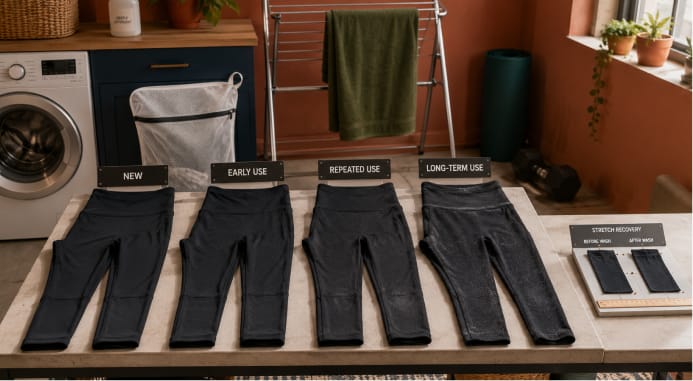
Washing May Reveal More Than One Hard Workout
Brand-new leggings frequently feel excellent.
The harder test comes later.
After repeated wear and washing, several characteristics can change:
- waistband recovery,
- knee shape,
- surface texture,
- pilling,
- color,
- seam integrity,
- compression sensation,
- overall hand feel.
Those changes result from the entire textile and garment system.
They cannot be predicted solely from whether the nylon was recycled.
Following care instructions is therefore important regardless of fiber origin. Excessive heat or aggressive laundering can be unnecessarily hard on stretch garments, particularly those containing elastane.
The meaningful comparison is not recycled nylon on day one versus virgin nylon on day one.
It is how two well-made garments behave after months of comparable use.
Certification Answers A Different Question
Certification can help establish whether recycled-content claims are traceable.
Fulgar states that Q-NOVA is certified and traced through the Global Recycled Standard, and also lists EU Ecolabel and OEKO-TEX Standard 100 Class I certifications for the fiber.
Textile Exchange’s standards and reporting work likewise reflects the industry’s growing emphasis on traceability and certified raw-material programs. For a broader look at the fiber market, the organization’s Materials Market Report provides current production and recycled-fiber data.
But certification should not be asked to answer a question it was not designed to answer.
A recycled-content certification does not guarantee:
perfect fit,
squat opacity,
zero pilling,
ideal compression,
waistband stability,
or years of durability.
Traceability and workout performance are related purchasing considerations, but they are not the same measurement.
What Serious Workout Leggings Actually Need
For someone comparing recycled and virgin nylon leggings, these practical characteristics are more informative:
| Performance Question | What To Examine |
|---|---|
| Squat opacity | Knit density, fit, color and stretch |
| Stretch | Fabric construction and elastane |
| Stretch recovery | Blend and textile engineering |
| Waistband stability | Pattern, elastic structure and fit |
| Sweat comfort | Moisture transport, fabric weight and airflow |
| Pilling resistance | Yarn construction, surface finish and abrasion |
| Chafing | Seams, fit, texture and movement |
| Durability | Construction, textile quality, use and care |
| Pocket stability | Placement, reinforcement and dimensions |
| Long-term shape | Recovery after repeated wearing and washing |
Notice what is missing from most of those rows.
Whether the nylon started as recycled or virgin feedstock does not independently determine the result.
Different Workouts Stress Fabric Differently
“Serious workout leggings” is not one technical specification.
Running creates thousands of repetitive movement cycles, sustained perspiration, and repeated friction.
Strength training can expose leggings to barbells, benches, belts, and rough equipment.
Yoga demands large ranges of stretch and comfortable floor contact.
Indoor cycling creates repeated hip flexion and saddle contact.
HIIT combines jumping, squatting, sweat, and rapid directional changes.
A recycled nylon fabric might be excellent for one of those applications and mediocre for another.
Exactly the same is true of virgin nylon.
The best fabric is therefore partly activity-specific.
A Fitting Room Can Reveal More Than The Hangtag
Consumers cannot reasonably conduct polymer analysis before buying leggings.
They can perform a movement test.
Do several deep squats.
Lunge forward and sideways.
Raise each knee.
Sit down.
Stand back up.
Walk quickly.
Check whether the waistband shifts.
Look at the knees after repeated bending.
Pay attention to seams.
Check opacity during flexion under ordinary lighting.
If the leggings have pockets, put a phone in one and repeat the movements.
These tests cannot predict how the garment will look after 100 washes, but they provide considerably more information about immediate workout suitability than a recycled-content percentage alone.
Recycled Nylon Also Needs Better Scale
The material’s future is not simply a question of whether one premium recycled yarn can work.
The larger challenge is producing recycled nylon at meaningful scale without sacrificing consistency or creating misleading environmental claims.
Textile Exchange’s figures show the size of that challenge. Polyamide accounted for around 7 million tonnes in 2024, yet recycled polyamide remained approximately 2% of the market.
By comparison, virgin fossil-based synthetic fibers continue to dominate global textile production.
Scaling recycled nylon therefore requires more than consumer demand.
It requires suitable feedstock, sorting, recycling infrastructure, polymer-quality control, textile engineering, traceability, and economic conditions that allow recycled material to compete with relatively inexpensive virgin synthetics.
That is a manufacturing challenge far beyond the leggings rack.
Can Recycled Nylon Actually Match Virgin Nylon?
In a well-engineered performance garment, yes—it can be a credible alternative.
Commercial recycled nylon 6.6 such as Q-NOVA is already engineered for sportswear applications, and Fulgar reports durability comparable with virgin polyamide alongside moisture-management properties.
But consumers should resist turning that evidence into the much broader statement that every recycled-nylon garment performs exactly like every virgin-nylon garment.
They do not.
Neither category is uniform.
The better question is whether the specific finished textile meets the demands of the workout.
For leggings, that means looking at stretch recovery, opacity, waistband stability, abrasion resistance, sweat behavior, seam placement, comfort, and performance after repeated washing.
Recycled content can then become another useful purchasing consideration rather than a substitute for those fundamentals.
That may ultimately be the test recycled nylon has to pass if it is going to displace substantially more virgin nylon: not whether it sounds environmentally preferable on a hangtag, but whether people can squat, run, lift, sweat, wash, and repeat without the garment becoming disposable activewear.