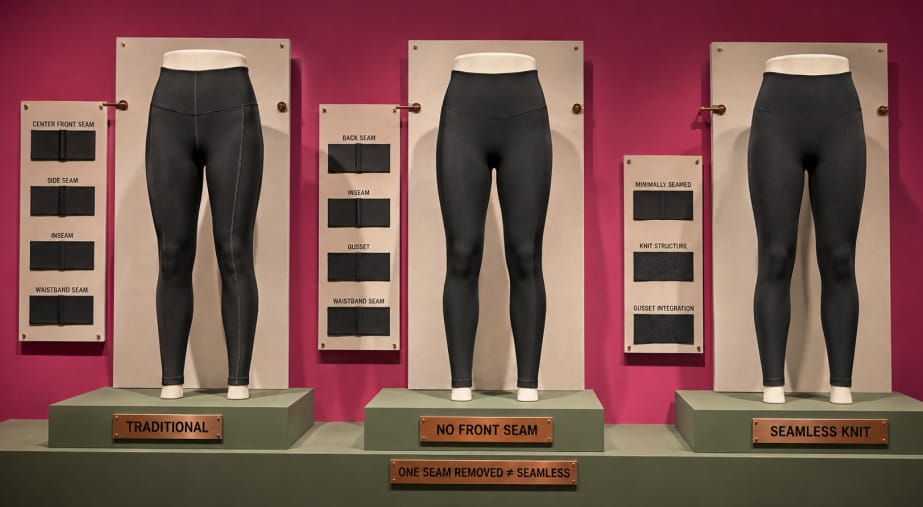

For years, the center-front seam was treated as an almost unavoidable part of workout leggings. It joined the front pattern pieces, helped establish the rise and crotch shape, and was so common that many shoppers probably never considered whether it needed to be there.
That assumption is changing.
In August 2026, front-seam-free construction is increasingly visible across mainstream activewear. Lululemon has expanded its Align No Line concept, while no-line construction has also moved into running and training tights. Aritzia now sells multiple leggings that explicitly advertise the absence of a front seam alongside gusset, waistband, and shaping changes.
The development matters because removing a seam is not simply an aesthetic edit.
The center-front seam traditionally performs structural work. Once designers remove it, they still have to control crotch depth, front rise, fabric tension, gusset geometry, waistband position, opacity, stretch recovery, and movement.
That makes the no-front-seam trend more interesting than another legging silhouette.
It is becoming a garment-engineering strategy.
For wearers, the potential benefits include a smoother front construction, one less seam that can create pressure or friction, and different ways for stretch fabric to interact with the body. But no-front-seam leggings cannot guarantee a specific appearance on every person, nor does removing one seam automatically make leggings more comfortable, durable, or better for training.
For readers comparing leggings from a body-neutral perspective, cameltoe.org approaches fit as an interaction among clothing, fabric, movement, and individual proportions rather than treating natural anatomy as something that needs correcting.
Lululemon Is Moving No-Line Construction Beyond One Yoga Legging
Lululemon provides one of the clearest examples of how quickly no-front-seam construction is moving beyond novelty status.
Its current Align No Line High-Rise Pant removes the conventional front-rise seam while retaining the brand’s Nulu fabric. Lululemon describes that textile as four-way stretch, sweat-wicking, breathable, and made with added Lycra for shape retention.
The current 25-inch version is designed primarily for yoga and lower-impact movement.
What makes the trend more significant is that Lululemon has not stopped there.
No-line construction now appears in crops, shorts, training products, and running tights. Current August U.S. coverage has also highlighted the No Line High-Rise Running Tight, including models with zippered storage.
A yoga legging and a running tight do not have the same job.
When the concept moves into running, designers have to account for thousands of repeated strides, more sustained perspiration, pocket loading, waistband movement, and greater repetitive friction.
When it moves into training tights, the garment may need to survive squats, lunges, burpees, rowing, floor exercises, and strength work.
That expansion is what turns no-front-seam construction from a visual trend into a genuine performance-design question.
What Does The Front Seam Actually Do?
Look at a conventional pair of leggings laid flat.
A seam generally travels from the front waistband downward toward the crotch.
That seam exists because traditional cut-and-sew leggings use separate pieces of flat fabric that must become a three-dimensional garment.
The human pelvis is not flat.
Leggings need enough space and curvature through the crotch and hips while remaining fitted around the waist, thighs, and legs. Joining shaped pattern pieces at the center front is one established way to create that geometry.
The seam therefore contributes to structure.
But it also adds thread, seam allowance, and a physical ridge to an area where highly elastic fabric already sits close to the body.
Depending on the material, seam construction, fit, activity, and individual anatomy, that ridge may be completely unnoticeable—or it can become a point of pressure, friction, or visible fabric gathering.
Removing it eliminates that specific structure.
It does not eliminate the need to create three-dimensional shape.
No Front Seam Does Not Mean Seamless
This terminology can confuse shoppers.
No front seam and seamless leggings do not mean the same thing.
A no-front-seam legging may still contain:
side seams,
inseams,
back seams,
gusset seams,
waistband seams,
and pocket seams.
The designer has simply eliminated the conventional center-front vertical seam.
A truly seamless or minimally seamed garment may instead rely on circular knitting or other specialized manufacturing techniques that reduce traditional cut-and-sew construction throughout larger portions of the garment.
So when a product advertises “no front seam,” it is better to take that phrase literally.
One structural line has disappeared.
The entire legging has not necessarily become seamless.
Removing The Seam Does Not Remove The Need For Shape
The engineering becomes more interesting once that center seam disappears.
Designers still need sufficient front rise.
They still need the garment to accommodate hip flexion.
They still need appropriate crotch depth.
Fabric tension must still be distributed without creating uncomfortable pulling.
The waistband still needs to remain positioned.
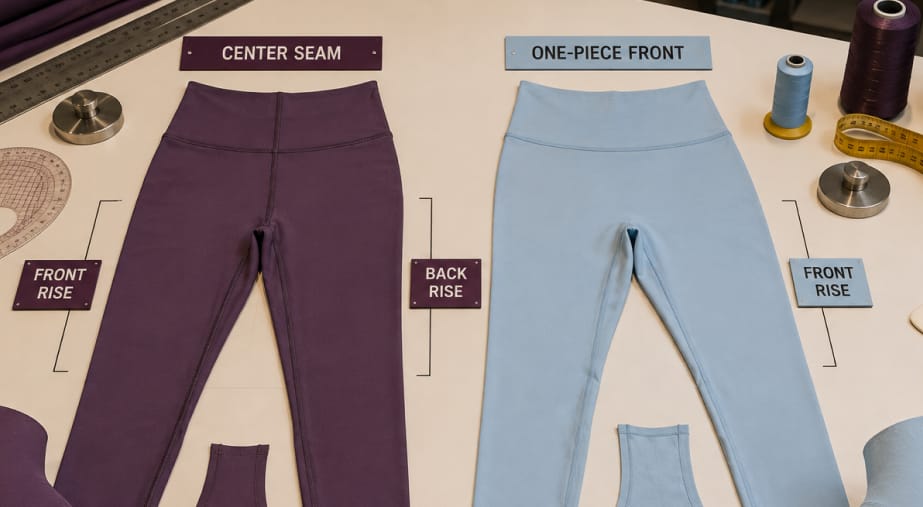
And the textile still has to recover after stretching.
A successful no-front-seam pattern therefore cannot always be created by simply deleting one stitching line from an existing pattern.
The front panel itself may need different geometry.
The gusset may need to change.
The waistband may need to interact differently with the front body.
Fabric characteristics can also become more important because the material is being asked to create shape without the same center-front construction.
The Gusset Becomes A Bigger Part Of The Story
A gusset is an additional piece of fabric positioned around the crotch area of many leggings.
Its shape varies substantially.
Some gussets are relatively small diamonds. Others extend farther forward or backward. Some are incorporated into much larger pattern pieces.
A well-designed gusset can help distribute tension, increase mobility, reposition seams, and reduce the amount of stress concentrated at a single seam intersection.
That becomes particularly relevant when the traditional front-rise seam is removed.
Aritzia demonstrates this broader construction strategy with its current BUTTER Cheeky Infinite Hi-Rise Legging. The company markets the garment with no front seam, but it also specifically references its gusset, curved back waistband, shaping construction, sweat-wicking fabric, and freedom of movement.
That combination matters more than the missing seam alone.
The no-front-seam feature exists within a larger pattern system.
Why The Front Seam Can Change Appearance
A center-front seam creates a defined structural line through an area where elastic material is already conforming closely to three-dimensional anatomy.
Depending on the garment, that seam can concentrate tension differently than the surrounding textile.
Removing it can produce a visually smoother panel.
That is why brands increasingly use terms such as “smooth look,” “streamlined,” or “no line.”
But the distinction needs responsible framing.
Natural anatomy does not disappear when a seam disappears.
Stretch fabric still follows the body’s shape.
Fabric can still gather or migrate.
The rise can still be too short.
The waistband can still move.
Sizing can still affect tension.
Different people can wear the same garment and experience very different results.
No-front-seam construction therefore removes one potential contributor to front-area fabric concentration. It cannot guarantee that every wearer will have the same smooth appearance shown in campaign photography.
That is a clothing-design issue, not a body defect.
Running Is A Much Harder No-Line Test
Running makes this construction particularly interesting because small garment problems become large ones through repetition.
A waistband that moves only slightly on one stride may become distracting after several miles.
A minor point of friction may become increasingly noticeable as perspiration rises.
Pockets containing a phone or keys can change how the tights load against the body.
Fabric also has to repeatedly flex and recover at the hips and knees.
Current August coverage of Lululemon’s No Line High-Rise Running Tight shows that the design concept is now being applied to running-specific apparel rather than remaining confined to yoga and casual wear.
That gives consumers a better performance question to ask:
Does the missing front seam actually help once the tights are wet, moving, loaded with essentials, and several thousand strides into the workout?
A smooth product photograph cannot answer that.

Training Tights Create Different Stress Again
Strength and mixed training expose leggings to deeper and more varied movement.
A squat places substantial stretch across the hips, thighs, knees, and seat.
A lunge creates asymmetrical tension.
Rowing repeatedly moves the torso toward the thighs.
Floor exercises can press seams directly against the body.
Barbells, benches, belts, and machines add friction that yoga leggings may encounter less frequently.
A no-front-seam training tight therefore still needs adequate fabric density, recovery, abrasion resistance, and waistband stability.
Removing the seam may reduce one possible pressure point.
It cannot compensate for poor fabric engineering.
Stretch Recovery Still Matters
Modern leggings can deform significantly during exercise and then appear to return almost immediately to their original dimensions.
That recovery is essential.
Poor recovery can contribute to:
loose knees,
a waistband that gradually feels less secure,
fabric migration,
and changes in compression during a workout.
Lululemon’s Align No Line construction retains Lycra within its Nulu material specifically for stretch and shape retention.
That illustrates an important principle.
Changing the pattern does not make textile performance less important.
It can make textile performance more important because larger uninterrupted panels are still expected to deform and recover repeatedly.
The Waistband May Matter More Than The Missing Seam
For many wearers, waistband behavior is ultimately more noticeable than center-front construction.
If leggings slide downward during running, the smooth front becomes irrelevant.
If the waistband rolls during squats, removing the front seam has not solved the most distracting problem.
Lululemon says the Align No Line redesign involved more than deleting stitching; the company says the garment was reworked so the waistband remains up with fewer seams during movement.
That is a better way to think about the trend.
Successful seam reduction means reconsidering the whole garment rather than celebrating one missing stitching line.
Fewer Seams Could Improve Comfort—But Not For Everyone
Every seam creates some amount of physical structure.
Well-made flat seams can be almost imperceptible.
Other seams may become noticeable during repetitive movement, particularly once the garment is damp.
Reducing seams could therefore reduce potential rubbing or localized pressure for some people.
Someone who has never noticed the center-front seam may experience almost no practical difference.
Someone who repeatedly finds that area uncomfortable may strongly prefer a no-line pattern.
Both experiences are valid.
Activewear comfort is individual because it depends on fabric, fit, movement, sweat, anatomy, and personal preference.
Fewer Seams Do Not Automatically Mean Better Durability
There is an intuitive argument that fewer seams create fewer points where stitching can fail.
That can be true in a very narrow sense: a seam that does not exist cannot split.
But garment durability is much broader.
Removing one seam can alter grain direction, panel size, fabric tension, and where forces move through the textile.
The material itself can still pill.
The waistband can lose recovery.
Elastane can deteriorate.
Other seams can fail.
High-friction zones can thin.
For that reason, there is not enough basis to claim that front-seam-free leggings are universally more durable than conventionally constructed leggings.
Long-term garment-specific testing matters more.
Opacity Has Not Been Solved Either
A smooth uninterrupted front panel does not tell shoppers whether leggings will remain opaque.
Transparency under stretch depends on fabric density, yarn construction, color, fit, and how far the material is being extended.
A no-front-seam legging that is too small can still become excessively stretched.
A lightweight fabric can still become more transparent during a deep squat.
A conventional front-seam legging made from an appropriate dense fabric may remain completely opaque.
Shoppers should therefore keep performing the same movement tests regardless of seam construction.
The Mirror Test Is Not Enough
The easiest place to appreciate no-front-seam leggings is standing still in front of a mirror.
That is also the least demanding test.
Workout clothing needs movement.
Try:
deep squats,
forward lunges,
side lunges,
high knees,
a seated position,
and a forward hinge.
For running tights, jog where appropriate.
Then notice what actually changed.
Did the waistband stay positioned?
Did the front panel remain comfortable?
Did fabric migrate?
Did the knees recover?
Did the gusset feel restrictive?
Did the garment remain sufficiently opaque?
Did another seam become more noticeable once the center seam was gone?
Those observations are more useful than whether the leggings initially looked smoother.
This Could Spread Beyond Traditional Leggings
The trend already extends into shorts, crops, running tights, and training garments.
That suggests front-seam-free construction could continue expanding.
Bike shorts are a particularly obvious application because they use many of the same close-fitting pattern principles as leggings.
Compression shorts could also use similar approaches.
One-piece training garments may incorporate larger uninterrupted front panels.
Specialized fitted base layers could reduce stitching in areas where repetitive movement causes irritation.
But seam reduction should not become an objective by itself.
A seam should disappear because another construction method solves the job better.
Otherwise, manufacturers are simply relocating the structural problem.
Traditional Front-Seam Leggings Are Not Obsolete
There is nothing inherently wrong with a center-front seam.
Well-engineered conventional leggings can provide excellent fit, durability, comfort, and movement.
Millions of people train in them without experiencing a problem.
That matters because fashion cycles often turn options into absolutes.
High rise becomes “better” than low rise.
Seamless becomes “better” than seamed.
Maximum compression becomes “better” than moderate compression.
Activewear does not work that way.
Different garment architectures work for different people, fabrics, and activities.
No-front-seam construction should expand choice, not create a new rule that everyone needs to follow.
What To Compare Before Buying
| Feature | Practical Question |
|---|---|
| Front construction | Is there a center-front seam? |
| Gusset | Does its geometry allow comfortable movement? |
| Rise | Is there enough front and back depth? |
| Waistband | Does it remain positioned during activity? |
| Fabric | Is its weight appropriate for the workout? |
| Recovery | Does stretched material return toward shape? |
| Opacity | Does coverage remain adequate during deep flexion? |
| Other seams | Are they positioned comfortably? |
| Fit | Is fabric migrating or pulling excessively? |
| Intended activity | Was the garment designed for yoga, running, lifting, or everyday wear? |
The no-front-seam label answers only one of those questions.
The complete garment answers the rest.
The Bigger Trend Is Smarter Placement Of Structure
The most interesting part of the no-front-seam movement is not simply that one line of stitching is disappearing.
It is that activewear designers are paying increasing attention to where structural elements belong on a moving body.
Lululemon has expanded no-line construction from its soft yoga-focused Align range into running and training apparel. Aritzia combines its own no-front-seam construction with a gusset, curved waistband, and other shaping elements rather than relying on one feature alone.
That is enough to suggest front-seam-free activewear is becoming more than a novelty.
But consumers should resist exaggerated interpretations.
No front seam does not mean no visible anatomy. It does not mean seamless construction. It does not guarantee perfect comfort, squat opacity, or performance.
What it can do is remove one structural line from a highly mobile area of a close-fitting garment.
If designers successfully redistribute the work through better gussets, rise geometry, waistband construction, stretch recovery, and thoughtful pattern engineering, the resulting activewear may indeed feel smoother and less distracting.
The future of workout leggings may not be completely seamless.
It may simply involve much smarter decisions about where seams belong—and where they no longer need to be.