

Microplastic shedding is often discussed as a laundry problem, but recent textile research provides a more comprehensive perspective. Activewear can release fiber fragments during washing; however, dry movement, abrasion, peeling, and cutting are also significant factors. This is particularly relevant for leggings, compression shorts, base layers, and sports bras because these garments are designed to stretch, recover, rub, and stay close to the body during repeated movement.
The available research does not support a simple ranking of every fabric, finish, or product. Results vary by test method, garment age, washing conditions, fabric structure, and whether researchers measure mass, fiber count, or fragments. A cautious reading is more useful than a claim that one activewear category is clean and another is inherently harmful.
Why Microplastic Shedding Is Not Only A Laundry Issue
Microplastic Shedding Beyond The Wash
A 2026 textile study reported that microplastic fiber fragments can be released in dry-state conditions, including peeling, abrasion, and cutting. The authors specifically examined dry release pathways rather than only wastewater from laundering, which broadens how activewear should be assessed. The paper also described emissions related to fabric-repair cutting, with the course direction of fabric and raw knits identified as relevant in the reported tests. The study is useful because it treats wear-like mechanical stress as part of the problem, not as an afterthought next to washing. The dry-state textile study supports that narrower point.
For activewear, this framing makes sense at the garment level. A running tight stretches across the knees and hips. A sports bra band moves against the rib area and outer fabric layers. A close-fitting top can rub under a backpack strap or against a barbell pad. Those examples do not prove a specific amount of release from a specific garment, but they show why laboratory laundry data alone may not capture the full use cycle.
Finishes Can Shift The Tradeoff
The same 2026 research also reported that some softened or antibacterial textile finishes reduced release during peeling but increased emissions under abrasion. That finding is a useful caution for activewear marketing. A finish may change one shedding pathway without improving every pathway. A softer hand feel, odor-control claim, or smoother surface should not be read as proof that a fabric sheds less in all real-use conditions.
This is especially relevant for sports bras. Support is not created by fabric content alone. It usually depends on band tension, strap placement, panel shape, stretch recovery, closures, and how the garment distributes pressure during movement. Those design features can add contact points and friction zones. A bra that feels secure for jumping may place more mechanical stress on certain fabric areas than a low-support studio bra, while a softer bra may move more on the body. Neither option should be framed as environmentally superior without direct evidence for that exact construction.
What Laundry Research Shows About Microplastic Shedding
Load Size And Measurement Limits
Real consumer laundry data from the United Kingdom, collected in the 2020–2022 period cited in the research notes, found average microfiber release of about 114 mg per kg of textile for wash loads of 1.0–3.5 kg. For larger loads of 3.5–6 kg, release was reported at about 66 mg per kg, roughly half the smaller-load figure. The same source estimated about 12,709 tonnes of microfibers per year across 23 European countries. The consumer laundry study is valuable because it used real soiled laundry rather than only pristine lab samples.
Those figures should be read carefully. They do not mean every full machine is automatically better, and they do not establish a universal wash recipe for every household. Load size interacts with machine type, agitation, textile mix, detergent use, garment age, and the way the study collected and measured fibers. The research still points to a practical idea: activewear’s environmental impact is partly shaped by routine fabric care, not only by what a hangtag says.
Microplastic shedding also becomes difficult to compare across studies because researchers can report fiber mass, fiber counts, fibers per liter, or release per kilogram of fabric. A shopper reading claims about “reduced shedding” should look for the testing basis: what fabric was tested, how it was washed or abraded, whether it was new or aged, and whether the result applies to a finished garment or only a fabric sample.
Why Activewear Fit Can Change Friction
Sports Bras Add More Contact Points
Sports bras are a useful example because their support mechanisms often rely on controlled tension. The lower band anchors the garment. Straps help manage vertical movement. Cups, panels, or compression zones can limit motion depending on the design. From an environmental research perspective, the key issue is not whether a bra is “good” or “bad.” The issue is that support design can create repeated fabric-on-skin and fabric-on-fabric contact.
That is where fit becomes more than a comfort question. A band that is far too loose may slide repeatedly. A band that is far too tight may feel uncomfortable and may place high stress on elastic areas. A racerback design may concentrate tension in different places than a straight-strap design. These observations do not replace individual fitting, and they should not be treated as health advice. They simply show why a garment’s movement pattern can be relevant to dry-state shedding questions.
Activity Level Changes Garment Stress
A studio mobility session, a treadmill interval workout, a cycling class, and a lifting session do not create identical textile stress. High-stretch moves can strain seams and fabric recovery. Repeated jumping can increase movement at bra bands and waistbands. Barbell contact can abrade shoulder and back panels. Mat work may increase rubbing at knees, hips, elbows, and back panels. The same pair of leggings may therefore experience different wear patterns depending on the activity.
This is why microplastic shedding should be viewed through use, not just fiber name. Polyester, nylon, elastane blends, brushed interiors, ribbed knits, and smooth compression fabrics can behave differently because structure and finishing matter. The research supplied here supports caution about dry abrasion and laundering; it does not justify broad claims that one synthetic activewear product has a fixed release rate in every workout.
How To Read Sustainability Claims With Care
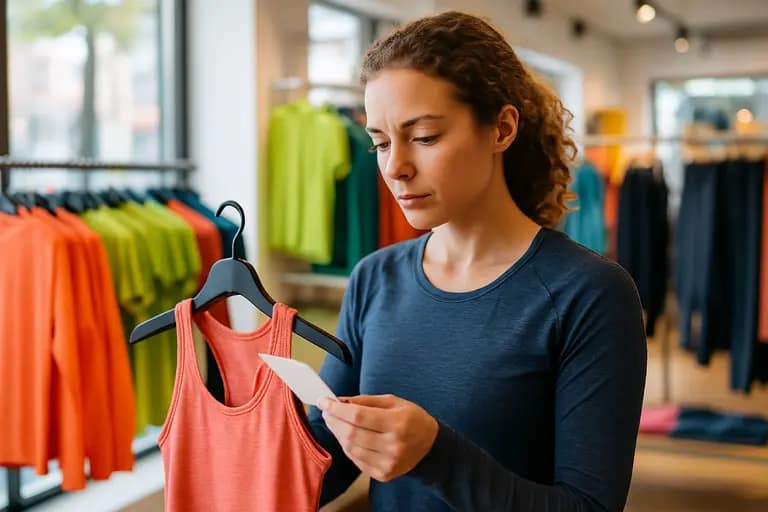
Activewear sustainability claims often focus on recycled content, special finishes, biodegradation language, or lower-impact manufacturing. Those topics can be relevant, but they are not the same as measuring fiber fragment release across washing and dry wear. A recycled polyester legging may reduce reliance on virgin feedstock, yet still needs assessment for durability, fabric loss, and care conditions. For a related discussion of performance apparel claims, the site’s review of CiCLO activewear claims takes a similarly cautious approach.
Several practical questions can keep the analysis grounded:
- Does the brand identify the actual test method behind any shedding claim?
- Was the testing done on finished garments or only fabric swatches?
- Were dry abrasion, peeling, or cutting evaluated, or only washing?
- Does the garment fit securely without constant sliding or adjustment?
- Can the item tolerate repeated washing without rapid surface wear?
None of these questions guarantees a low-shedding purchase. They help separate measured information from vague environmental language. Readers comparing apparel education across related sites may also find Petraclass useful within the same network.
Microplastic Shedding In Activewear Fit Decisions
Microplastic shedding research does not ask every shopper to abandon activewear or buy a new wardrobe. A more measured response is to choose garments that match the activity, fit without excessive shifting, and remain durable through ordinary care. For sports bras, that means checking that the band, straps, cups or panels, and closures support the intended movement without relying on constant adjustment. For leggings and tops, it means watching for early pilling, thinning, roughened surfaces, or seams that create repeated rubbing.
The strongest evidence in the supplied research points to two lessons. First, laundering can release measurable microfiber mass, with reported release affected by load size and real consumer laundry conditions. Second, dry-state actions such as peeling, abrasion, and cutting can also release fragments, and some finishes may improve one release pathway while worsening another. Those findings do not identify a single best fabric for every athlete, but they do argue for better testing, clearer labels, and longer-lasting activewear design.
If a garment causes persistent skin irritation, unusual discomfort, numbness, breathing discomfort from excessive tightness, or concerns related to pregnancy, medication, or a health condition, discuss clothing pressure and exercise needs with a qualified clinician. Fabric choices can support comfort and function, but they do not replace medical advice.