

Activewear Chemical Safety became easier to discuss after September 10, 2026, when the first sector-wide, data-driven baseline for chemicals used across apparel and footwear supply chains was released. The 2026 Apparel & Footwear Safer Chemistry Profile is not an activewear-only document, but activewear fabrics sit inside the broader apparel and footwear category. That matters for sports bras, leggings, compression shorts, base layers, and water-repellent training shells because chemical decisions are made long before a finished garment reaches a rack.
The report gives buyers and product teams a better way to separate evidence from reassurance. A label may say performance, stretch, sweat management, or water resistance. Those claims describe garment function. They do not, on their own, explain which chemicals were used in dyeing, finishing, printing, bonding, or water-repellent treatment. The 2026 profile shifts the question from “Is this fabric safe?” to a more testable set of questions: which substances are known, which are restricted, which are verified as safer options, and where data gaps remain.
What Activewear Chemical Safety Measures
Activewear Chemical Safety Starts With SDS Data
The profile analyzed more than 15,000 Safety Data Sheets, or SDSs, containing nearly 44,000 substance entries. After duplicates were removed, the dataset represented 2,829 unique chemicals. That scale is useful because activewear is not made from one ingredient. A sports bra may include knit fabric, elastane, thread, elastic, foam or molded cup materials, dyes, prints, adhesives, hardware coatings, and finishing chemistry. Each part may have its own supplier trail.
SDS data is not the same as a finished-product exposure assessment. It is a supply-chain view of chemical inputs. That distinction keeps the analysis cautious. The profile does not mean every garment contains every listed substance, and it does not allow a shopper to assess personal exposure from a photo, tag, or marketing page. It does show where the apparel and footwear sector has enough information to prioritize screening and substitution.
Why High-Use Chemicals Matter
One of the profile’s more practical findings is concentration of use. Just 11% of unique chemicals, about 311 of the 2,829 identified substances, accounted for roughly 80% of total uses. For Activewear Chemical Safety, that finding points to a realistic priority: a relatively small group of high-use substances may deserve the most attention from brands, mills, chemical suppliers, and standards programs.
The report also found that, among identified chemicals with hazard characterization, about 69% were verified as safer options. That signals measurable progress, but it should not be read as the sector having finished the work. Around 28.1% of identified chemicals remained uncharacterized, meaning their hazards were not yet well known in the dataset. Data quality also limited certainty: about 11% of substance entries could not be confidently identified because of incorrect CAS numbers or unclear chemical names. Entries marked confidential or trade secret accounted for 1.7% of entries, so the larger barrier was not secrecy alone; it was also the basic quality of chemical identification.
Why Standards Matter For Activewear Fabrics
RSLs, MRSLs, And Finished Garments
Restricted Substance Lists, often called RSLs, and Manufacturing Restricted Substance Lists, or MRSLs, are central tools in the profile’s recommendations. An RSL is typically aimed at substances restricted in finished goods. An MRSL focuses further upstream on chemicals restricted from intentional use during manufacturing. In activewear, that difference matters because finished garment testing may not capture every manufacturing input, while upstream controls can influence dye houses, finishing facilities, and component suppliers before fabric is cut and sewn.
Sports bras show why this layered approach is needed. The support system is not only fabric. Support usually comes from the lower band, cup or front-panel structure, strap geometry, fabric recovery, closures, coverage, and how those elements work together during movement. A low-impact yoga bra, a medium-support studio bra, and a high-support running bra may use different elastics, stabilizing panels, foam components, or bonded construction. Chemical standards have to account for those varied components, not just the visible outer fabric.
PFAS Scrutiny Is A Live Compliance Signal
PFAS scrutiny has become one of the clearest public examples of why fabric claims require detail. In April 2026, Texas Attorney General Ken Paxton launched a probe into whether Lululemon’s activewear still contained PFAS; Lululemon said it had stopped using PFAS in 2023 and that any prior use involved only a small number of water-repellent items, according to AP reporting on the Texas probe. That episode did not establish a universal finding about all activewear, and it should not be treated as proof about any specific item a person owns. It did show that water-repellent performance language can draw regulatory questions.
For shoppers, the useful takeaway is not panic. It is precision. If a garment is promoted for water repellency, stain resistance, or durable surface treatment, a buyer can ask what chemistry is used, whether the brand follows an RSL and MRSL, and whether it publishes testing or conformance details. For readers comparing related buyer questions across apparel categories, activewear transparency questions can help frame what to ask without assuming risk from a single marketing term.
What Shoppers Can Ask Without Overreading Claims
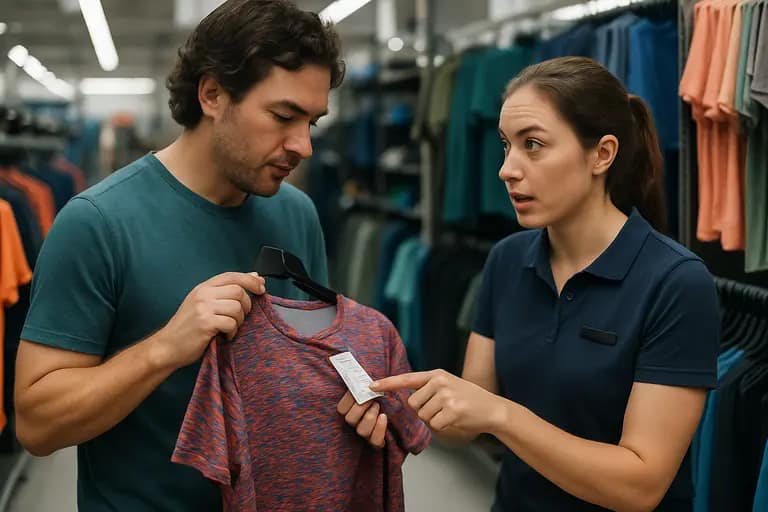
Activewear Chemical Safety Questions For Sports Bras
Activewear Chemical Safety should be evaluated alongside fit, not in place of it. A sports bra can be made with better-documented chemistry and still be the wrong choice for a workout if the band rides up, straps dig, cups shift, or the fabric loses recovery during repeated movement. The reverse is also true: a bra can feel supportive in a fitting room while leaving open questions about finishes, dye chemistry, or supplier standards.
For low-impact activity such as stretching or slower studio movement, many wearers prefer less rigid support, softer fabric, and broad contact areas that do not distract during bending. For running, jumping, field drills, or high-intensity intervals, support may depend more on a stable underband, reduced vertical movement, adjustable straps, encapsulation or compression structure, and fabric recovery. These are fit and function considerations, not medical guarantees. Comfort, breast size, activity type, pregnancy status, skin sensitivity, and prior surgery can all affect what feels workable; individual needs vary.
A Short Question Set For Brands
The profile supports a practical but cautious buyer checklist. None of these questions proves that a product is risk-free, but they can help distinguish specific standards from broad reassurance.
- Does the brand use both an RSL for finished products and an MRSL for manufacturing inputs?
- Are water-repellent or stain-resistant finishes used, and if so, what standard governs them?
- Can the brand identify the dyeing, printing, bonding, elastic, and foam standards used in sports bras?
- Does the company explain how it handles uncharacterized chemicals or unclear supplier data?
- Are chemical-safety claims connected to a named standard rather than general low-tox language?
A related site in the same network, Petra Class, may serve as a helpful resource for those seeking a broader educational perspective while exploring apparel and wellness topics. However, the critical inquiry for activewear purchases remains specific: what does the brand disclose about the fabric and component supply chain?
Chemical Safety Standards In Activewear
Chemical safety standards in activewear are moving toward better measurement, but the 2026 profile shows both progress and uncertainty. The strongest signal is that verified safer options are already common among characterized chemicals. The main caution is that uncharacterized substances and unclear chemical entries still leave gaps. Those gaps are not a reason to assume harm from every sports bra or legging. They are a reason to ask for clearer supplier data, better chemical naming, and stronger use of RSLs and MRSLs.
Activewear Chemical Safety also has to be read with the realities of garment design. Stretch fabrics, support panels, elastics, padding, adhesives, finishes, and hardware can all contribute to how a sports bra performs. A high-support bra for repeated jumping may require different construction than a light-support bra for mat work. Chemical standards should follow those components through the supply chain, while fit testing should still happen on the body through arm raises, controlled hops, deep breaths, and the actual movements the garment is meant to handle.
This is general education, not personal medical advice. If a garment seems linked with persistent skin irritation, pain, numbness, breathing discomfort, or symptoms that do not resolve after changing clothing, discuss the pattern with a qualified clinician. Useful questions include whether a skin reaction needs evaluation, whether known allergies or sensitivities should guide fabric choices, and whether activity level, pregnancy, surgery history, or other health factors change what support features may be appropriate.