

A new front-zip workout top is drawing attention to an often-overlooked barrier to exercise: getting into and out of tight activewear when shoulder movement is painful, restricted, or temporarily limited.
On July 1, 2026, San Francisco-based Zippytops announced its signature performance top, a fitted sleeveless garment with a full-length front zipper, built-in bust support, and extra fabric behind the zipper. Founder Andrea Reese developed the concept after a shoulder injury made pulling conventional workout tops over her head difficult. The company lists the top at $64 in sizes XS through XL, with a 75% nylon and 25% spandex composition. It is made in San Francisco from imported materials.
The design does not treat a shoulder condition or make exercise medically appropriate during recovery. Its potential value is simpler: a front opening may reduce the amount of overhead reaching and fabric pulling required to dress.
That seemingly modest change illustrates why adaptive activewear is expanding beyond specialized medical garments. For some people, the difference between an accessible top and a conventional compression shirt can affect independence, comfort, and willingness to participate in movement.
Why Workout Clothing Can Become an Accessibility Barrier
Traditional fitted workout tops are usually pulled over the head. Removing them after exercise can require even more effort because sweat increases friction and causes fabric to cling to the torso.
That movement may be inconvenient for anyone, but it can become a significant obstacle for someone with reduced shoulder range of motion. Shoulder movement may be limited by pain, stiffness, swelling, an injury, frozen shoulder, arthritis, a rotator cuff problem, or temporary restrictions after surgery. These conditions are not interchangeable, and their diagnosis and management belong with a qualified healthcare professional. (MedlinePlus shoulder information)
Dressing is considered a basic activity of daily living. It involves coordinated reaching, arm positioning, balance, grip, and garment handling. Research examining shoulder and elbow movement during everyday activities found that many tasks can require approximately 130 degrees of shoulder flexion or abduction, although the researchers noted that dressing itself has been studied less frequently than other activities. (Bounce Science: The Ultimate Guide to Finding Your Perfect Sports Bra)
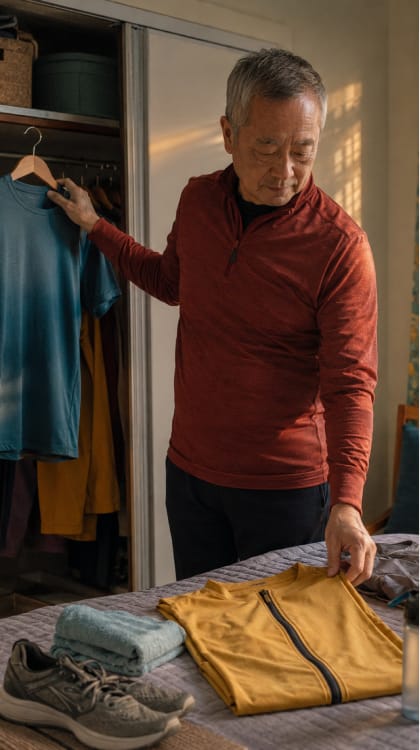
A front-opening garment does not eliminate all shoulder movement, but it may remove the need to lift both arms high enough to pull a tight neckline over the head. The wearer can instead place the garment around the torso, insert each arm separately, and close it from the front.
That design principle is already recognized in postoperative guidance. The American Academy of Orthopaedic Surgeons recommends loose-fitting clothes and a button-front shirt for people preparing for shoulder replacement because arm use will be limited after surgery. The recommendation does not validate any specific workout top, but it supports the practical logic behind front-opening apparel. (AAOS shoulder replacement guidance)
What Zippytops Introduced in July 2026
Zippytops describes itself as a woman-owned adaptive activewear company founded by Andrea Reese, whose professional background was in engineering and market research rather than clothing design. According to the company, Reese spent several years researching fabrics and construction and consulting design and manufacturing specialists in San Francisco after her own shoulder injury exposed the limitations of over-the-head workout clothing.
The company’s July announcement positioned its signature top for workouts, everyday movement, and periods of restricted shoulder mobility. The launch materials also mention athletes, active professionals, postpartum and breastfeeding customers, and people recovering from shoulder surgery or injury. Those are company-described use cases, not independently tested medical indications.
As of August 3, 2026, the company’s product pages listed black, blue, and white versions at $64. The published size chart covers bust measurements from 29 to 44 inches across sizes XS through XL.
| Design Detail | Intended Practical Benefit | What a Shopper Should Verify |
|---|---|---|
| Full-length front zipper | Avoids pulling the top over the head | Whether the zipper is manageable with the available hand strength and dexterity |
| Fabric lining behind the zipper | Creates a barrier between the zipper and skin | Whether the lining stays flat and prevents rubbing during movement |
| Built-in upper lining and support | May reduce the need for a separate layer during some activities | Whether the support level is appropriate for the person and workout |
| 75% nylon and 25% spandex | Provides stretch and a close performance fit | Whether the fabric feels breathable, soft, and comfortable when damp |
| Sizes XS–XL | Covers the company’s published 29-to-44-inch bust range | Whether the size chart accommodates torso length, shoulder width, and individual proportions |
| Full midsection coverage | Avoids the cropped silhouette common in some activewear | Whether the hem stays in place during reaching, bending, or seated exercise |
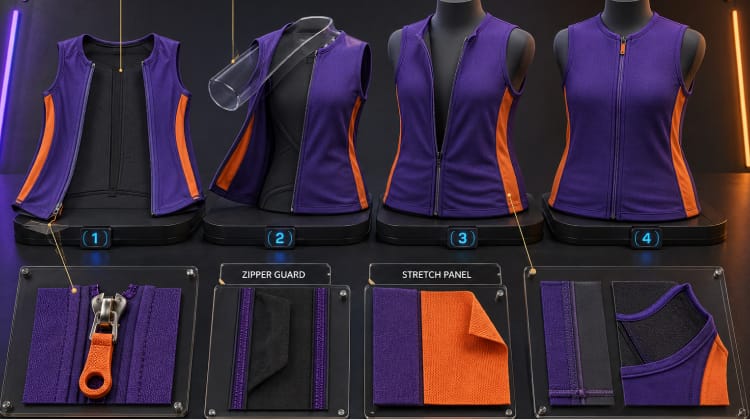
These features come from the company’s product description and launch announcement. They should not be interpreted as independent proof of comfort, accessibility, support, or clinical benefit for every wearer.
Why Front Closures Can Help Without Solving Every Problem
Adaptive clothing is sometimes discussed as though one closure can make a garment universally accessible. In practice, mobility, reach, dexterity, strength, sensation, balance, and body shape can affect dressing in different ways.
A front zipper may help someone who has difficulty reaching overhead but can use both hands near the center of the torso. It may be less helpful for a person who has limited grip strength, tremor, reduced finger coordination, or difficulty aligning and engaging a small zipper pin.
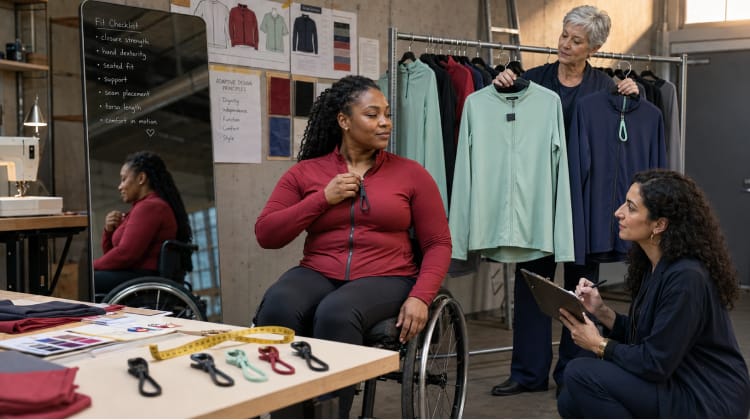
Research on inclusive apparel design recommends evaluating reach, dexterity, and mobility as separate capabilities rather than treating all dressing difficulties as one problem. Depending on the wearer, useful adaptations could include a large zipper pull, magnetic fastening, loops, snaps, Velcro-style closures, stretch panels, side openings, or a garment that can be donned with one hand.
The closure is also only one part of the garment. A top can open easily but still be uncomfortable because of a narrow armhole, tight chest band, abrasive seam, unstable hem, difficult zipper, or fabric that becomes heavy with sweat.
For that reason, adaptive design should be judged by the full dressing and movement experience—not by the presence of a zipper alone.
The Larger Need for Adaptive Fitness Clothing
Adaptive activewear is relevant to more people than a narrow medical audience.
CDC data released through its Disability and Health Data System indicate that 28.7% of U.S. adults—an estimated 70 million people—reported a functional disability in 2022. The data include challenges involving mobility, cognition, hearing, vision, self-care, and independent living. CDC also reported that 12.2% of adults had a mobility disability and 3.6% had a self-care disability involving difficulty dressing or bathing. (CDC disability data)
Those figures do not represent 70 million prospective customers for one garment. Disability is diverse, and many people with disabilities do not need adaptive clothing. People without a permanent disability may also benefit from easier dressing during a temporary injury, pregnancy, recovery, aging, or a period of reduced mobility.
The public-health context is still relevant. CDC reports that nearly half of U.S. adults with disabilities get no leisure-time aerobic physical activity. Clothing is only one of many possible barriers, alongside cost, transportation, inaccessible facilities, limited equipment, health concerns, and a lack of inclusive programs. (CDC physical activity information)
Research has nevertheless found that inadequate clothing can restrict participation in exercise, work, social events, and other meaningful activities. A qualitative study by Allison Kabel, Kerri McBee-Black, and Jessica Dimka identified functional, sensory, and cultural clothing barriers among people with disabilities and their families. A later scoping review concluded that clothing interacts with mobility, self-care, personal factors, and participation.
Accessible clothing will not remove every obstacle to physical activity, but it can reduce one unnecessary point of difficulty.
Who Might Benefit From This Type of Top?
A front-zip workout top may be worth considering for a person who:
- Has difficulty pulling tight clothing over the head.
- Can move each arm into an open garment more comfortably than through a narrow neckline.
- Wants to dress with less assistance.
- Finds that conventional sports tops become difficult to remove after sweating.
- Prefers full midsection coverage rather than a cropped top.
- Wants a garment that can transition between walking, light training, yoga, dance, pickleball, or daily errands.
These are practical scenarios rather than medical recommendations. A person recovering from an injury or operation should not assume that easier clothing means exercise is safe to resume.
The appropriate activity, movement limits, and timing of a return to exercise depend on the condition and treatment plan. CDC recommends that people with disabilities or chronic health conditions consult a healthcare professional or physical-activity specialist when they need guidance about suitable activities and amounts of exercise. (CDC activity guidance)
What to Check Before Buying Adaptive Activewear
The most useful test is not whether a garment is marketed as adaptive. It is whether the intended wearer can put it on, close it, move in it, and remove it with less difficulty.
Start with the closure. Determine whether the zipper can be aligned and pulled without painful reaching or substantial grip force. A longer or textured zipper pull may be easier to manage than a small smooth tab. The zipper should remain secure during movement without pressing into the sternum or abdomen.
Inspect the protective lining behind the zipper. It should cover the teeth and slider where they contact the skin. The fabric should remain flat rather than bunching into a ridge during bending or seated activity.
Consider the support level separately from accessibility. Built-in support may simplify dressing by reducing layers, but it may not provide enough control for high-impact running or jumping. Conversely, a band that is too firm could be difficult to close or uncomfortable around the ribs.
Test the armholes and neckline. A front closure reduces overhead movement, but narrow openings may still require uncomfortable shoulder rotation. The wearer should be able to insert the more limited arm first and remove it last without forcing the joint.
Move through the positions required by the intended activity. That might include reaching forward, sitting, rolling a wheelchair, walking, using exercise bands, lifting light weights, or performing a controlled squat. Check whether the hem rises, the zipper bows outward, or the armholes rub.
The return policy also matters. A garment that works for one pattern of limited mobility may not work for another, and dressing ease can be difficult to evaluate from a product photograph.
Limited Sizing Remains an Accessibility Issue
The launch expands the types of workout tops available, but its published XS-to-XL range also illustrates a continuing limitation in adaptive apparel.
Accessibility involves more than closures. A person may need an extended size, shorter or longer torso, more room through the abdomen, a different bust-to-waist ratio, softer elastic, larger armholes, or a seated-fit pattern. A design cannot be broadly inclusive if people cannot find a size that fits their body comfortably.
The company’s current size chart covers bust measurements from 29 to 44 inches. Shoppers near the top or bottom of a range should consider how much compression they prefer and whether the built-in support changes the fit. The available chart does not replace trying the garment through movement.
Future adaptive-activewear growth will need to combine functional openings with broader sizing, varied support levels, easier closures, sensory-conscious seams, and options developed with people who have different disabilities and movement patterns.
Recovery Requires More Than Easier Clothing
The Zippytops announcement includes people recovering from shoulder injuries or surgery among its intended audiences. That use case requires an important safety boundary.
After shoulder surgery, some people must wear a sling or immobilizer and limit arm movement to protect repaired tissue. The safe duration and allowed movements depend on the operation. MedlinePlus advises patients to follow their surgeon’s and physical therapist’s instructions and not assume that an arm can be moved normally simply because pain has improved. (MedlinePlus shoulder-surgery guidance)
A top worn during recovery must not disturb an incision, compress swelling, catch on a sling, interfere with wound care, or require movement beyond the prescribed limits. Some people may need a much looser button-front shirt rather than fitted activewear during the early recovery period.
Anyone considering the top after surgery should ask the clinical team when fitted clothing is appropriate, how to dress without stressing the repair, and whether the garment can be worn safely with any required brace or sling.
The product is clothing, not rehabilitation equipment. It cannot restore range of motion, accelerate healing, or determine when a person is ready to return to the gym.
What This Launch Means for Activewear Design
Zippytops is a small, specific example of a larger design shift: activewear can be judged not only by compression, sweat management, color, and appearance, but also by how easily a person can use it.
The company has identified a recognizable problem. Tight workout tops can be difficult to remove, and an overhead neckline can create an avoidable barrier for people with limited shoulder movement. Moving the opening to the front is a practical response.
The remaining question is how well the garment performs for different users. The launch materials do not cite independent wear testing, clinical studies, comparative dressing-time data, or published evaluations involving people with different mobility and dexterity needs. That does not make the design ineffective; it means consumers should distinguish a plausible accessibility feature from a clinically proven outcome.
The strongest adaptive products are usually developed through repeated testing with the people expected to use them. Feedback should include not only whether a garment can be put on, but also how it feels when seated, sweating, reaching, using one hand, managing fatigue, or removing the item at the end of a workout.
For consumers, the practical standard is straightforward: adaptive activewear should reduce effort without adding new pressure, friction, exposure, or frustration. A front zipper may accomplish that for some wearers. Others will need a different closure, fit, support level, or garment altogether.