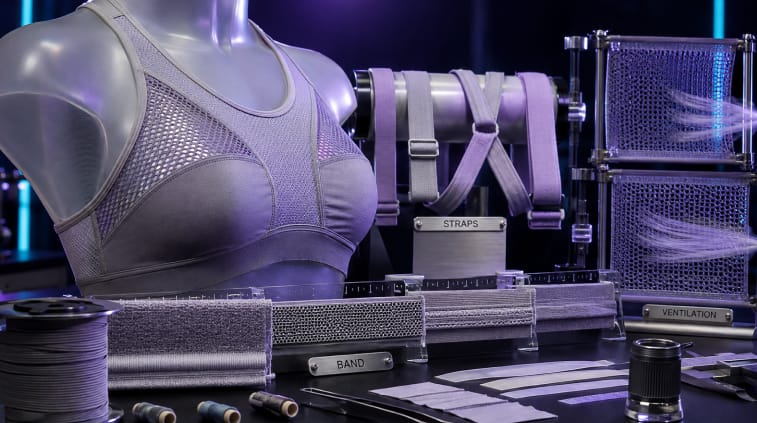

An elite athlete can make sports-bra design more specific by identifying problems that are difficult to see on a sketch or mannequin: where straps press during sprinting, how a band behaves after repeated jumps, whether mesh actually feels ventilated once the body heats up, and whether a garment stays secure when an athlete switches between very different movements.
That does not mean an athlete-designed sports bra automatically works for every body.
The distinction is especially relevant after Adidas by Stella McCartney launched a new performance-running capsule co-designed with American heptathlete Anna Hall on July 28, 2026. The collection includes a Running Medium Support Bra with engineered floral mesh panels and Adidas CLIMACOOL technology, along with a race crop, brief, onesie, and special-edition Adizero Evo SL trainer. Adidas says the collection was developed for competition, training, and recovery.
Hall provides an unusually demanding apparel-design case because she does not compete in one repetitive event. A heptathlete hurdles, jumps, throws, sprints, and finishes with an 800-meter run. Clothing that feels secure during the shot put may behave very differently during the high jump or final lap.
The value of athlete input, then, is not that one champion can define the ideal sports bra. It is that she can expose a design to movements that ordinary product development might otherwise miss. (Best Sports Bras and Tops of June 2026)
Why Anna Hall Is an Unusual Athlete to Build a Race Kit Around
Hall entered the collaboration as one of the leading combined-events athletes in the world. At the 2025 World Athletics Championships in Tokyo, she won the women’s heptathlon with 6,888 points, becoming the first U.S. woman in 32 years to win a global heptathlon title. World Athletics currently lists Hall at No. 1 in the women’s heptathlon rankings. (Anna Hall’s World Athletics profile)
That background matters for activewear design because the heptathlon compresses seven distinct movement environments into two days: the 100-meter hurdles, high jump, shot put, 200 meters, long jump, javelin, and 800 meters.
A specialist distance runner mainly asks clothing to behave predictably through thousands of similar strides. Hall’s apparel has to tolerate explosive hip flexion over hurdles, overhead and rotational throwing, aggressive jumping, maximal sprinting, and sustained running.
Her relationship with Adidas by Stella McCartney also predates the July 2026 capsule. Adidas says Hall had already competed in the collaboration’s apparel for years before becoming directly involved in this collection. Hall described versatility as central to being a heptathlete and said the project combined the fashion aesthetic she prefers with the technical performance she needs.
That is a more meaningful form of athlete involvement than simply appearing in campaign images after the product is finished—but consumers should still separate participation in design from independent testing.
What Adidas and Stella McCartney Actually Launched
The Anna Hall Capsule went on sale through Adidas channels and selected retail locations beginning July 28, 2026.
Adidas describes the collection as the first Adidas by Stella McCartney high-performance range to use its new engineered floral construction. The company says the material was developed around breathability, stretch, and support rather than using floral detail only as surface decoration.
The collection includes:
- Running Medium Support Bra: engineered floral mesh panels with CLIMACOOL technology.
- Running Floral Detail Crop: bonded hems, a strappy back, and a streamlined shape.
- Running Floral Detail Brief: lightweight construction with a fully lined finish.
- Running Floral Detail Onesie: engineered floral fabric, mesh panels, and a close performance fit.
- Adizero Evo SL Detail Space Trainer: a special-edition running shoe in Semi Flash Aqua.
Adidas specifically describes the medium-support bra as providing breathable support for high-intensity training and competition. That is a manufacturer performance claim rather than an independent laboratory result. No independent study evaluating the Anna Hall bra’s motion control, pressure, thermal performance, chafing, or durability was identified for this article.
That distinction is important because a sports bra cannot be judged from its support category alone.
“Medium support” may describe where a brand positions a product within its own range. Whether that amount of support is comfortable and sufficient depends on the athlete, breast volume, activity, fit, band tension, cup construction, straps, and individual preference.
What Athlete Co-Design Can Change in a Sports Bra
The biggest advantage of involving an athlete is access to repeated, high-quality feedback under realistic movement.
A mannequin can show how a bra looks. A standard stretch test can show how fabric behaves under tension. Neither automatically reveals what happens when an athlete reaches maximum speed, lands from a jump, rotates forcefully through a throw, and then repeats the sequence while sweating.
An elite athlete can identify pressure or movement problems through hundreds of hours of training.
For a sports bra, that feedback may affect the underband, strap path, neckline, armhole, fabric distribution, seam location, coverage, ventilation, and how quickly the garment returns to position after the torso changes direction.
Laboratory evidence supports the idea that construction matters. A 2024 Scientific Reports study from researchers including Genevieve Williams, Chris Mills, Brogan Jones, and Joanna Wakefield-Scurr compared breast-torso movement while 12 women ran at 10 km/h in different support conditions. The breast and torso moved in phase for more than 90% of the running gait cycle in both sports bras, compared with about two-thirds of the cycle without breast support. The encapsulation bra also produced somewhat more synchronized movement than the compression design. (breast-support biomechanics study)
That does not prove one construction is best for everyone. It shows that changing the support system can measurably change how the body and breast move together during running.
Seven Events Create Seven Different Apparel Tests
A heptathlon exposes race clothing to demands that a single running session cannot reproduce.
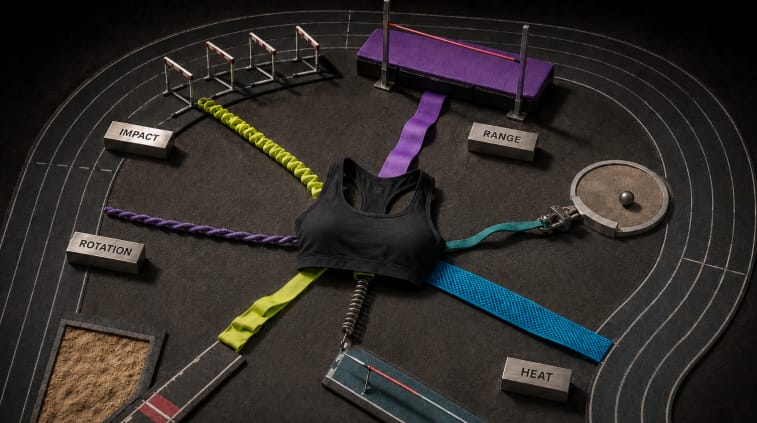
| Heptathlon Event | Sports-Bra or Race-Kit Design Challenge |
|---|---|
| 100m Hurdles | High-speed running, aggressive arm action, repeated impact and rapid hip movement |
| High Jump | Extreme torso extension, rotation and overhead arm movement |
| Shot Put | Powerful upper-body rotation and pressure from throwing positions |
| 200m | Maximal or near-maximal sprinting with high impact and arm drive |
| Long Jump | Sprint speed followed by explosive takeoff and landing |
| Javelin | Large shoulder range, trunk rotation and overhead throwing |
| 800m | Sustained running, heat accumulation, sweat and repeated breast movement |
This variety helps explain why Hall described versatility as central to the collection.
A strap layout that feels fine during an 800-meter run could pull differently when an athlete raises the throwing arm for javelin. A neckline that stays flat during sprinting might shift during a high-jump arch. A bra band that provides secure compression could also become noticeable as breathing rate rises during the final event.
An athlete who repeatedly performs all seven disciplines can report those interactions quickly.
The same logic applies to recreational athletes. A sports bra used only for stationary cycling faces different demands from one worn for tennis, running, basketball, or circuit training. Consumers should therefore select support for the activity rather than relying on appearance or an athlete endorsement.
Medium Support Does Not Mean the Same Thing for Every Body
The Anna Hall capsule raises an interesting consumer question because Adidas calls the new bra medium support while also positioning it for high-intensity training and competition.
Those descriptions are not necessarily incompatible. Hall may find that construction appropriate for the way her body moves and for her events.
Another wearer may not.
A 2025 study published in Medicine & Science in Sports & Exercise examined female runners wearing a high-support sports bra and found that participants with larger breast volumes still experienced significantly greater breast displacement than participants with smaller breast volumes. The researchers did not find a corresponding difference in running economy, but breast volume was associated with changes in several upper-body biomechanical measures. (breast size and running biomechanics)
That finding helps explain why sports-bra recommendations cannot be reduced to “medium impact equals this workout” or “high support equals that workout.”
Two people can run at the same speed in the same garment and experience different breast movement, band pressure, strap loading, heat, and perceived support.
Body-neutral activewear design should account for that variability rather than treating one elite athlete’s successful fit as a universal template.
Sports Bra Support Is About More Than Compression
It is tempting to judge a sports bra by how tightly it compresses the chest.
Research suggests the design problem is more complicated.
Compression bras generally restrict movement by holding breast tissue closer to the torso. Encapsulation designs support the breasts more separately. Some modern garments combine both approaches.
The 2024 running study found differences in breast-torso coordination between compression and encapsulation designs, while earlier biomechanics work has also demonstrated that bra components can alter breast displacement and perceived comfort.
Straps are another important variable.
A study involving 23 active women with D+ cup sizes compared six strap configurations during treadmill running. Wider vertical straps produced lower strap pressure and less discomfort than narrower arrangements, although changing the strap design did not significantly change vertical breast displacement in that experiment. (sports-bra strap study)
That illustrates a useful design principle: reducing movement is not the only objective.
A bra can control motion but still be uncomfortable because the straps dig into the shoulders. It can feel secure but trap heat. A highly compressive band may minimize shifting yet feel restrictive during deep breathing.
A successful race bra needs enough stability without creating a different problem somewhere else.
Breathability Matters More Once Intensity Rises
Adidas places particular emphasis on the engineered floral mesh and CLIMACOOL construction in Hall’s new bra.
The company says the floral detail is engineered for breathability, stretch, and support, while mesh panels are intended to help manage heat during competition and training.
That concept makes sense for a heptathlete.
Competition can involve long periods at a stadium punctuated by explosive effort. The 800 meters comes after six previous events, meaning the athlete reaches the final race after substantial accumulated movement and environmental exposure.
But “breathable” should still be treated as a textile-performance characteristic that needs testing, not a guarantee that an athlete will remain cool.
Ventilation depends on knit density, mesh opening size, garment layers, sweat rate, humidity, airflow, fabric contact with the skin, and how much of the torso is covered.
Sports-bra pressure can also influence how the garment feels thermally. Research involving 21 women found that increasing pressure at the underband or shoulder areas affected some local skin-temperature measurements and subjective pressure sensations, although thermal-comfort responses were more complex.
For consumers, visible mesh is therefore a useful clue—but not the same as proof of superior cooling.
Fit Testing Still Matters More Than the Athlete’s Name
Hall’s involvement can make the product more credible as a performance project. It cannot determine whether the bra fits another person correctly.
That limitation is especially important because sports-bra fit remains a widespread problem.
A multicenter U.S. study involving 438 females aged 11 to 64 at five geographically different academic sports-medicine centers found that 27.4% reported that insufficient breast support had prevented them from being active or exercising. Breast size was significantly associated with how often lack of support limited physical activity.
That is a larger issue than whether one race kit looks fashionable.
A sports bra that works properly can affect whether someone feels comfortable enough to run, jump, attend a fitness class, or continue an activity without repeatedly adjusting clothing.
Before using a new bra for a hard workout, check the actual fit:
- The underband should remain level and secure without making breathing feel restricted.
- Cups or front panels should contain the breast tissue without obvious spilling, folding, or empty areas.
- Straps should remain stable without digging sharply into the shoulders.
- The neckline and armholes should not rub during repeated arm movement.
- Perform several jumps, a brief jog, arm swings, and torso rotations before relying on the garment for longer training.
- Check whether the fabric becomes abrasive, heavy, or excessively warm once damp.
- Make sure removal is still manageable after the garment becomes sweaty.
Persistent breast pain, skin injury, or other unexplained symptoms should not simply be blamed on a sports bra. A qualified healthcare professional can evaluate ongoing symptoms when needed.
Athlete Input Becomes More Valuable When It Changes Construction
There is a meaningful difference between an athlete appearing in a campaign and an athlete influencing how a garment is built.
The most useful athlete feedback is specific.
“The bra feels good” offers little design information.
“The lower edge moves upward during the high jump,” “this strap catches during javelin,” or “the fabric feels too warm by the final laps” gives designers something they can modify and retest.
Hall’s heptathlon background potentially produces a particularly wide range of this feedback because her sport repeatedly changes movement pattern.
Adidas says the finished capsule incorporates bonded hems, mesh panels, streamlined fits, engineered floral construction, and support features across its race pieces. Those details are attributable to the company’s design description; Adidas has not published independent comparative data showing how much Hall’s personal feedback changed each feature.
Consumers should therefore recognize the value of co-design without treating it as clinical validation or laboratory certification.
One Elite Athlete Cannot Represent Every Sports-Bra Customer
There is another limitation built into athlete-led design: elite athletes are individual people.
Hall can offer exceptional insight into what her body experiences during world-class heptathlon training and competition. She cannot directly represent every breast size, torso length, shoulder shape, age, recreational intensity, or comfort preference.
This becomes especially relevant if a company turns an athlete-tested product into a consumer line.
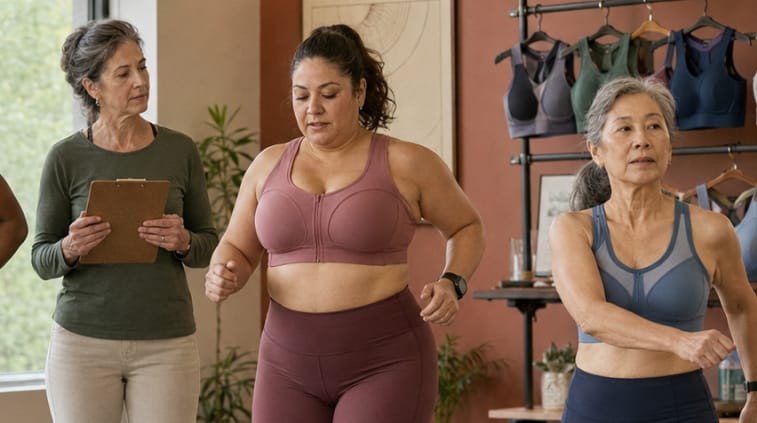
Sports-bra researchers have repeatedly found that breast size, garment construction, and support level affect movement and comfort differently among wearers. In the 2024 running study, encapsulation and compression bras produced measurably different movement patterns. In the 2025 research on breast volume, larger-breasted runners experienced more movement even while wearing high support.
A strong consumer development process therefore needs more than one athlete.
Ideally, an athlete’s feedback becomes one layer alongside fit testing across different sizes, motion analysis, wash testing, pressure assessment, thermal evaluation, and repeated wear under different conditions.
The athlete can expose problems.
A diverse fit panel determines whether the solution scales.
What Recreational Runners Can Learn From Hall’s Race Kit
Most people buying a sports bra are not preparing for a world championship heptathlon, but several principles transfer directly.
First, match the bra to the actual movement. A garment comfortable for yoga may not control movement well enough for repeated sprinting. Conversely, the most restrictive bra available may be unnecessary for a low-impact session.
Second, test the entire garment rather than concentrating only on the front panels. Straps, underband, armholes, seams, closures, mesh zones, and fabric edges all interact with moving skin.
Third, consider heat and sweat. A comfortable dry fitting room tells you little about what the garment will feel like after 30 minutes of running.
Fourth, remember that more compression is not automatically better. The goal is appropriate support with acceptable comfort and unrestricted movement.
Finally, ignore the assumption that attractive design and serious performance are incompatible. Hall and Stella McCartney’s capsule explicitly attempts to combine the two. Fashion details can coexist with technical construction when the decoration does not compromise movement, support, ventilation, or comfort.
What the Anna Hall Case Really Shows
Anna Hall’s new Adidas by Stella McCartney race kit provides a useful example of what athlete co-design can contribute to sports bras.
Her experience matters because she understands competition at an unusually high level and because the heptathlon exposes clothing to sprinting, hurdling, jumping, throwing, and endurance running in one event.
That creates opportunities to refine strap placement, ventilation, support, seam construction, range of motion, and garment stability based on real athletic movement.
But the athlete’s name is not the final test.
The new Running Medium Support Bra may be well suited to Hall’s needs while another runner needs a different support level, strap configuration, band construction, or size. Current biomechanics research shows that sports-bra design changes breast motion, that different support constructions behave differently, and that breast volume influences movement even when supportive garments are worn.
The strongest lesson from Hall’s collaboration is therefore not that elite athletes know the perfect sports bra.
It is that good activewear design starts by listening closely to how real bodies move—and then testing whether the resulting solution works for more than one of them.