

A pair of leggings can feel extremely compressive and still roll at the waist.
That apparent contradiction is important because activewear brands have traditionally used tightness as one of the easiest ways to create a secure feeling. More compression can make leggings feel firmly anchored when someone first pulls them on, but it does not necessarily solve what happens during squats, running, Pilates, or repeated bending.
A new leggings collection launched in New York is testing a different approach.
On September 3, 2026, activewear brand BRXL, from Popilush, announced its STAYLAT Leggings collection. Rather than presenting maximum compression as the main solution, BRXL says the leggings use a multi-layer waistband system intended to remain flat and resist rolling while allowing movement. The company describes the design as appropriate for both training and everyday wear.
The launch arrives at an interesting point for activewear design because it raises a broader question: Is waistband engineering more useful than simply making leggings tighter?
Potentially, yes.
Independent research shows that garment pressure changes with sizing, posture, garment construction, and location on the body. Another recent study found that high waistbands can measurably alter abdominal pressure during certain exercises. Those findings do not independently validate BRXL’s anti-roll technology, but they do challenge the idea that greater compression is always the best route to stability.
For shoppers, the practical distinction is straightforward: compression, rolling, sliding, and waistband stability are related problems, but they are not the same problem.
BRXL Is Trying To Engineer The Waistband Instead Of Just Tightening It
BRXL introduced STAYLAT as a leggings system built specifically around waistband stability.
According to the company’s September 3 STAYLAT announcement, the design uses multiple structural elements rather than relying on uniform tightness.
The company’s current skinny-legging model uses what BRXL calls a Three-Layer Waistband System, combined with a crescent-shaped front panel and a three-dimensional support structure intended to resist twisting and rolling.
BRXL describes the three-layer waistband as providing smooth support, adaptive fit, and stay-put performance. The crescent front panel is intended to reduce creasing while allowing movement, while the additional support structure is designed to help the waistband recover after bending and stretching.
Those are manufacturer claims.
They should not be interpreted as independent evidence that the leggings will never roll on every wearer or during every activity.
That distinction matters because waistband behavior depends on both garment construction and the body wearing it.
Still, the engineering concept itself is worth examining.
Instead of asking the entire garment to become tighter, the design attempts to give the waistband more structural stability.
That is a different strategy.
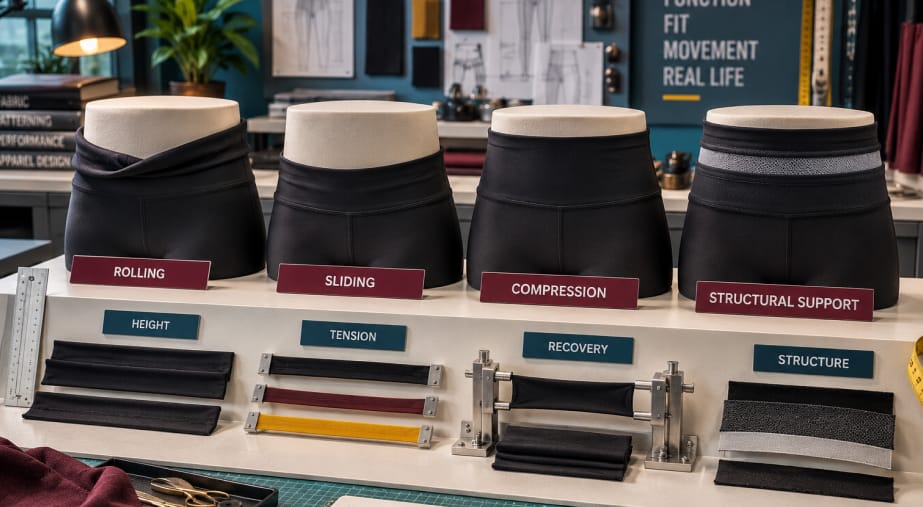
Rolling And Sliding Are Two Different Fit Problems
People frequently describe any waistband movement as leggings “falling down,” but at least two different things can happen.
A waistband can slide downward.
Or its upper edge can roll or fold over itself.
Sliding occurs when the garment cannot maintain its position against the forces pulling it downward during movement.
Rolling involves the waistband losing its vertical stability and folding.
A waistband could theoretically resist sliding because it is tight around the torso while still rolling at its upper edge.
Likewise, a relatively soft waistband might remain flat but gradually migrate downward.
This is why increasing compression cannot be assumed to solve both problems.
The mechanical requirements are different.
A Waistband Needs More Than Circumferential Tightness
Imagine a wide strip of very soft elastic wrapped firmly around the torso.
It can apply considerable inward pressure.
But if the material lacks enough vertical stability, the upper portion may still collapse when the wearer bends forward.
Now imagine a slightly less compressive band with a more stable multi-layer structure.
It may be better able to resist folding even though it does not squeeze as strongly.
That illustrates the difference between pressure and structural stability.
For a waistband to remain in place, several variables can matter simultaneously:
- circumference and elastic tension;
- waistband height and vertical stiffness;
- fabric recovery;
- torso and hip geometry;
- friction between fabric and underlying layers or skin;
- seam and panel construction;
- the movement being performed.
A garment can therefore feel tight without being particularly well stabilized.
More Compression Does Not Always Mean More Stability
Independent research on sports compression clothing demonstrates how variable garment pressure can be.
A study involving 12 national-level boxers tested compression tights and leggings in undersized, manufacturer-recommended, and oversized configurations.
Researchers measured interface pressure at six locations while participants were sitting, standing, and lying down.
The results showed that pressure depended on garment type, sizing, body location, and posture.
Standing also produced higher average pressure than sitting for both tights and leggings.
That matters because activewear does not exert one fixed amount of compression throughout a workout.
The pressure someone experiences while standing in a fitting room may not represent what happens when they squat, sit, bend, or move dynamically.
The sports compression garment study also found that the pressure profile was not simply graduated or progressive across the garments tested.
In practical terms, tightness is not a single specification.
Where pressure occurs can matter as much as how compressive the garment feels overall.
Sizing Down Is an Imperfect Fix
One common response to leggings that slide is to choose a smaller size.
That can sometimes change fit.
It can also create a new problem without correcting the original one.
Interestingly, BRXL currently tells shoppers that those wanting a more sculpted fit can size down in its STAYLAT leggings. Its skinny version is currently listed at $59.99, while the flare version is $65.99. The size chart extends from XS through 3XL.
But consumers should distinguish a preference for a more sculpted appearance from the mechanical question of whether a waistband stays in place.
Sizing down reduces garment dimensions.
That may increase pressure.
It does not redesign the waistband.
If rolling is caused primarily by insufficient vertical stiffness, incompatible waistband height, or the way the band interacts with a person’s torso, making the entire garment smaller may not address the underlying issue.
It can instead increase pressure at the waist, hips, thighs, or other locations.
High Waistbands Can Affect More Than Appearance
Waistband pressure is not purely a cosmetic issue.
A 2024 Journal of Strength and Conditioning Research study examined high- and low-waist athletic garments during bodyweight exercise in 10 healthy women.
Participants performed isometric and dynamic squats, lunges, and planks while researchers monitored respiratory mechanics and abdominal pressure.
Resting pulmonary function did not change with the high-waist garments.
During isometric squatting, however, peak abdominal pressure was significantly higher with the high waistband: 17 ± 6 cmH2O compared with 15 ± 6 cmH2O in the low-waist condition.
That is a small study, and it does not demonstrate that ordinary high-waisted leggings are dangerous.
Nor did it examine BRXL products.
But it provides a useful reminder that waistbands are mechanical structures interacting with a moving torso.
The study’s waistband and exercise findings support evaluating athletic waistbands during movement rather than assuming that stronger abdominal pressure is automatically desirable.
Compression And Anti-Roll Construction Solve Different Problems
This distinction can make leggings easier to evaluate.
| Design Feature | Primary Job | What It Does Not Guarantee |
|---|---|---|
| Higher Compression | Increases garment pressure and close fit | No rolling |
| Wider Waistband | Distributes contact over a larger area | No sliding |
| Multi-Layer Band | Can increase structural stability | Universal fit |
| High Rise | Provides greater torso coverage | Better stability |
| Elastic Recovery | Helps fabric return after stretching | Correct waistband geometry |
| Shaped Panels | Can alter how force is distributed | Comfort for every wearer |
None of these features functions independently.
A wide waistband made from extremely soft material can behave differently from a wide waistband containing multiple structural layers.
A high-rise design can work beautifully on one torso and repeatedly fold on another.
A compressive garment can feel secure while standing and become uncomfortable during deep flexion.
The entire system matters.
Body Shape Changes How A Waistband Behaves
This is where waistband discussions need to remain body-neutral.
People have different relationships among waist circumference, hip circumference, torso length, rib cage position, abdominal shape, and pelvic structure.
Those differences affect how clothing sits.
A waistband rolling on someone does not mean their body is shaped incorrectly.
It means the interaction between that garment and that body is not producing the intended result.
This is particularly important with high-rise leggings because the waistband covers a larger portion of the torso.
Two people with identical waist measurements may have different torso proportions.
The same waistband can therefore reach a different anatomical position on each wearer.
A band that sits comfortably below the rib cage for one person may reach considerably higher on another.
Waistband Height Can Become Part Of The Problem
High-rise leggings create more vertical material above the hips.
That can provide coverage and a secure sensation.
It also gives the waistband more material that potentially needs to remain structurally stable.
During deep hip flexion, the relationship between the abdomen, pelvis, and waistband changes substantially.
If the waistband cannot accommodate that movement, the top may fold.
A lower waistband may avoid that particular fold simply because it occupies a different position.
That does not make low-rise leggings inherently better.
It illustrates why waistband height should match both personal preference and activity.
Someone who primarily walks or performs standing strength exercises may experience a high waistband differently from someone repeatedly moving between deep squats, seated positions, and floor exercises.
Yoga Is A Particularly Useful Waistband Test
BRXL positions its current STAYLAT skinny leggings for yoga and training.
Yoga happens to expose waistband behavior quite effectively.
A standing mirror test provides little information about what happens during repeated spinal flexion and hip movement.
Forward folds, seated positions, lunges, twists, and transitions can reveal whether the waistband:
remains flat,
slides,
folds,
creates excessive abdominal pressure,
or requires repeated adjustment.
The same applies to Pilates and floor-based strength training.
A waistband that looks perfectly stable while standing may behave very differently after 30 minutes of varied movement.
Squats Test Something Different
Squatting changes the geometry of both the hips and torso.
The hips flex.
The knees bend.
The pelvis changes position.
The waistband fabric has to respond while the legging body stretches elsewhere.
This is where fabric recovery becomes important.
If the waistband extends but does not recover effectively, it may gradually become less stable during repeated repetitions.
If it resists extension too strongly, it may create an uncomfortable pressure sensation.
The ideal outcome lies somewhere between those extremes.
A stable waistband needs to accommodate movement and then recover.
An Anti-Roll Waistband Cannot Guarantee A No-Adjustment Workout
BRXL’s central proposition is attractive: stay flat and stop adjusting.
But consumers should be careful with absolute interpretations of anti-roll terminology.
No garment architecture can eliminate differences in anatomy, sizing, movement, layering, fabric condition, and personal preference.
Even a well-engineered waistband may work differently across activities.
Running creates repeated impact.
Yoga involves large changes in torso position.
Strength training can combine deep hip flexion with external load.
Cycling keeps the torso flexed for extended periods.
Every context changes the mechanical problem.
“Anti-roll” is therefore more useful as a description of design intent than as a universal guarantee.
Compression Is Not Automatically A Performance Benefit
Another reason not to chase maximum tightness is that compression itself should not be confused with improved exercise performance.
Sports compression garments have been researched for possible effects on performance and recovery, but ordinary fashion or training leggings cannot be assumed to provide clinically meaningful or standardized compression simply because they feel tight.
A 2023 analysis of eight commercial women’s leggings found substantial differences in garment measurements and pressure profiles. The researchers noted that the commercial leggings they tested did not reproduce the graduated pressure pattern associated with medical compression stockings.
That distinction is important.
Everyday workout leggings are not medical compression garments.
Consumers should not infer circulation or medical benefits from words such as “compression,” “sculpting,” or “support.”
For the everyday wearer, compression may primarily describe garment feel and fit.
A Better Waistband Can Reduce The Need For Whole-Garment Tightness
This may be the most interesting implication of the STAYLAT approach.
If engineers can stabilize the area that actually needs stabilization, they may not need to increase tension throughout the entire garment.
That is conceptually similar to other areas of performance-apparel design.
A sports bra does not necessarily become better by tightening every panel equally.
A running shoe does not become more secure by making every section rigid.
Good products distribute structure according to function.
Leggings can follow the same principle.
The waistband’s job is not identical to the job of the fabric around the knees.
The hip panels experience different forces from the calves.
Treating the entire garment as one uniform compression tube can overlook those differences.
Fabric Recovery Still Matters
Structural waistband engineering does not eliminate the importance of material.
BRXL says STAYLAT uses LYCRA ADAPTIV within its training-oriented design. The brand describes the material system as providing adaptive fit and recovery.
Again, those are manufacturer-specific product claims.
The broader textile principle is well established: elastic recovery matters in fitted activewear.
A waistband repeatedly expands during movement.
If it cannot return sufficiently toward its original dimensions, its fit may change throughout a workout or over repeated wear.
That is why a brand-new waistband and a waistband after months of washing do not necessarily behave identically.
Long-term stability depends on construction, materials, laundering, heat exposure, and frequency of use.
The Best Test Is Movement, Not Maximum Tightness
A shopper does not need laboratory pressure sensors to learn a lot about a waistband.
The most useful test is to recreate the movements the leggings will actually encounter.
For training leggings, try several squats.
Sit down and stand up repeatedly.
Perform a forward fold.
Lunge.
Raise one knee.
If the garment is intended for running, jog briefly where appropriate.
Then notice what happened.
Did the waistband remain in approximately the same position?
Did its upper edge fold?
Did it slide downward?
Did you feel the urge to pull it upward?
Did deep breathing remain comfortable?
Did the waistband create localized pressure?
Those observations are more useful than asking whether the leggings feel extremely tight.

Waistband Comfort Can Change During A Workout
A waistband that feels comfortable during the first minute can become distracting later.
Sweat changes the interaction between fabric and skin.
Repeated movement warms the material.
The abdomen repeatedly expands and contracts with breathing.
Food intake, hydration, and normal day-to-day changes can also alter how the same garment feels.
This variability is another reason a leggings fit should not be interpreted as a judgment about the wearer’s body.
Bodies change throughout the day.
Good activewear needs enough adaptability to accommodate ordinary variation.
That is central to the body-neutral approach used throughout cameltoe.org: garment fit should be evaluated as an interaction between clothing, movement, and individual proportions—not as evidence that someone’s body needs correcting.
Anti-Roll Engineering Is More Interesting Than Simply Adding Compression
BRXL’s September 2026 STAYLAT launch does not prove that the industry’s waistband problem has been solved.
Independent testing would be needed to determine how reliably the system prevents rolling across different bodies, sizes, activities, wash cycles, and extended wear.
But the underlying design direction is useful.
It shifts the conversation away from a simplistic equation:
tighter = more secure.
Existing research shows that garment pressure varies with size, posture, garment type, and body location. High waistbands can also alter abdominal pressure during some exercises. Commercial leggings do not necessarily deliver standardized compression simply because manufacturers describe them as compressive.
An anti-roll waistband takes a more targeted approach.
Instead of asking the entire pair of leggings to squeeze harder, designers can work on vertical stiffness, layering, recovery, panel geometry, waistband height, and force distribution.
That does not mean less compression will always be better.
Some wearers genuinely prefer a firm compressive sensation, and certain garment constructions depend on tension for stability.
The better principle is appropriate compression in the right places.
For shoppers frustrated by rolling leggings, the next pair does not necessarily need to be tighter.
It needs a waistband whose height, structure, elasticity, recovery, and dimensions work with the way that person actually moves.
That is a much more useful standard than compression alone.