

Pilates asks a lot from a pair of leggings, but extreme compression may not be one of those requirements.
During a typical class, clothing has to accommodate deep hip flexion, spinal articulation, leg circles, bridges, planks, seated positions and repeated transitions between the floor and standing. A waistband that feels secure while walking into the studio may behave very differently during a Roll Up or Teaser.
That makes the latest move toward softer activewear particularly interesting.
Activewear company Thrivin is preparing to launch its new Essence fabric platform on September 9, 2026, as part of its FLOW collection. Ahead of the release, the company brought Essence to Los Angeles, where 20 wellness and lifestyle creators participated in a rooftop movement event. Thrivin describes Essence as a low-compression, second-skin fabric developed specifically around Pilates, studio movement and everyday wear.
The positioning deliberately challenges one of activewear’s dominant ideas: that workout leggings need to become increasingly compressive, sculpting and supportive to perform well.
For Pilates, that assumption deserves scrutiny.
Current research on compression garments does not establish that high compression is necessary for Pilates performance. Much of the scientific literature instead examines running, high-intensity exercise and post-exercise recovery, and even there, performance benefits are inconsistent. A 2025 systematic review and meta-analysis involving 51 eligible studies and 899 participants found no significant improvement in running race time or time to exhaustion from compression garments. (pubmed.ncbi.nlm.nih.gov)
That does not prove soft leggings are better.
It suggests something more practical: for Pilates, garment stability, mobility, coverage, temperature comfort and personal preference may be more useful shopping criteria than maximum compression.
Thrivin Essence Is Designed Around A Different Definition Of Performance
Thrivin introduced Essence publicly on September 2, 2026, describing it as a fabric intended for Pilates, studio sessions, walking and everyday activity rather than maximum compression.
Two days later, the company detailed its Los Angeles launch event.
According to Thrivin’s Essence LA event report, the company gathered 20 wellness and lifestyle creators on a rooftop pool deck for a guided movement session designed to demonstrate how the material behaved during lower-intensity activity.
The company describes Essence as its softest activewear fabric to date and says it provides a low-compression, second-skin sensation.
Those descriptions are manufacturer claims, not independent evidence that Essence improves Pilates performance or that low-compression leggings are objectively better for the activity.
The broader concept, however, is worth examining.
Running apparel is often optimized for repeated impact, sweat management and low weight.
High-impact training clothing may emphasize containment and stability.
Strength-training leggings may prioritize abrasion resistance, opacity and recovery under deep stretch.
Pilates presents another combination of demands.
Maximum garment pressure is not obviously at the top of that list.
Pilates Requires Mobility More Than Impact Control
Pilates can be physically demanding without being a high-impact activity.
That distinction matters for clothing.
Running repeatedly creates flight and landing phases. Jump-based workouts introduce rapid acceleration and impact. Court sports involve cutting and explosive direction changes.
Pilates generally emphasizes controlled movement.
Depending on the class format, exercises can include spinal flexion and extension, hip rotation, abduction, adduction, leg extension, planks, bridges and sustained positions.
Those movements can challenge leggings considerably.
But they challenge them differently.
A Pilates legging needs to stretch through a large range of positions without becoming distracting.
It needs to recover after repeated extension.
The waistband needs to remain reasonably stable when the torso flexes.
Fabric should provide the level of coverage the wearer expects during deep movement.
Seams should not become uncomfortable when someone lies on a mat or reformer.
None of those requirements automatically calls for maximum compression. Is “Invisible Scrunch” the Next Evolution of Sculpting Leggings?
Compression And Support Are Not The Same Thing
Activewear terminology often makes compression and support sound interchangeable.
They are not.
Compression describes mechanical pressure applied by a garment to the body.
Support is a much broader concept.
A legging can feel supportive because its waistband remains stable, its fabric recovers effectively, its seams stay positioned correctly and the garment moves predictably with the wearer.
Another pair can feel extremely tight while repeatedly rolling at the waist.
This distinction is particularly relevant in Pilates because so much of the class can happen in flexed, seated or horizontal positions.
A garment that feels “held in” while standing does not necessarily perform better once the body starts moving through those positions.
Research Does Not Show That More Compression Automatically Improves Exercise
Compression garments have received substantial scientific attention.
Their effects are more complicated than activewear marketing sometimes suggests.
A major systematic scoping review identified 183 studies examining compression garments across performance, muscle function, biomechanics, cardiovascular responses, cardiorespiratory measures, thermoregulation and perception.
The researchers concluded that evidence for improved physical performance was equivocal. They found little support for improvements in kinetic or kinematic outcomes and noted that compression garments were unlikely to meaningfully alter several metabolic and cardiovascular measures. (pubmed.ncbi.nlm.nih.gov)
A more recent systematic review and meta-analysis published in the Journal of Sport and Health Science evaluated compression garments during running.
Researchers identified 51 eligible studies involving 899 participants, with 33 studies entering the primary meta-analysis.
Compression garments produced no statistically significant improvement in race time and no significant improvement in time to exhaustion. They did reduce soft-tissue vibration, although the certainty of evidence for the review’s outcomes was rated low to very low.
This research concerns running rather than Pilates.
That limitation is important.
It cannot tell us whether Thrivin Essence, or any other soft legging, is better for Pilates.
But it does provide a useful boundary around a common assumption:
a tighter athletic garment should not automatically be interpreted as a higher-performance garment.
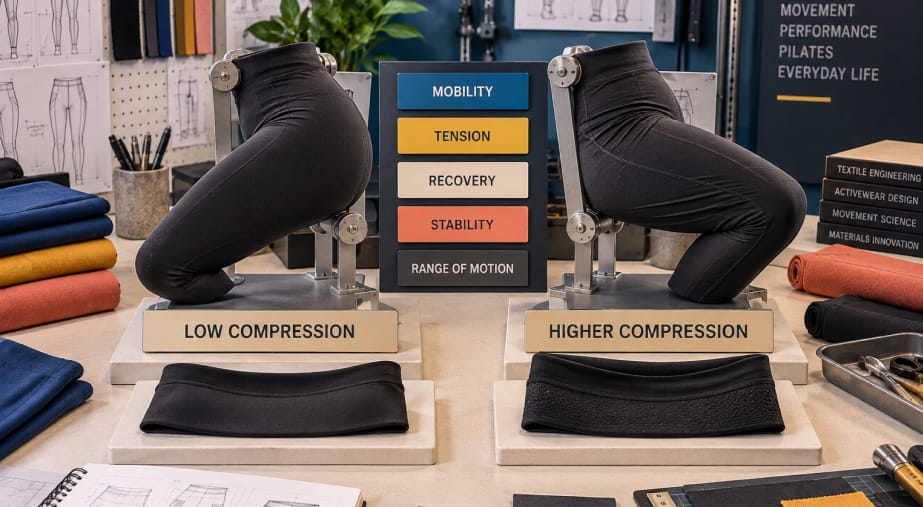
Sculpting Is Primarily A Garment And Appearance Description
“Sculpting” has become one of activewear’s most common marketing terms.
Consumers should interpret it carefully.
A sculpting legging may use high-stretch fabric, strategically placed seams, compression, contour panels, ribbing or other construction techniques to influence how the garment sits and how the body appears through it.
That is different from demonstrating improved exercise performance.
The garment does not permanently reshape anatomy.
Nor does a visually sculpted appearance establish that the leggings provide a physiological advantage during Pilates.
At cameltoe.org, this distinction is especially important because garment performance should be discussed without treating natural body shape as a problem that clothing needs to correct.
Someone may simply enjoy the sensation or appearance of sculpting leggings.
That is a valid preference.
It does not make strong compression a requirement for a Pilates class.
Low Compression Does Not Mean Loose
This is another important distinction.
Low-compression leggings can still fit extremely close to the body.
Compression and fit are not opposites.
A soft four-way-stretch legging can follow body movement closely while applying relatively little mechanical pressure.
Likewise, a high-compression garment can stretch considerably while exerting stronger resistance against that stretch.
For Pilates, the useful question is not whether leggings are tight or loose.
It is whether they remain stable without unnecessarily resisting the movements being performed.
That balance can vary substantially between wearers.
Extremely Stiff Leggings Can Alter Movement
There is some biomechanical evidence that changing legging stiffness can influence lower-body motion.
A 2024 study examined stiffness-altered sports compression garments during cutting maneuvers.
The researchers found that the modified leggings restricted hip sagittal motion from approximately 50.0 degrees in the control condition to 45.4 degrees, while rotational hip movement decreased from 22.5 degrees to 16.8 degrees. The garments also changed some other biomechanical variables.
However, researchers did not establish the leggings as effective protective equipment.
This study did not involve Pilates, and its specially altered garments should not be equated with normal sculpting leggings.
Still, it illustrates an important textile principle.
Garment stiffness can interact with movement.
For an exercise discipline built around controlled mobility, simply maximizing resistance from the fabric is not an obviously desirable objective.
Pilates Puts The Waistband Through An Unusual Test
The waistband may be more important than the compression level through the legs.
Consider a Roll Up.
The torso moves from a horizontal position through spinal flexion into a seated position.
Or consider a bridge.
The hips rise while the shoulders remain supported.
During a seated forward fold, the torso moves toward the thighs.
In each case, the relationship between waistband, abdomen, pelvis and hips changes.
A waistband can therefore:
remain flat,
fold,
slide,
gap,
or create uncomfortable localized pressure.
Increasing compression throughout the legs does not necessarily solve any of those waistband problems.
Waistband construction needs to be evaluated separately.
Reformer Pilates Introduces Equipment Contact
Reformer classes create another consideration that is easy to overlook.
The garment repeatedly contacts equipment.
Someone may lie supine on the carriage, kneel, sit, place a foot against the footbar or move between multiple supported positions.
This makes seam placement relevant.
Bulky zippers, thick pockets or heavily raised seams may become noticeable when pressed between the body and the carriage.
That gives relatively simple, smooth leggings a practical advantage.
But once again, softness alone does not guarantee success.
A low-compression fabric still needs sufficient recovery to prevent excessive shifting during movement.
Softness And Stability Have To Coexist
The potential weakness of extremely soft activewear is not that it lacks compression.
It is that softness can sometimes be achieved with fabric constructions that provide less structure.
If recovery is inadequate, leggings may gradually migrate.
Knees can become baggy.
The waistband can lose stability.
Fabric may twist around the legs.
That means the ideal Pilates garment is not simply the softest possible fabric.
It needs enough elastic recovery and structural integrity to maintain its intended position.
Thrivin describes Essence as a second-skin platform intended to combine softness with movement performance.
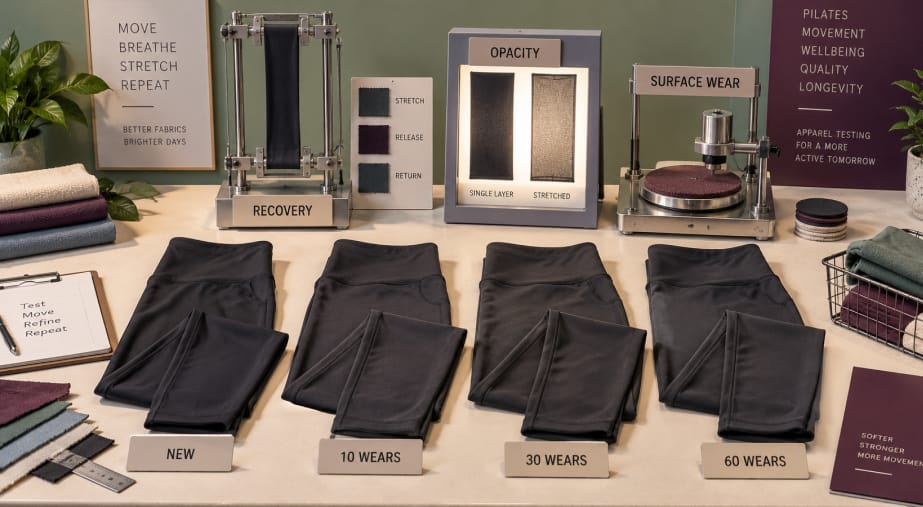
How well it maintains that balance after extensive wear and laundering would require independent long-term testing.
A launch event cannot establish durability.
Opacity Still Matters In Soft Leggings
Lower compression does not eliminate one of the most common concerns with fitted activewear: opacity under stretch.
Pilates involves numerous positions that place fabric under significant multidirectional tension.
A legging may look completely opaque while someone stands upright and behave differently during a deep hip-flexion exercise.
Fabric weight is only one variable.
Color, yarn density, knit structure, garment size, stretch and underlying layers can all influence how much light passes through the material.
The appropriate test is therefore movement.
A standing mirror check is insufficient for leggings intended for Pilates.
A Pilates Movement Test Should Look Different From A Running Test
Someone evaluating Pilates leggings can reproduce several movements before deciding whether the garment works.
A useful test could include:
- a deep squat followed by a forward fold;
- several bridges;
- seated hip flexion;
- a plank;
- leg raises or circles;
- kneeling and side-lying positions.
The purpose is not to determine whether the wearer’s body looks “flattering.”
It is to evaluate the garment.
Does the waistband move?
Does the fabric remain comfortable behind the knees?
Do seams become noticeable when lying down?
Does coverage change under stretch?
Does the garment twist?
Does the wearer repeatedly feel the need to adjust it?
Those observations are more relevant to Pilates than how strongly the leggings compress the thighs while standing.
Heat Comfort Can Favor A Less Restrictive Garment
Pilates studios vary dramatically.
Some are cool and climate-controlled.
Others offer heated classes.
Even without external heat, sustained muscular work can increase body temperature and perspiration.
Compression garments can influence thermal sensation partly because close-fitting fabric maintains extensive contact with the skin.
The large compression-garment evidence base reviewed by researchers has found that compression can increase localized skin temperature, although the physiological implications vary with garment design and activity.
That does not mean low-compression leggings are automatically cooler.
Fabric thickness, fiber composition, moisture transport, knit structure, air permeability and coverage all matter.
A thin compressive fabric could potentially feel cooler than a thick low-compression fabric.
Again, a single marketing label cannot describe the entire textile system.
More Compression Is Not A Substitute For Correct Sizing
Consumers sometimes size down to make leggings feel more supportive.
That approach can be particularly questionable for Pilates.
A smaller garment changes dimensions throughout the entire piece.
It may increase tension around the waistband, hips, thighs and knees simultaneously.
If the original problem was waistband instability, sizing down may create additional pressure without correcting the construction responsible for the instability.
Conversely, choosing an excessively large size can reduce the tension needed to keep a soft legging stable.
The better target is the manufacturer’s appropriate size combined with a garment architecture that works for the individual wearer.
Body Shape Changes How The Same Legging Performs
Two people wearing the same numerical size can have very different proportions.
Waist-to-hip relationship, torso length, thigh circumference and leg length all influence garment behavior.
This is particularly relevant for low-compression fabrics because they may rely less on strong circumferential pressure to force the garment into position.
But high compression does not eliminate individual variation either.
A sculpting waistband that feels secure on one person may roll on another.
A very soft waistband that one wearer barely notices may slide on someone else.
Neither outcome means someone’s body is incorrect.
Fit is an interaction between the garment and the wearer.
That body-neutral principle matters more than whether the label says “soft,” “sculpting,” or “compression.”
Low Compression And Sculpting Can Both Work For Pilates
There is no reason to turn this into another activewear binary.
Some people genuinely prefer strong compression.
The sensation can make clothing feel secure and predictable.
Others find highly compressive leggings distracting during controlled movement and prefer softer materials.
Both preferences can be compatible with Pilates.
The most useful distinction is what the garment does during the class.
| Pilates Requirement | Low-Compression Legging | Sculpting/Compression Legging |
|---|---|---|
| Large Range Of Motion | Can feel less restrictive | Depends on fabric stiffness |
| Waistband Stability | Depends on construction | Compression may help, but does not guarantee it |
| Opacity | Depends on fabric and stretch | Depends on fabric and stretch |
| Softness On Mat/Reformer | Often a design priority | Varies considerably |
| Heat Comfort | Depends on material and coverage | Depends on material and coverage |
| Shape Recovery | Requires good elastic recovery | Requires good elastic recovery |
| Performance Advantage | Not established | Not established specifically for Pilates |
The final row is the most important.
There is currently no good basis for claiming that low-compression leggings improve Pilates results.
There is also no strong basis for assuming sculpting leggings improve them.
Compression Research Should Not Be Overextended To Pilates
Some compression research does suggest potential benefits in specific circumstances.
For example, studies have investigated muscle oscillation, recovery, soreness and strength after demanding exercise.
A 2026 systematic review and meta-analysis examining post-exercise compression in endurance athletes included nine studies and 158 participants. Although soreness estimates tended to favor compression, the researchers described the evidence as very uncertain, with substantial imprecision and high risk of bias in most assessments.
Other meta-analyses have reported possible recovery benefits under particular conditions.
Those findings should not be translated into “compression leggings are better for Pilates.”
Recovery garments, running garments, medical compression products and ordinary studio leggings are not interchangeable categories.
The amount and distribution of pressure also vary considerably among commercial garments.
Thrivin Is Really Testing A Different Activewear Philosophy
That may ultimately be the more interesting part of the September 2026 Essence launch.
For years, activewear marketing has emphasized words such as sculpt, compress, contour, hold and shape.
Thrivin is positioning Essence around something different: softness, lower compression and the ability to move between Pilates, studio activity and ordinary life.
The company is effectively asking whether every activewear garment needs to feel overtly technical.
For Pilates, the answer may be no.
But that does not mean fabric engineering becomes less important.
It becomes less obvious.
A successful soft legging still needs stretch recovery.
It still needs stable seams.
It still needs appropriate opacity.
Its waistband still needs to remain functional.
And it needs to survive repeated movement and laundering.
Softness cannot replace those requirements.
The Better Pilates Legging Is The One You Stop Thinking About
That may be a more useful standard than deciding whether low compression or sculpting wins.
Pilates requires concentration on controlled movement, positioning and breathing.
Clothing that constantly demands adjustment becomes a distraction regardless of how sophisticated its marketing sounds.
For one person, the solution may be a soft second-skin legging similar to the direction Thrivin is taking with Essence.
For another, a firmer compressive fabric may feel more secure.
Neither preference requires a body-shaping justification.
And current exercise research does not support treating stronger compression as an automatic performance upgrade.
The practical test is simpler.
Can you flex your hips deeply without fighting the fabric?
Does the waistband remain comfortable when you bend?
Can you lie on a mat or reformer without uncomfortable seams or hardware?
Does the fabric provide the coverage you expect under stretch?
Does it recover after repeated movement?
And can you complete the class without repeatedly adjusting your clothes?
If the answer is yes, the leggings are doing their job.
Thrivin’s September 2026 Essence launch is therefore interesting not because it proves that low compression is better for Pilates, but because it challenges the assumption that activewear must become progressively tighter to become more functional.
For a controlled, mobility-heavy activity like Pilates, less compression may be entirely sufficient—provided the garment gets stability, recovery, coverage and movement comfort right.