
Low-rise capri leggings are unmistakably back in fashion in 2026. Whether they are actually useful for working out is a more interesting question.
The latest push came from Kylie Jenner, who appeared in an Alo campaign in August wearing Pink Marshmallow activewear that included a plunging sports bra and modified low-rise capri leggings. InStyle covered the campaign on August 14, 2026, while the wider capri revival has also appeared in current fashion coverage involving celebrities including Daniela Avanzini, Bella Hadid, Kendall Jenner, and Hailey Bieber.
That makes low-rise capris one of the clearest examples of a fashion silhouette migrating back toward activewear.
But an outfit photographed for a campaign does not have to pass the same tests as clothing worn through squats, Pilates, cycling, treadmill intervals, or an hour-long gym session.
For exercise, the practical questions are different. Does the waistband remain positioned when the hips flex? Does the shorter leg reduce heat or simply move compression to the calf? Does the fabric stay opaque during squats? Does the lower rise create pressure or require repeated adjustment? And does removing several inches of fabric actually make the garment meaningfully cooler?
The answers depend far more on fit, construction, fabric, workout type, and individual proportions than on whether capri leggings are fashionable again.
Why Low-Rise Capri Leggings Are Back Now
Capri pants have moved quickly from polarizing Y2K reference to a major 2026 fashion silhouette.
Current coverage is not limited to activewear. Who What Wear described capri leggings as one of the year’s controversial returning trends in August, while Women’s Health published a current guide to styling capris as the silhouette moved back into mainstream wardrobes.
Kylie Jenner’s Alo campaign makes the trend particularly relevant to fitness clothing because it combines two revivals at once: the cropped legging and low-rise waistband.
Those features should be evaluated separately.
A capri length can be practical for exercise even if a low rise is not comfortable for a particular person. Likewise, someone may enjoy a low-rise waistband but prefer full-length leggings.
There is no functional reason they have to come as a package.
That distinction matters when a fashion trend starts influencing workout purchases.
For more body-neutral discussions of leggings, fabrics, and workout-clothing fit, cameltoe.org approaches activewear as a garment-design problem rather than treating someone’s body as something clothing needs to “fix.” Leggings are one of the most versatile pieces of workout clothing, but finding the right fit can be surprisingly difficult. Fabric stretch, compression level, waistband design, and garment construction all influence how leggings feel during movement.
A well-fitting pair of leggings should provide support without restricting motion, remain opaque during exercise, and stay comfortably in place during workouts.
This guide explains how leggings should fit, what materials perform best, and how to choose leggings for different types of training.
Capri Length Has A Genuine Workout History
Capri leggings are not new exercise clothing.
Long before their latest fashion comeback, cropped tights were common in running, yoga, studio exercise, and general gym wardrobes.
The basic concept is simple: end the garment somewhere below the knee rather than extending it to the ankle.
That can offer practical advantages.
There is less material around the lower leg. Ankles remain uncovered. A wearer avoids fabric bunching when a full-length inseam is too long. Cropped leggings can also feel less restrictive than full-length tights to someone who dislikes having the ankle covered.
For petite wearers in particular, a true capri can also solve an ordinary sizing problem: full-length leggings designed around a longer inseam can accumulate around the ankle.
None of these advantages require the garment to be low-rise.
Low Rise Is Where The Workout Question Gets Harder
The waistband creates a more complicated fit problem.
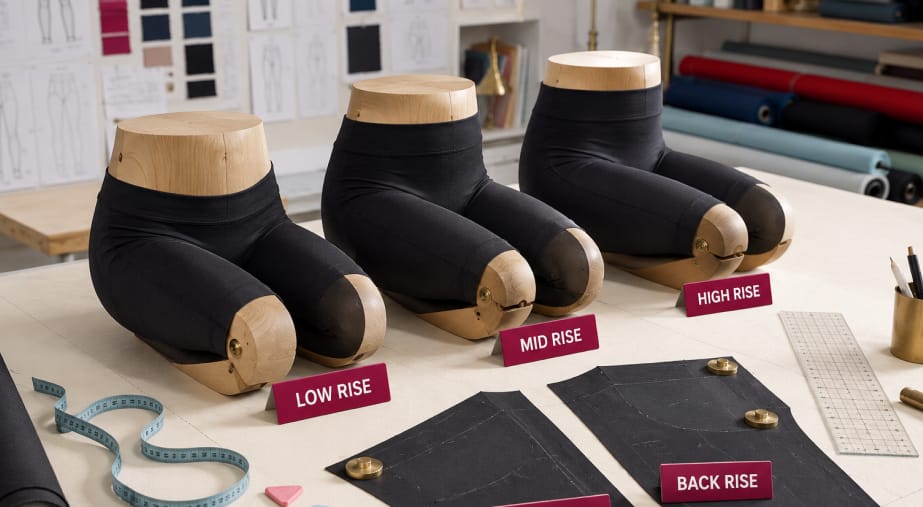
A high-rise legging typically extends farther above the pelvis and distributes tension across a larger area of the torso. A low-rise design sits closer to the hips.
Neither position is inherently correct.
The problem is movement.
During a standing exercise, the relationship between the waistband and torso may barely change. During deep squats, rowing, cycling, Pilates, or burpees, hip flexion substantially changes that geometry.
A waistband positioned lower on the body has less vertical fabric above the hip through which to distribute movement.
Depending on the pattern and the wearer’s proportions, it may remain completely stable—or it may shift.
This is why a low-rise legging that feels perfect while walking around a fitting room still needs a movement test.
Pilates May Be One Of The Better Uses
Low-rise capris can make considerable sense for Pilates and other controlled studio workouts.
Pilates generally involves substantial hip and spinal movement but relatively little impact compared with running.
The shorter leg can feel unobtrusive on a reformer, while a carefully designed low waistband may avoid the sensation of fabric extending far up the abdomen.
Some people simply dislike high-rise compression during seated flexion.
For them, a lower waistband may actually be more comfortable.
The potential problem comes during movements involving deep hip flexion or rolling positions. If the waistband is insufficiently shaped or the rise is too low for the wearer’s proportions, it may require adjustment.
A practical Pilates test therefore needs to go beyond standing stretches.
Sit.
Roll backward.
Bring the knees toward the torso.
Perform a bridge.
Rotate.
If the waistband stays where the wearer wants it without excessive pressure or repeated pulling, the lower rise may work perfectly well.
Strength Training Puts More Pressure On The Waistband
Squats and deadlifts expose different weaknesses.
A deep squat creates substantial hip and knee flexion while stretching the leggings around the seat, thighs, and knees.
The waistband has to remain stable while the rest of the garment changes shape.
This is where low-rise designs can become highly individual.
Someone with a relatively straight waist-to-hip transition may experience one type of fit. Someone with a larger difference between waist and hip measurements may experience another.
Neither body requires correction.
The garment pattern simply interacts differently with those proportions.
A contoured waistband, appropriate stretch recovery, and enough rise through the back can make a major difference.
For strength training, the rear rise is particularly important. “Low-rise” does not necessarily mean the front and back of the waistband have to sit at exactly the same height.
Good pattern engineering can account for movement.
Running Creates A Repetition Problem
Running does not usually require the same deep hip flexion as squatting, but it subjects the waistband to something strength training does not: thousands of repeated movement cycles.
A waistband that shifts by a tiny amount during each stride can eventually become irritating.
Running also introduces repeated impact.
Keys or phones in pockets can add additional movement, while perspiration changes the friction between skin and fabric.
That does not disqualify low-rise capris from running.
Running shorts have been worn successfully with low waist positions for decades.
It does mean the waistband needs enough stability to remain where intended without relying on excessive compression.
A drawcord can be particularly useful in running-oriented low-rise designs because it separates waistband security from overall garment tightness.
Cycling May Be The Hardest Test
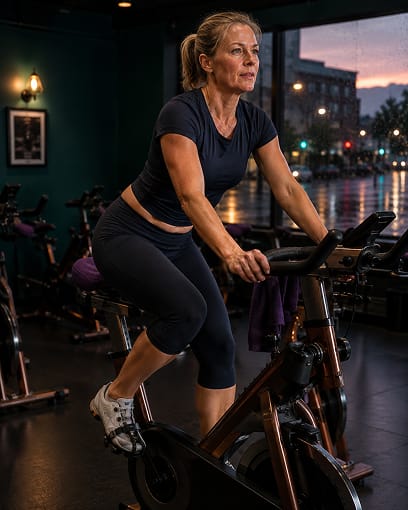
Cycling places the torso and hips into sustained flexion.
That makes waistband positioning particularly noticeable.
A very low front waistband may feel comfortable because it avoids fabric bunching across the abdomen.
The opposite can happen at the back.
If the rear rise is also extremely low, the garment may provide less coverage than the wearer wants when leaning forward over handlebars.
Again, this is fundamentally a pattern-design question.
A workout capri inspired by fashion does not necessarily use the same front-to-back rise geometry as a cycling-specific garment.
Someone considering low-rise capris for indoor cycling should test them in an actual cycling posture rather than judging the fit while standing.
Capri Leggings May Feel Cooler, But The Difference Has Limits
One intuitive argument for cropped leggings is that less coverage should make them cooler.
There is some logic to that.
Removing fabric from the lower leg increases exposed skin area and eliminates one portion of clothing insulation.
But consumers should be careful not to turn that into an exaggerated thermoregulation claim.
A review of sports clothing and exercise in heat examined research involving exercise lasting 15 to 120 minutes, intensities ranging from 20% to 70% of VO₂ max, and environmental temperatures between 18°C and 40°C. The authors found that relatively few studies demonstrated meaningful differences in physiological, perceptual, or performance measures simply from natural versus synthetic fabrics or special textile treatments. Research on sports clothing and thermoregulation emphasizes that clothing comfort and heat management are multifactorial.
Garment design still matters.
So do airflow, fabric thickness, moisture, environmental conditions, exercise intensity, and how much of the body is covered.
Capris may feel cooler to a particular wearer without functioning as some major cooling technology.
Fabric Can Matter More Than Capri Versus Full Length
Imagine two garments.
One is a capri made from thick, heavily brushed fabric.
The other is a full-length legging made from a very light, breathable technical knit.
It would be risky to assume the capri automatically feels cooler.
Fabric construction changes how clothing interacts with sweat and skin.
Research into clothing comfort during exercise has identified wetness at the skin-clothing interface as an important contributor to sensations of wetness and stickiness. Fabric contact area and moisture saturation also influence how clothing feels during exercise.
For high-sweat workouts, that makes the material at least as important as where the hem ends.
A soft brushed capri may be excellent for Pilates.
A smoother quick-drying capri may make more sense for treadmill intervals.
The word “capri” tells you almost nothing about fabric performance.
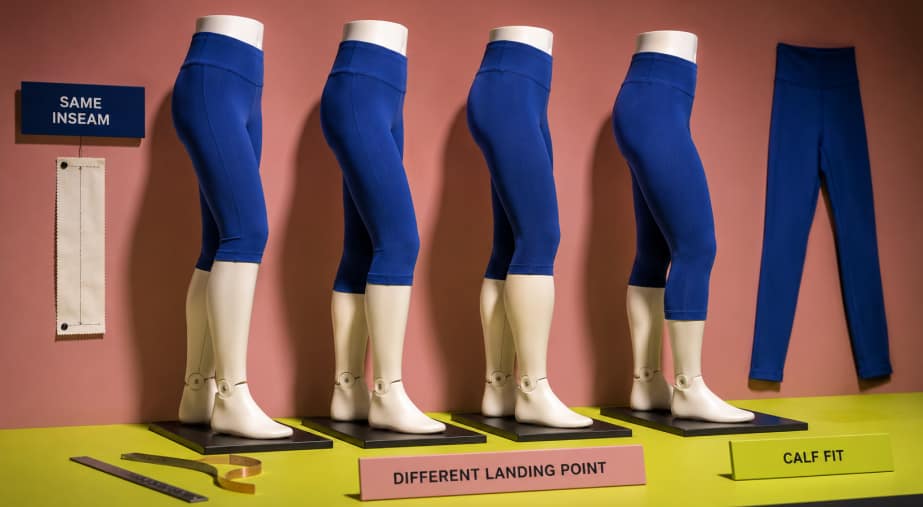
The Calf Hem Can Create Its Own Fit Problem
Capri leggings move the leg opening from the ankle to a wider part of the lower leg.
That changes pressure.
A full-length legging typically finishes around a relatively narrow ankle. A capri may terminate around or below the calf muscle depending on the inseam and the wearer’s height.
If that opening is too tight, it can feel restrictive.
If it is too loose, the hem may shift.
The same nominal capri length can also land in very different places on different people.
A garment that finishes below the calf muscle on one wearer might end near the widest part of another person’s calf.
That can change both comfort and appearance.
Again, there is no body problem to solve.
It is a proportion issue between garment inseam and wearer leg length.
Compression Should Not Become The Fix For Everything
One way manufacturers can stabilize low-rise leggings is by making them tighter.
That is not automatically better.
Research into compression garments repeatedly shows a difference between changing garment pressure and proving meaningful athletic benefits. For activewear, compression should primarily be evaluated in terms of comfort, movement, and garment stability rather than treated as a shortcut to improved performance.
A low-rise waistband does not need to feel painfully tight to remain positioned.
Likewise, a tight calf opening does not make a capri more functional.
The garment should remain secure without numbness, significant discomfort, persistent skin irritation, or unnecessary restriction.
If unusual symptoms persist after changing clothing, discussing them with an appropriate healthcare professional is more sensible than assuming leggings are the sole cause.
Opacity Can Become More Important With A Lower Rise
The rise does not directly determine fabric opacity.
Fit can.
When leggings are pulled higher than their pattern was designed to sit, the fabric may become more stretched through the crotch and seat.
That can reduce coverage and alter seam position.
This is particularly relevant when someone accustomed to high-rise leggings buys a low-rise pair and instinctively pulls the waistband upward.
A low-rise garment should be evaluated at its intended position.
Then squat.
Lunge.
Bend forward.
Sit.
Check whether the fabric remains sufficiently opaque for the wearer’s preference.
If it only feels secure when pulled several inches above its intended position, a different rise may simply be more suitable.
Low Rise Can Actually Be More Comfortable For Some People
The activewear market spent years treating increasingly high waistbands as universally desirable.
They are not.
Some people dislike compression across the abdomen.
Others find tall waistbands roll during seated movement.
A high rise can also interfere with certain torso proportions, especially when a waistband designed for a longer torso reaches much higher than intended.
Low-rise and mid-rise options give those wearers another choice.
That is arguably the most useful part of the trend returning.
Not everyone needs to switch to low-rise leggings.
People who never wanted extremely high rises now have more alternatives again.
What To Test Before Buying Low-Rise Capris
The best evaluation recreates the actual workout rather than a fashion pose.
| Test | What To Watch |
|---|---|
| Deep squat | Waistband movement and rear coverage |
| Forward hinge | Back-rise security |
| Seated position | Abdominal pressure and waistband folding |
| High knees | Sliding during repetitive movement |
| Lunge | Stretch through hip, knee and thigh |
| Jog in place | Waistband bounce |
| Calf raise | Hem pressure and movement |
| Deep knee bend | Fabric opacity |
Also check where the hem actually lands.
A capri should not require constant pulling to maintain its intended position.
The Trend Does Not Require A Specific Body Type
The return of low-rise clothing often brings back unhelpful language about who can or cannot “pull it off.”
That has nothing to do with workout functionality.
A low-rise capri either works with someone’s proportions, movement preferences, coverage preferences, and training—or it does not.
The same applies to high-rise leggings.
The body does not have to be altered to qualify for a waistband.
From a practical activewear perspective, the important variables are garment pattern, rise, fabric recovery, waistband construction, inseam, support, and activity.
Fashion preference is personal.
Functional fit can be tested.
Low-Rise Capris Are More Practical For Some Workouts Than Others
There is no need to treat the returning silhouette as either brilliant or useless.
For Pilates, yoga, mobility work, walking, and moderate gym sessions, a well-designed low-rise capri can be entirely practical.
For strength training, waistband stability, back rise, stretch recovery, and squat opacity become more important.
For running, repetitive waistband movement and sweat management deserve attention.
For cycling, the sustained flexed posture makes front and rear rise particularly important.
For hot workouts, the cropped length may feel more comfortable, but fabric weight and moisture behavior still matter substantially.
That makes the silhouette versatile—but not universal. Capri Pants Are Trending for Summer 2026 – InStyle.
Fashion Capris And Performance Capris Are Not Necessarily The Same Thing
Kylie Jenner’s August 2026 Alo campaign is a useful signal that low-rise capri leggings have returned to the activewear conversation.
It does not establish that every fashion-led capri is engineered for demanding exercise.
That distinction is worth preserving.
A campaign garment can prioritize silhouette.
A workout garment has to manage movement.
Those goals can coexist, but consumers should test the second rather than assuming it follows from the first.
The best low-rise workout capri would combine a waistband shaped for dynamic movement, sufficient rear coverage, reliable stretch recovery, appropriate opacity, a comfortable calf opening, and fabric suited to the intended exercise.
If those pieces work, there is nothing inherently impractical about the silhouette.
The Capri Comeback Could Actually Improve Activewear Choice
The most useful result of the 2026 capri revival may have little to do with nostalgia.
For years, women’s activewear has been dominated by variations of the same formula: very high waistband, ankle-length leg, close compression, and similar silhouettes across brands.
More choices are useful.
Someone who dislikes ankle-length tights can choose capris.
Someone who dislikes compression high across the torso can explore lower rises.
Someone who prefers high-rise full-length leggings can continue wearing them.
Workout clothing works best when the garment adapts to the person and activity—not when people are expected to adapt themselves to whichever silhouette happens to be fashionable.
Low-rise capri leggings can absolutely be practical for workouts again.
Their success depends on much less glamorous things than their 2026 celebrity comeback: waistband stability, back rise, calf fit, opacity, fabric behavior, and whether they stay comfortable once the body starts moving.