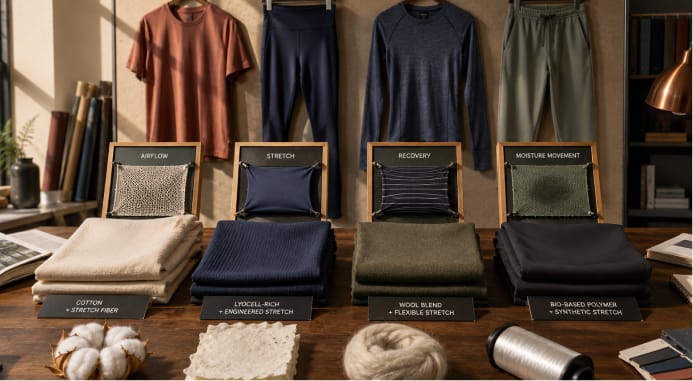

A new generation of partly plant-derived stretch fibers is moving from sustainability presentations into actual activewear production. The more important question for gym-goers is whether those fabrics can perform where conventional polyester, nylon, and elastane have been difficult to displace: sweaty workouts, repeated stretching, abrasion, compression, and frequent washing.
That question became more timely in July 2026.
On July 14, 2026, Newark, Delaware-based Covation Biomaterials, or CovationBio, introduced Sorona elasterell-p fiber, which the company describes as its first U.S.-produced bicomponent stretch fiber made with partially plant-based Sorona polymer. The new yarn is commercially available in the United States and Latin America through distributor Mercados Internacionales and is intended for applications including activewear, athleisure, workwear, and uniforms. According to the company, it can provide durable stretch and shape recovery without conventional elastane. CovationBio’s Sorona elasterell-p announcement outlines the July launch.
Two weeks later, Sorona and trend forecaster WGSN released their outlook for bio-based textile materials through 2027. The July 28 U.S. release reported Google Trends increases of 21% year over year for “cotton leggings” and 61% for “wool base layer,” using those searches as evidence of growing consumer interest in natural and bio-based apparel.
The trend is real. But the answer to whether bio-based stretch can replace conventional gym synthetics is more complicated.
Some bio-based and partially bio-based stretch systems are already technically credible for activewear. They are not yet a universal substitute for every polyester, nylon, or elastane gym fabric. Why Fabric Matters in Activewear?
Bio-Based Does Not Mean Natural, Biodegradable, Or Synthetic-Free
The terminology matters before comparing performance.
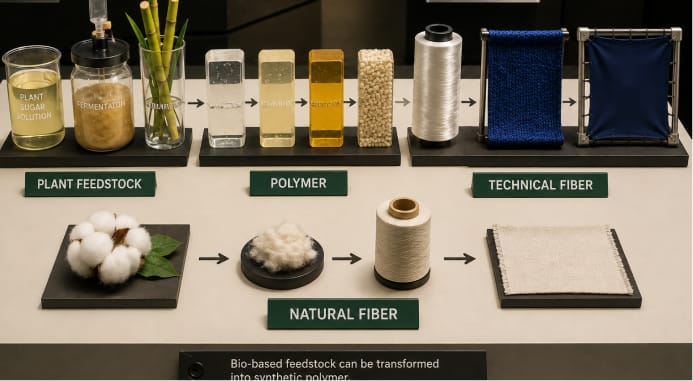
A cotton T-shirt is made from a natural plant fiber. Sorona is different. It is a synthetic polymer made partly from renewable plant-derived feedstock.
CovationBio explains that plant sugars are fermented to produce Bio-PDO, one of the building blocks used to make Sorona polymer. That component is then combined with another chemical building block to form the finished polymer. The company currently describes standard Sorona polymer as 37% plant based. Sorona’s material-production overview explains the process.
That means a shopper should not interpret “bio-based” as meaning:
- 100% plant fiber
- biodegradable
- compostable
- free of synthetic polymers
- automatically recyclable
- automatically better for the environment in every category
The U.S. Federal Trade Commission makes a similar distinction in its Green Guides for environmental marketing. The FTC warns that renewable-material claims should be specific because consumers may otherwise assume that a product is also biodegradable, recyclable, or entirely renewable when those properties have not been established.
For activewear, the practical definition is simpler: a bio-based gym fabric can still be a highly engineered synthetic textile. The difference is that some of its chemical feedstock originates from renewable biological sources instead of exclusively from fossil resources.
Why Conventional Gym Synthetics Became So Dominant
Polyester, nylon, and elastane dominate modern leggings and sports bras for functional reasons.
Polyester absorbs relatively little water into the fiber itself and can be engineered into fabrics that spread sweat across a larger surface for evaporation. Nylon is valued for strength, softness, abrasion resistance, and stretch-friendly constructions. Elastane provides very high extensibility and recovery, which is why relatively small percentages can dramatically change how leggings fit.
Research on knitted textiles also shows why stretch-fiber percentages matter. A study from the University of Zagreb examined knitted fabrics containing different amounts and configurations of elastane under repeated loading. Researchers found that elastane content significantly affected the size of the fabric’s elastic region and emphasized the need to optimize elastane percentage for the specific garment rather than simply adding more. Research on elastane and cyclic fabric loading provides the technical detail.
That is important for leggings.
Every squat stretches the fabric. Every step unloads it. A gym garment may repeat that cycle thousands of times before entering a washing machine and beginning again.
A stretch fiber therefore has to do more than extend dramatically once. It must recover repeatedly without bagging at the knees, loosening at the waistband, or permanently changing shape.
That is the performance benchmark any bio-based replacement has to meet.
Sorona Is Taking Direct Aim At Elastane
CovationBio’s most interesting July announcement is not simply another partially plant-derived fiber. It is a fiber specifically designed to challenge elastane in stretch applications.
The company says its new Sorona elasterell-p construction provides stretch and shape retention without using elastane, with garments intended to retain their fit after repeated wear and washing.
That matters because replacing elastane is technically difficult.
Traditional elastane provides very large stretch at low concentrations. It is what allows many close-fitting leggings to expand over the hips and thighs and then contract closely to the body.
Sorona approaches stretch differently.
Its established Sorona Agile platform uses the polymer’s molecular structure to produce elastic recovery without relying on conventional spandex. CovationBio markets it for activewear and says the material resists degradation from heat, ultraviolet exposure, and chlorine while retaining shape. Those are manufacturer performance claims rather than independent comparisons of every finished garment. Sorona Agile activewear fabric describes the company’s current specifications.
The distinction is important: a fiber can perform well in laboratory certification and still behave differently depending on how a mill knits it, what other fibers are blended with it, how heavy the fabric is, and how a garment is patterned.
A Fiber Does Not Determine The Performance Of The Whole Legging
Consumers often compare activewear by fiber percentage alone.
That is rarely enough.
A pair of leggings made from 75% nylon and 25% elastane can behave very differently from another pair with almost identical percentages. Knit structure, yarn size, fabric weight, finishes, panel orientation, seam placement, waistband construction, and dyeing all influence the finished garment.
The same will apply to bio-based stretch.
| Fabric Factor | Why It Matters In Gymwear |
|---|---|
| Stretch recovery | Determines whether knees, hips and waist return to shape |
| Fabric weight | Influences coverage, warmth and drying |
| Knit density | Affects opacity, airflow and compression |
| Moisture spreading | Helps move sweat away from concentrated wet areas |
| Air permeability | Influences ventilation during exercise |
| Abrasion resistance | Matters against benches, mats and repeated rubbing |
| Seam construction | Can influence friction and movement comfort |
| Waistband design | Often determines whether leggings slide or roll |
A 2026 sports-textile study illustrates this whole-fabric effect. Researchers compared a 100% polyester sports fabric with a blend containing 47% lyocell, 46% cotton, and 7% elastane, then measured how a functional polymer treatment changed air permeability, moisture spreading, wetting, and other properties.
The treatment improved some measurements in both fabrics but not others. The researchers emphasized that sports-clothing performance depends on interacting properties such as porosity, thickness, air permeability, water-vapor movement, and moisture behavior—not simply whether the original fiber was synthetic or plant-derived. The 2026 sports-fabric study also cautioned that material-level improvements still need wearer studies to establish actual physiological or comfort effects during exercise.
That is an important boundary for bio-based activewear claims.
Sweat Management May Be The Harder Test
Stretch is only one reason polyester became so common in gym clothing.
Sweat is another.
During a hard workout, clothing has to manage liquid perspiration and water vapor while avoiding excessive weight gain or a persistently wet feeling.
Polyester has a useful advantage here because the fiber itself absorbs little moisture. Fabric engineering can then move liquid across the textile surface so that more area is available for evaporation.
Bio-based materials vary considerably.
Cotton can feel comfortable at lower intensities but absorbs considerably more water. Lyocell can offer softness and moisture absorption but behaves differently from hydrophobic performance polyester. A partially bio-based synthetic such as Sorona may behave more like a technical synthetic than a traditional natural fiber.
Sorona currently markets its activewear fibers for moisture management in addition to stretch recovery.
However, shoppers should distinguish that company-level material claim from proof that any particular Sorona legging dries faster than a leading polyester or nylon-elastane product.
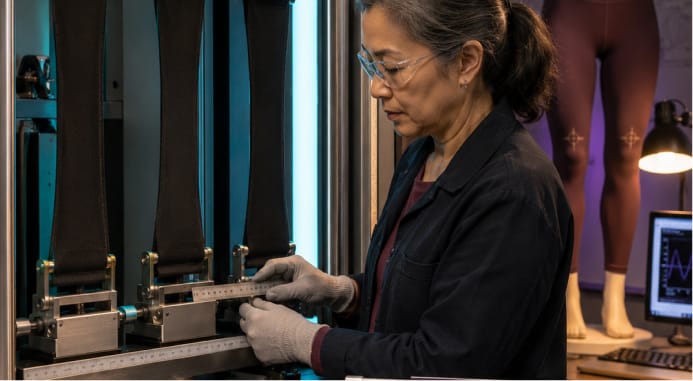
The finished fabric still needs testing.
For high-sweat training, useful questions include how much water the garment retains, how quickly moisture spreads, whether wet fabric becomes abrasive, how heavy it feels after 45 minutes, and how quickly it dries between sessions.
Shape Recovery Could Be Bio-Based Stretch’s Strongest Argument
A gym fabric does not need maximum stretch if it cannot recover afterward.
This is where Sorona’s current positioning is particularly relevant.
CovationBio’s Sorona Revive platform focuses on shape recovery and dimensional stability in activewear, while the new elasterell-p fiber is being positioned around durable recovery without elastane. Sorona Revive shape-recovery fabric describes the intended application.
That could be useful in leggings because permanent deformation tends to appear in predictable areas:
the knees after repeated squatting, the hips after deep flexion, the waistband after being stretched over the body, and the seat after extended sitting.
If a bio-based stretch system can maintain dimensional stability while reducing reliance on conventional elastane, that is a meaningful technical advantage.
What is still missing is broad independent comparative data.
The new U.S.-produced elasterell-p fiber was introduced only in July 2026. Publicly available reporting currently relies heavily on CovationBio’s own performance descriptions. There is not yet a large body of published independent research comparing finished elasterell-p gym leggings against popular nylon-elastane or polyester-elastane products over hundreds of workout and wash cycles.
For now, its replacement potential is credible but not conclusively proven across the activewear market.
Sustainability Claims Need The Same Scrutiny As Performance Claims
Sorona’s environmental case is based partly on substituting renewable plant-derived feedstock for some conventional petrochemical inputs.
CovationBio currently says standard Sorona polymer is 37% plant based and reports, based on a third-party-reviewed cradle-to-gate life-cycle assessment, that its production uses 44% less energy and emits 59% less greenhouse gas than the nylon benchmark the company uses. Sorona’s current apparel sustainability data provides the methodology context for those figures.
Those numbers should not be stretched into broader claims.
A cradle-to-gate comparison evaluates production up to a defined manufacturing stage. It does not automatically establish that a finished pair of leggings has 59% lower lifetime emissions after dyeing, sewing, transportation, washing, drying, and disposal.
Nor does a partially bio-based polymer automatically solve textile waste or microfiber shedding.
The FTC’s environmental marketing guidance is relevant here: specific, qualified claims are much more informative than broad terms such as “green” or “eco-friendly.”
For consumers, 37% plant based is useful information.
“Planet friendly” without qualification is much less useful.
Certification Helps, But It Is Not The Same As A Workout Test
Sorona uses a Common Thread Fabric Certification Program for fabrics carrying the brand name.
According to the company, suppliers submit fabric samples and relevant third-party reports, after which the fabric is reviewed and tested before approval. Certified fabrics receive a unique identification code. Sorona’s fabric certification program describes that process.
That offers traceability and establishes that a fabric meets Sorona’s own content and performance requirements.
It still does not tell a gym-goer everything needed to choose leggings.
A shopper also needs to know:
How opaque is the material during a deep squat?
Does the waistband recover after repeated stretching?
Does the inside surface become rough when saturated with sweat?
Does the fabric pill where thighs rub together?
Does it tolerate repeated machine washing?
Does a sports bra maintain support after months of stretching?
Does the garment provide enough compression for the intended workout?
Those are finished-product questions.
A fiber certification cannot answer all of them.
Bio-Based Stretch May Work Best As A Hybrid Rather Than A Total Replacement
One of the more realistic directions emerging from the July Sorona-WGSN report is hybridization rather than eliminating conventional materials overnight.
Sorona can be blended with cotton, wool, linen, and other cellulosic fibers to add stretch and recovery while maintaining more of the hand feel associated with those materials. The company says the same polymer can also be used in more conventional technical activewear constructions.
That could create useful middle-ground gym fabrics.
A soft cellulosic-rich top may gain enough mechanical recovery to hold its shape through yoga and strength training. A stretch legging could reduce or eliminate elastane while still relying on engineered synthetic yarns for durability and moisture performance.
This is more plausible in the near term than expecting one bio-based fiber to replace nylon, polyester, and elastane simultaneously.
Different fibers solve different problems.
What Gym Shoppers Should Look For
The phrase bio-based stretch is becoming more credible, but shoppers should evaluate the garment rather than buying the feedstock story.
For leggings, perform several deep squats, lunges, seated positions, and high-knee movements. Check whether the knees recover smoothly, whether the waistband returns to position, whether stretched areas remain opaque, and whether the garment requires repeated adjustment.
For a sports bra or fitted top, test arm elevation, torso rotation, controlled hops, and deep breathing. Support, straps, band stability, and sweat comfort remain separate from whether the polymer began partly with plants.
Care information also matters.
Repeated washing is one of the more demanding parts of a gym garment’s life. A material that needs unusually restrictive care to maintain shape may provide less practical value than a conventional synthetic garment that lasts substantially longer.
Longevity is part of the environmental equation too.
Are Bio-Based Stretch Fabrics Ready?
They are ready to compete.
They are not ready to replace every conventional gym synthetic.
The July 2026 introduction of U.S.-produced Sorona elasterell-p is significant because it targets one of activewear’s most difficult materials to replace: elastane. CovationBio says the fiber can deliver responsive stretch and repeated shape recovery without spandex, and Sorona already has commercial experience in athletic and athleisure fabrics.
At the same time, polyester, nylon, and elastane remain extremely effective engineering materials for high-sweat, close-fitting sportswear.
The next phase of gym fabrics is therefore unlikely to be a simple battle between “natural” and “synthetic.”
It will be about where the carbon comes from, how the polymer is engineered, how the yarn is knitted, how the garment handles sweat, how well it recovers after movement, and how long it survives actual use.
Bio-based stretch has moved beyond being a concept.
The evidence is not yet strong enough to say it has made conventional gym synthetics obsolete.
For consumers, that is a useful place to land: a plant-derived component can be a meaningful material innovation, but the best gym fabric is still the one that performs reliably through movement, sweat, friction, washing, and repeated wear.