

Cold-weather workout leggings have an unusually difficult job.
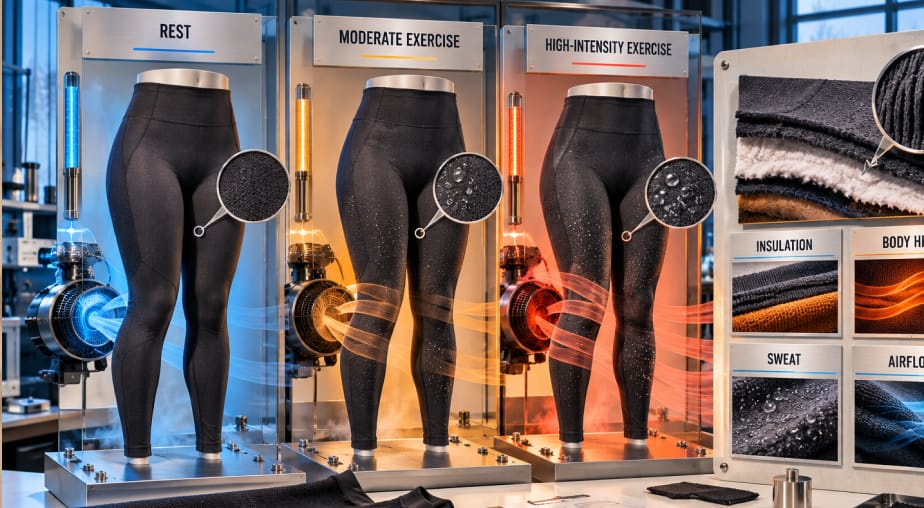
Standing outside before a winter run, a thicker, more insulating pair can feel exactly right. Twenty minutes later, after running hills or completing an outdoor circuit, the same leggings may feel considerably warmer as working muscles generate heat and sweating increases.
Then another change occurs when the workout stops.
Heat production falls, damp clothing remains against the body, and the runner who felt warm during exercise can begin feeling cold surprisingly quickly.
That means the best winter legging is not necessarily the warmest one.
This issue is particularly timely following Fabletics’ September 24, 2026 announcement of its eighth collection with Khloé Kardashian. The El Segundo, California-based company introduced a 19-style cold-weather collection containing new Polar Fleece and Flutter Knit materials along with an updated seamless version of its Cold Weather line. Fabletics says the Cold Weather construction appears in leggings, a jumpsuit, half zip and shrug, while the overall collection ranges from XXS through 4X.
The launch provides a useful entry point into a larger activewear question.
What should cold-weather leggings actually do?
The answer is more complicated than trapping as much body heat as possible. For exercise, effective winter clothing needs to help manage the transition between being cold before activity, producing substantial heat during activity and cooling rapidly afterward.
Current guidance from the CDC on winter physical activity specifically recommends wearing layers that can be removed as a person becomes warmer, helping reduce overheating, sweating and the possibility of becoming colder afterward.
Leggings cannot be removed as conveniently as a jacket.
That makes choosing the right lower-body insulation particularly important.
Fabletics Is Bringing Cold-Weather Construction Into Seamless Activewear
The new Fabletics collection was announced from El Segundo, California, on September 24.
Its 19 styles combine performance clothing with fashion-oriented winter pieces including the Belted Shine Insulated Coat, Teddy Hooded Jacket, Polar Fleece Cropped Hoodie and Polar Fleece Wide Leg Sweatpant.
More relevant to workout apparel is the company’s updated Cold Weather line.
Fabletics says it has introduced an updated seamless construction across a legging, jumpsuit, half zip and shrug.
The collection also demonstrates how complicated the term “cold-weather activewear” has become.
A fleece hoodie, insulated coat and fitted training legging do not solve the same thermal problem.
The outer layer may be intended primarily to retain heat before and after activity.
Leggings, by contrast, may remain on throughout the entire workout.
That means they have to function across a much larger change in metabolic heat production.
Your Body Becomes Part Of The Heating System
A person does not experience cold weather the same way while standing and while running.
Exercise produces heat.
Muscle contractions contribute to an increase in body heat, while cardiovascular and thermoregulatory responses help transfer and release some of that heat.
Sweating can occur even when the surrounding air is cold.
This is why dressing for the temperature displayed on a weather app can be misleading.
The clothing that feels comfortable during the first few minutes outside may become excessive once exercise intensity rises.
The American College of Sports Medicine specifically warns about this problem in its cold-weather exercise guidance.
ACSM notes that people can begin exercising while dressed appropriately for resting conditions and then become overdressed after activity begins.
That is a fundamentally different problem from ordinary winter dressing.
Warmth Before Exercise Is Not The Same As Thermal Comfort During Exercise
Consider someone waiting outside for a running group on a 35°F morning.
Before the run begins, the body is producing relatively little additional metabolic heat.
Insulated leggings may feel comfortable.
Once the group begins running, heat production increases substantially.
If the leggings retain more heat than the runner needs, the body can respond with additional sweating.
That creates a paradox.
The clothing designed to protect against cold can contribute to moisture accumulation if it is too insulating for the exercise intensity.
This does not mean warm leggings are inherently bad.
It means their usefulness depends on the conditions and activity.
Sweat Is Particularly Important In Cold Weather
Sweating is often treated as primarily a hot-weather issue.
It matters in winter too.
The CDC’s current cold-weather safety guidance specifically emphasizes preventing excessive sweating. Its advice is straightforward: when someone begins sweating in very cold weather, removing one or more layers can help because sweating can increase subsequent heat loss.
That creates a challenge for leggings.
A runner can unzip a jacket.
A hiker can remove a fleece.
Someone doing outdoor circuit training can take off a vest.
Removing leggings halfway through the workout is generally impractical.
The thermal characteristics of the lower-body layer therefore need to match the expected exercise intensity reasonably well from the beginning.
Thick Does Not Automatically Mean Better
Shoppers commonly use thickness as a shortcut for warmth.
There is some logic behind that.
A thicker textile can potentially trap more air, and trapped air can contribute to insulation.
But thickness alone does not determine thermal behavior.
Fiber type matters.
Fabric construction matters.
Knit density matters.
Wind permeability matters.
Moisture absorption and transport matter.
Fit matters.
Brushed interior surfaces can also change the amount of air retained near the body.
Two leggings that look equally thick can therefore behave differently outdoors.
This is why “winter weight” is useful as a product category but not a standardized guarantee of thermal performance.
Brushed Leggings And Fleece-Lined Leggings Are Not Identical
The language surrounding winter activewear can also become confusing.
“Brushed,” “thermal” and “fleece-lined” are sometimes treated as interchangeable descriptions.
They are not necessarily the same construction.
Brushing modifies a textile surface by raising fibers, creating a softer, fuzzier texture that can help trap air.
A genuinely fleece-lined garment may contain a more substantial insulating interior structure.
Neither term by itself tells shoppers exactly how warm the garment will be during exercise.
For activewear, a heavily insulated lining could be useful for low-intensity activity in genuinely cold conditions while becoming uncomfortable during harder running at a milder temperature.
The activity matters as much as the fabric.
Wind Changes The Problem
Temperature alone is not enough to evaluate winter exercise clothing.
Wind matters because moving air increases convective heat loss.
Running and cycling create additional relative airflow even when the ambient wind is modest.
The American College of Sports Medicine advises people exercising in cold conditions to consider wind speed as well as air temperature.
That means leggings designed for calm-weather walking may behave differently during exposed winter running.
A highly air-permeable fabric can help release heat during vigorous activity.
The same characteristic can become uncomfortable when cold wind passes through the textile during a slower session.
This creates another balancing problem:
ventilation can be useful until it becomes excessive heat loss.
Wind Resistance And Breathability Need To Coexist
It is tempting to solve the wind problem by making a garment impermeable.
That introduces another problem.
If moisture and excess heat cannot escape, the microclimate inside the clothing can become warm and damp during exercise.
Cold-weather outerwear therefore often attempts to combine wind protection with some ability to release heat and moisture.
Leggings have fewer adjustment mechanisms than jackets.
They rarely contain large ventilation zippers.
Designers may instead manipulate knit density, fiber structure, panel placement or material thickness.
A winter running tight might use more protective fabric across exposed areas while allowing greater vapor or air movement elsewhere.
This kind of zoned construction can be more useful than simply making the entire garment heavier.
Moisture Management Does Not Mean You Will Stay Dry
“Moisture-wicking” is another term that can create unrealistic expectations.
A wicking textile does not prevent sweat.
It is intended to influence how liquid moisture moves through or across the fabric.
Whether that moisture ultimately evaporates depends on the entire clothing system and environmental conditions.
If a runner is wearing multiple layers that limit evaporation, moisture can remain within the system.
Humidity, precipitation and exercise intensity can also change the result.
That means a winter legging described as moisture-wicking should not automatically be interpreted as staying dry throughout a hard workout.
Wet Clothing Changes Cold-Weather Comfort
Remaining dry matters because water changes heat transfer.
The CDC emphasizes that wet clothing can chill the body quickly and recommends protecting clothing from rain and snow during cold exposure.
Its winter-weather safety guidance recommends multiple loose-fitting layers and identifies wool, silk and polypropylene as potential materials for inner layers because of their cold-weather properties.
For workout leggings, the situation is somewhat different because the garment is usually close fitting rather than loose.
But the underlying moisture issue remains relevant.
A legging that becomes heavily saturated during exercise can feel very different when activity stops.
The Post-Workout Period May Be The Hardest Part
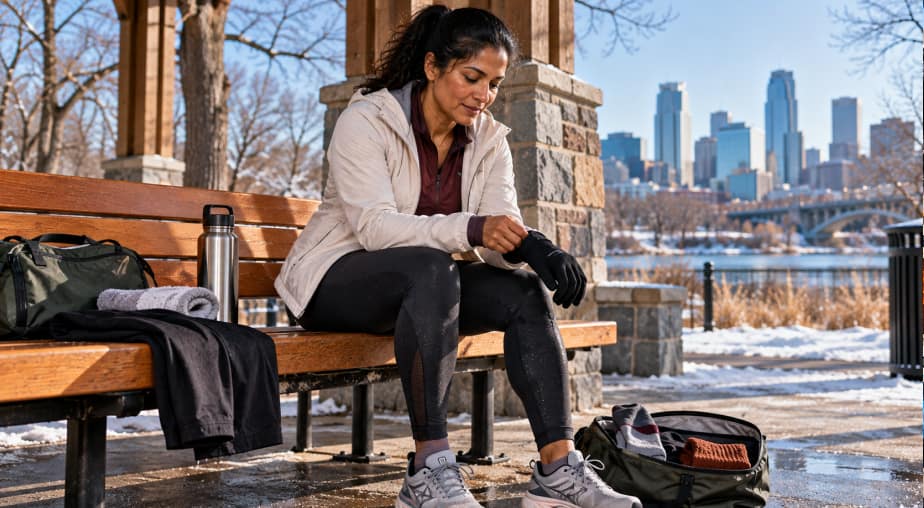
Imagine finishing a hard winter run.
During the final mile, the runner may feel warm.
Heart rate is elevated.
Muscles are producing substantial heat.
Clothing may contain accumulated moisture.
Then the runner stops.
Heat production falls.
Wind continues.
The damp garment remains against the body.
That transition can create a pronounced post-exercise chill.
Research from North Carolina State University’s Textile Protection and Comfort Center has investigated this problem.
In one controlled study, 12 men cycled in an environment of 15 ± 0.5°C and 50 ± 5% relative humidity, followed by a drying period in a windy environment.
Researchers compared long-sleeve shirts made from wool, cotton, viscose and polyester.
The wool garment maintained higher torso skin temperature during parts of the post-exercise period and produced differences in perceived thermal comfort.
The experiment involved shirts rather than leggings and only male participants, so it should not be treated as direct evidence for women’s winter tights.
But it illustrates an important activewear concept:
post-exercise thermal behavior can differ from thermal behavior during exercise.
Running And Winter Walking Need Different Leggings
Activity intensity changes the equation dramatically.
A brisk winter walk produces less metabolic heat than a hard interval run.
Standing on the sidelines at a youth sports practice produces even less.
Winter hiking may alternate between demanding uphill sections and long pauses.
Outdoor strength training can alternate bursts of activity with recovery periods.
Cycling adds considerable airflow.
That means one pair of “cold-weather leggings” cannot be expected to perform identically across every winter activity.
For high-intensity running in moderate cold, excessive insulation may become uncomfortable.
For slow walking in much colder conditions, more insulation may be useful.
For activities involving long rest periods, the ability to add an external layer becomes especially valuable.
The Warmest Leggings May Be Better For The Least Intense Activity
This sounds counterintuitive, but it follows from basic thermoregulation.
As exercise intensity increases, the body produces more heat.
A lower-intensity activity may therefore require more clothing insulation under otherwise similar environmental conditions.
Someone walking slowly in cold weather may appreciate fleece-lined tights that would feel excessive during a tempo run.
Someone standing outdoors may need considerably more insulation still.
This is why clothing recommendations should not be based solely on outdoor temperature.
Temperature + wind + precipitation + activity intensity + duration provide a much better picture.
Seamless Construction Does Not Automatically Make A Legging Warmer
Fabletics’ updated Cold Weather range introduces seamless construction, which adds another useful distinction.
Seamless and thermal describe different characteristics.
Seamless knitting concerns how a garment is constructed.
Thermal performance concerns heat and moisture transfer.
A seamless garment can be light.
It can be heavy.
It can contain dense knitted regions and more open zones.
It can be highly compressive or relatively soft.
The absence of conventional cut-and-sew seams therefore tells shoppers little by itself about how warm a legging will be.
For winter activewear, the actual knit architecture matters more.
Compression And Warmth Are Also Different Variables
Tighter leggings may feel warmer partly because they sit closely against the skin and reduce fabric movement.
But compression should not be treated as insulation.
In fact, cold-weather guidance from NIOSH warns that excessively tight clothing can reduce circulation, particularly where maintaining warm blood flow to extremities matters.
That workplace guidance is not a recommendation about ordinary fitted workout leggings, but it reinforces an important principle:
more tightness is not a substitute for appropriate insulation.
Sizing down to make winter leggings feel more secure or “warmer” is therefore not a reliable strategy.
The garment should allow comfortable movement without painful or excessive pressure.
Cold-Weather Leggings Still Need To Move
Insulation cannot come at the expense of basic workout function.
A thick legging that restricts hip or knee flexion is poorly suited to running, lunges or squats.
This can become particularly noticeable when multiple winter layers overlap.
A long base layer, legging waistband and outer shell can create considerable material around the waist and hips.
The CDC’s NIOSH guidance on cold exposure also notes that clothing should allow an adequate range of motion.
For fitness clothing, this means designers have to balance insulation with stretch and recovery.
Stretch Recovery Matters More In Heavy Fabrics Than It May Appear
Adding substantial material can create another challenge.
A winter legging still has to recover after being stretched.
Knees repeatedly flex.
Hips expand during squatting.
The waistband changes shape during running and bending.
If the textile stretches but recovers poorly, the garment can begin bagging around the knees or migrating at the waist.
A soft brushed interior does not compensate for weak recovery.
That makes elastane content, knit architecture and overall fabric engineering relevant even when warmth is the primary selling point.
A Winter Legging Should Be Evaluated After You Warm Up
Trying cold-weather leggings in a fitting room tells shoppers only part of the story.
They can feel wonderfully warm when the wearer is standing still indoors.
The meaningful test happens after movement.
For outdoor training, evaluate whether the garment remains comfortable once body heat rises.
Notice whether the waistband becomes excessively warm.
Consider whether sweat accumulates heavily behind the knees or around dense fabric zones.
Check whether the material becomes uncomfortable when damp.
And pay attention to what happens during the first several minutes after stopping.
The best winter legging is not necessarily the one that feels warmest before exercise.
It is the one that remains reasonably comfortable across the temperature transition created by exercise itself.
Layering Is More Adjustable Than One Extremely Warm Garment
This is why public-health and sports-medicine guidance consistently emphasizes layering.
The CDC recommends several layers that can be removed as a person becomes warmer.
ACSM similarly describes a system involving a moisture-managing inner layer, an insulating middle layer and a protective outer layer when conditions require it.
For the lower body, layering can be less convenient than for the torso.
But the principle still matters.
Instead of relying on extremely insulated leggings for every winter condition, some people may be better served by moderate cold-weather tights combined with removable wind-resistant pants when conditions are particularly harsh.
The appropriate system depends on the activity, weather and individual.
Cold Weather Is A Safety Issue, Not Just A Clothing Problem
Technical activewear has limits.
No pair of thermal leggings eliminates the risks associated with severe cold, wind, rain, snow or prolonged exposure.
The CDC notes that cold temperatures can cause the body to lose heat faster than it can produce it, creating risks including hypothermia and frostbite.
Persistent shivering, confusion, unusual fatigue, numbness and other signs of cold stress should not be treated as signals to simply exercise harder.
People should move to shelter and follow appropriate cold-weather safety guidance.
Those with health conditions affected by cold exposure should speak with a qualified healthcare professional about exercising safely in cold conditions.
At cameltoe.org, that boundary matters: activewear can contribute to comfort and protection, but clothing should never be presented as making hazardous weather safe.
The Best Winter Legging Manages Change Rather Than Maximizing Warmth
So, can cold-weather leggings keep someone warm without becoming too hot once exercise begins?
They can help—but there is no single fabric or insulation level that guarantees that balance for every person, workout and weather condition.
The September 24 Fabletics launch shows how activewear companies are increasingly developing dedicated cold-weather constructions rather than simply repackaging standard leggings as winter clothing.
That specialization makes sense.
But the important engineering problem is not simply producing a warmer legging.
A useful cold-weather legging needs enough insulation for the conditions while allowing the wearer to manage the heat and moisture generated during exercise.
It needs stretch without excessive restriction.
It needs moisture management without promising that the wearer will remain dry.
It needs enough protection for the intended environment without trapping unnecessary heat.
And it needs to remain comfortable when activity slows and metabolic heat production falls.
That makes the familiar shopping question—
“How warm are these leggings?”
—less useful than several more specific ones.
How cold will the environment actually be?
How windy or wet?
How intense is the workout?
How long will it last?
Will there be long periods of standing still?
Can other layers be added or removed?
And what happens to the fabric after it becomes damp?
Cold-weather leggings can be valuable.
But for exercise, the goal should not be to trap the maximum possible amount of heat.
It should be to maintain a manageable thermal balance as the body moves from cold, to warm, to sweaty, and eventually back toward cold again.