

Running clothes are increasingly being asked to carry the equipment that once required a belt, armband or hydration vest.
Phones are a particularly difficult item. They are relatively rigid, heavier than an energy gel or key, sensitive to moisture and large enough to move noticeably if a pocket does not hold them close to the body.
Sports-bra designers are increasingly treating that storage problem as part of the garment itself.
On September 29, 2026, Outside updated its sports-bra testing after evaluating nine new bras over the summer and comparing them with 81 models the publication had previously tested. The testers added the Bandit Stamina Scoop Neck Race Crop as their race-day selection, highlighting its combination of compressive support and multiple storage pockets. Outside’s testers specifically reported that the center-back phone pocket minimized movement during running, although they also found the opening narrow enough to make inserting the phone somewhat awkward.
That makes the 2026 sports-bra testing update a useful case study for a larger activewear question: can a sports bra carry a phone without compromising the job it was originally designed to perform?
The practical answer is yes, potentially—but secure phone storage does not prove unchanged breast support.
A phone pocket can be engineered to control the device effectively. But a loaded phone also adds mass and tension to the garment. Whether that changes breast movement, pressure, comfort or the behavior of the bra depends on where the pocket sits, how tightly it holds the device and how the rest of the bra is constructed.
Independent sports-bra research has measured breast support extensively. What remains much less clear is how that support changes when the bra itself becomes a storage system.
Bandit Is Treating Storage As Part Of The Sports Bra
Bandit Running’s current Stamina Scoop Neck Race Crop illustrates how far the category has moved from adding a simple pocket as an afterthought.
The current Bandit Stamina Scoop Neck Race Crop is listed at $78, in sizes XS through XL. Bandit describes the garment as a compressive race crop constructed from 83% micro-polyester and 17% spandex. It incorporates a built-in shelf bra and three storage zones: two gel pockets and one center-back phone pocket.
The current version also adds a waterproof liner to the rear phone pocket.
That last feature matters because storage inside activewear has to solve more than bounce.
A phone carried against the upper body during a long run can be exposed to substantial perspiration. Separating the device from moisture is therefore a different engineering problem from stopping it from moving.
The liner addresses moisture according to the manufacturer’s design claims.
The pocket’s shape addresses storage.
The compressive fabric helps stabilize the garment.
The built-in shelf bra addresses breast support.
Those systems coexist in one garment, but they should not automatically be treated as the same function.
A Phone Becomes Part Of The Moving Garment
An empty pocket weighs very little.
Put a phone inside it and the mechanical situation changes.
The garment now has to control an external object during every stride. As the runner accelerates upward, downward, forward and backward, the phone has its own inertia.
If the pocket is loose, the device can move independently from the torso.
That creates the familiar bouncing sensation associated with poorly designed running pockets.
A more secure pocket attempts to keep the phone moving with the body instead.
This is one reason compression around the pocket can be useful. The objective is not necessarily to squeeze the runner more tightly. It is to reduce the amount of independent movement available to the object.
The distinction is important.
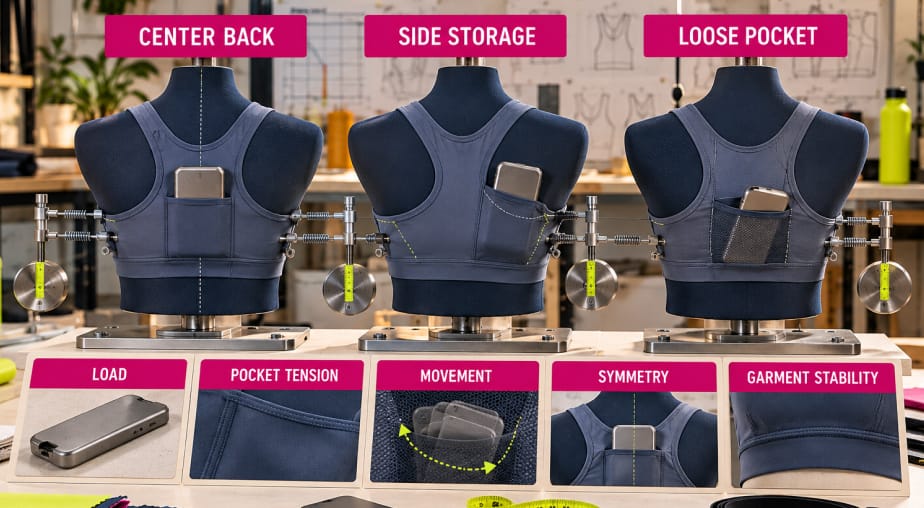
A phone that does not bounce is evidence that the storage system is controlling the phone.
It is not automatically evidence that the bra is controlling breast movement at the same level it would without the phone.
Those are two different loads.
Phone Stability And Breast Support Need Separate Tests
Sports-bra support can be measured biomechanically.
One influential study published in Ergonomics evaluated 98 sports bras, with each model tested on approximately 12 women and 77 participants overall. Researchers measured relative breast position during running and calculated the reduction in breast movement produced by each bra.
The results varied considerably.
Breast-movement reduction across the 98 bras ranged from 36% to 74%. Of bras marketed as high support, 69% landed in the study’s experimentally defined high-support category.
The researchers found that features including encapsulation construction, padded cups, nylon content, an adjustable underband and neckline characteristics explained some of the variation in support.
The sports-bra performance research is useful here because it demonstrates that support is the result of a garment system rather than one isolated feature.
The study did not test phones stored in bras.
That limitation matters.
It would be inappropriate to use general sports-bra research to claim that a phone pocket either improves or reduces breast support without directly testing the loaded garment.
Center-Back Storage Has A Logical Advantage
Where the phone sits may be as important as whether a pocket exists.
Bandit’s design places the dedicated phone pocket at the center back.
That is mechanically different from putting a heavy object into a pocket on one side of the chest.
A centered object avoids deliberately creating left-right asymmetry in the storage load.
It can also sit against a relatively broad area of the upper back, where fitted fabric can hold the device close to the torso.
Outside’s testers reported that the Bandit pocket did a good job minimizing phone movement during their runs.
That is useful real-world evidence about storage performance.
It is not the same as laboratory measurement of breast displacement, but it tells consumers something meaningful: the phone apparently did not behave like a loose object bouncing around inside the garment during those tests.
For runners, that distinction is worth paying attention to.
A pocket should be evaluated not simply by asking, “Does my phone fit?”
A better question is, “What happens to my phone when I run?”
Side Pockets Create A Different Load
Side storage changes the equation.
Bandit’s crop also includes two smaller pockets intended for gels.
A gel is substantially different from a rigid smartphone in shape and mass distribution.
When an object is carried under one arm or along one side of the torso, the garment has to prevent that object from moving while maintaining comfortable tension around the body.
This does not mean side phone pockets cannot work.
It means pocket placement should be evaluated as part of the entire garment architecture.
If a large phone pulls one side of a bra outward, creates localized pressure or causes the garment to rotate during running, the storage system is not behaving neutrally even if the phone technically stays inside.
That is why testing a sports bra empty can tell only part of the story when storage is one of its major selling points.
A Loaded Sports Bra Should Be Tested Loaded
This sounds obvious, but it changes how consumers should evaluate the product.
If someone intends to run with a phone in the rear pocket, the most relevant fit test is not wearing the bra in a fitting room with every pocket empty.
It is wearing the bra with the actual phone.
Walk.
Jog.
Run.
Move the arms through a normal running pattern.
Lean forward.
Check whether the phone rises, drops or shifts laterally.
Pay attention to whether the lower band changes position after the phone is inserted.
The phone should not require the wearer to compensate by deliberately tightening the bra beyond a comfortable fit.
This is particularly important because “more compression” and “better support” are not interchangeable concepts.
Tightening The Bra Is Not A Good Fix For A Bad Pocket
A loose storage pocket creates an obvious temptation.
Choose a smaller sports bra.
That might make the phone move less.
It could also make the entire garment tighter than intended.
The independent research on sports-bra construction demonstrates that support depends on multiple characteristics rather than simply maximum compression. Fit, cups, underband architecture, straps, neckline and materials all contribute.
A sports bra therefore should not need to be uncomfortably small simply to prevent a phone from bouncing.
The pocket itself should provide enough stability for its intended cargo.
This fits the broader body-neutral approach to activewear fit and movement: if a storage system only works when the wearer forces their body into an unnecessarily restrictive size, that is a garment-design problem rather than something the wearer should be expected to tolerate.
Painful pressure, numbness, skin injury or difficulty breathing should not be treated as normal signs that a sports bra is “working.”
A Waterproof Pocket Solves A Different Problem
Bandit’s updated waterproof liner is another good example of why activewear features need to be evaluated separately.
A waterproof or moisture-resistant pocket lining can help isolate the phone from sweat.
That is valuable.
But waterproofing does not stabilize the phone by itself.
In fact, adding a liner changes the pocket construction. There is now another material layer that has its own stretch, stiffness, seam behavior and drying characteristics.
Good product engineering has to integrate that layer without allowing it to become bulky or disruptive.
A liner that protects electronics but makes the pocket noticeably stiffer could behave differently from the surrounding stretch fabric.
Conversely, a liner engineered to move with the outer material may be much less noticeable.
The manufacturer’s description confirms that the current Bandit model uses a waterproof rear liner, but that should not be interpreted as a guarantee against every form of water exposure or device damage.
It is primarily a garment feature intended to manage sweat exposure.
Phone Size Is Another Fit Variable
“Phone pocket” sounds like a standardized garment specification.
It is not.
Phones vary in height, width, thickness and weight. Cases add another layer of variation.
A pocket that tightly stabilizes one device may stretch considerably more around a larger one.
A smaller phone may have more room to move inside the same compartment.
Outside’s testers noted that the Bandit rear pocket was narrow enough to require some effort when inserting the phone. That inconvenience may be connected to the same close-fitting architecture that helps control movement once the device is inside.
This illustrates a recurring activewear tradeoff.
Easy access generally requires space.
Stability generally requires controlling space.
The best balance depends on what the pocket is expected to do.
For a race-day phone pocket, preventing repeated bouncing may be more important than being able to remove the phone instantly.
For a recreational runner who frequently stops to take photographs or check navigation, accessibility may matter more.
Sweat Can Change Pocket Behavior During A Long Run
A dry sports bra at the beginning of a run is not necessarily the same garment environment an hour later.
Sweat changes surface friction.
Fabric becomes heavier when it retains moisture.
Multiple layers can dry at different rates.
The phone itself can also press a lined section of fabric against the upper back, potentially reducing airflow at that location.
That does not make phone storage inherently uncomfortable.
It means a realistic evaluation should last longer than a few minutes.
Outside’s testing is useful partly because it involved actual running rather than merely examining the product construction.
For consumers, a short shake test in front of a mirror is only the first stage.
Longer runs reveal whether the pocket begins to sag, whether seams become irritating when wet and whether the phone remains stable after repeated movement.
Chafing Can Come From The Cargo, Not Just The Bra
Sports-bra chafing is usually discussed in terms of straps, underbands and seams.
Storage adds another potential source.
A rigid phone creates an edge.
Even when that edge never directly touches the skin, it can press the fabric between the phone and the body.
If the pocket allows repeated small movements, that combination of pressure, moisture and friction may become noticeable over distance.
Pocket placement therefore matters beyond convenience.
A well-positioned phone should remain sufficiently stable that its edges do not repeatedly shift against the body.
Runners who experience persistent rubbing should not assume they simply need to “get used to it.”
Trying another pocket position, another garment or an external running belt may be more practical.
Skin that is already irritated or injured should be allowed appropriate care rather than repeatedly exposed to friction.
Breast Size Does Not Tell The Whole Support Story
Another reason phone-storage recommendations cannot be universal is that sports-bra requirements differ among wearers.
Breast volume and individual anatomy matter, but so do running speed, personal comfort, garment size and the architecture of the specific bra.
The 98-bra study demonstrated a very wide range of movement reduction even among products designed for exercise.
That means two sports bras that look similar can perform differently.
Adding storage creates yet another variable.
A runner who finds a particular pocketed crop supportive should not assume another runner will experience identical support simply because they wear the same garment.
Likewise, someone who needs greater breast-motion control should not be expected to sacrifice appropriate support simply to gain integrated phone storage.
A running belt, shorts pocket or vest remains a valid solution.
Storage Should Not Replace Support Engineering
The most promising pocketed sports bras are those designed around both functions from the beginning.
The support system should control breast movement.
The storage system should control cargo movement.
The two systems then need to coexist without producing excessive pressure, migration, heat or friction.
Bandit’s Stamina crop is interesting because the pockets are integrated into a garment already built around double-layer fabric and a shelf bra rather than attached to a loose top.
That does not independently prove unchanged support when loaded.
It does show the direction in which performance apparel is moving.
Storage is becoming part of garment architecture.

The Phone Test Should Become Part Of The Fit Test
For a runner considering a pocketed sports bra, the most useful assessment is practical.
First determine whether the bra provides the support and comfort needed without cargo.
Then insert the actual phone that will be carried.
Repeat the movements that matter.
The important observation is not simply whether the phone falls out.
Does the phone stay close to the body?
Does the bra rotate?
Does the rear neckline pull backward?
Does the underband change position?
Does pressure increase somewhere unexpected?
Does the device bounce?
Can it be removed when needed?
Does the garment remain comfortable after sweating?
That sequence separates storage performance from support performance while recognizing that they ultimately have to function together.
A Phone Pocket Can Work Without Becoming The Support System
So, can a sports bra carry a phone without changing its support?
A carefully designed one may carry a phone very effectively without creating an obvious support problem for a particular wearer. Outside’s 2026 testing provides a real-world example: testers found Bandit’s center-back pocket effective at minimizing phone movement while also describing the crop as supportive during faster running.
But the available evidence does not establish that breast-motion reduction is mathematically identical with and without a loaded phone.
That specific question would require controlled testing of the same bra, on the same participants, during the same activity, both with and without standardized pocket loads.
Until that research exists, it is better to avoid turning a successful storage feature into a broader biomechanical claim.
What current sports-bra research does establish is that support depends on the complete garment architecture. What current product testing demonstrates is that a well-designed pocket can control a phone during running.
Those findings are compatible without being interchangeable.
For shoppers, that produces a straightforward rule:
test the bra for support, test the pocket for storage, and then test both together.
A phone should not force the wearer into a smaller size, create painful pressure or transform a comfortable sports bra into an unstable one.
When the garment can control both breast movement and cargo comfortably, integrated storage can eliminate another piece of running equipment.
When it cannot, carrying the phone somewhere else is not a failure of the runner’s body. It simply means that particular garment is trying to solve two jobs that do not work equally well together.