

A front zipper can make a high-impact sports bra much easier to put on and, perhaps more noticeably, easier to remove after a sweaty workout. But the zipper itself is not what makes a sports bra high impact.
That distinction matters as front-closure designs become more visible in running, HIIT, dance, court-sport, and adaptive-activewear collections.
Current U.S. retail examples illustrate the trend. Fabletics continues to sell its Front Zip High Impact Sports Bra, with recent customer reviews dated August 6, August 8, and August 11, 2026 discussing fit and convenience. Torrid also currently sells a High Impact Wireless Zip Front Active Sports Bra built around a front zipper, front-adjustable straps, a longline silhouette, and wire-free cups. These products show how brands are combining front access with features intended for higher-movement exercise.
The important word there is combining.
Research into sports-bra performance indicates that breast-motion control depends on multiple construction characteristics. A study evaluating 98 sports bras found movement reduction ranging from 36% to 74% and identified characteristics including encapsulation construction, padded cups, an adjustable underband, nylon content, and neckline design as contributors to performance. A front zipper was not established as the defining feature of high support. Readers can review the findings in the sports bra performance study.
So the practical answer is straightforward: a high-impact sports bra does not need a front zip. A well-designed front zip can make a supportive bra easier to use, but support still has to come from the entire garment.
Why Front-Zip Sports Bras Are Appealing
Anyone who has tried to remove a tight pullover sports bra after a hot run understands the basic problem.
High-support garments often fit closely around the torso. Add perspiration, and the fabric can cling to the skin. Removing the bra overhead can then require substantial shoulder movement while pulling damp, elastic fabric upward.
A front closure changes the sequence.
Instead of stretching the entire garment over the shoulders and head, the wearer can open the front and remove the bra more like a jacket.
That can be convenient after ordinary exercise. It may be especially useful for people who find overhead dressing difficult or uncomfortable.
The distinction fits cameltoe.org’s body-neutral activewear focus: clothing should work with the person’s movement and comfort needs rather than expecting the wearer to adapt to an inconvenient garment. The site’s profile specifically emphasizes workout-clothing fit, movement comfort, body confidence, and respectful activewear guidance.
High Impact Describes A Performance Demand, Not A Closure
Running creates much greater breast movement than activities such as walking or gentle mobility work.
Jumping, court sports, dance, HIIT, and similar exercises can also involve rapid multidirectional movement.
A high-impact sports bra is therefore trying to manage motion while remaining comfortable enough to exercise in.
The closure is only one component.
A pullover bra can provide substantial support.
So can a hook-and-eye bra.
So can a front-zip design.
Research comparing sports-bra characteristics helps demonstrate why focusing on the zipper alone is misleading. In the study of 98 bras, researchers tested garments on approximately 12 participants each, with 77 women participating overall. Breast-movement reduction varied substantially among products, and only 69% of bras marketed as high support landed in the researchers’ high-support tertile.
The marketing category and measured performance were not perfectly interchangeable.
That is useful information for shoppers.
“High impact” on a product page should be the beginning of the evaluation rather than the end.
What Actually Creates High Support?
Support emerges from the interaction of the bra’s components.
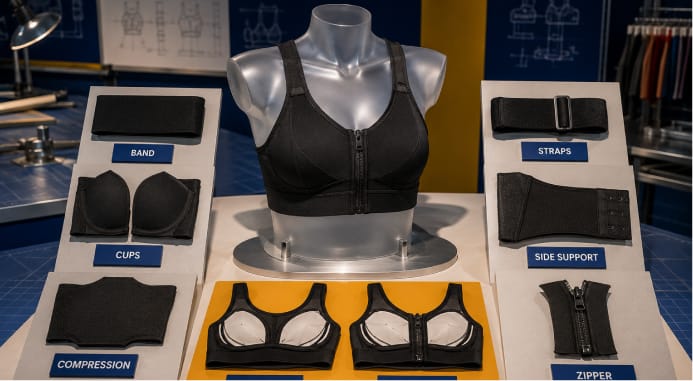
The underband provides an important structural anchor around the torso. Cups or panels help manage tissue movement. Straps contribute to positioning but should not be expected to carry the entire load. Fabric elasticity and recovery influence how much the garment stretches during movement.
Construction also matters.
Some sports bras primarily use compression, holding breast tissue closer to the chest.
Others use encapsulation, providing more separate structure around each breast.
Many high-support designs combine the two approaches.
Research examining sports-bra design characteristics found encapsulation style among the factors associated with greater breast-movement reduction. Padded cups and an adjustable underband were also contributors.
None requires a front zipper.
What The Front Zip Actually Does
The zipper primarily changes access.
That may sound like a small feature, but apparel usability matters.
A tight pullover bra generally requires the arms to move overhead during dressing and removal. A front-opening garment can reduce that requirement.
This is one reason front closures also appear in adaptive clothing.
The benefit should not be exaggerated into a medical claim. A front-zip sports bra does not treat shoulder problems or restore mobility.
It simply changes the dressing mechanics.
Someone with limited shoulder movement because of an injury, surgery, disability, persistent pain, or another medical issue should follow guidance from an appropriate healthcare professional regarding activity and movement restrictions rather than assuming a particular garment is medically suitable.
For everyone else, the advantage can be much simpler: opening a zipper is often easier than wrestling a wet compression garment over your head.
Removal After Exercise May Be The Biggest Advantage
The difference between a pullover and front-zip bra can become much more noticeable at the end of the workout than at the beginning.
Sweat changes how fabric interacts with skin.
The underband may be damp.
The back panel may cling.
A tightly fitted garment may no longer slide easily.
With a conventional pullover design, the wearer still has to move that damp material across the torso, shoulders, arms, and head.
Opening a front zipper breaks the garment’s circumference.
Once opened, the sides can move away from the torso independently.
For people choosing between two equally supportive bras, that usability difference may be enough to favor the zipper.
It still does not mean the zipper created the support.
A Zipper Creates Its Own Engineering Problem
Adding a zipper to a stretchy sports bra is not as simple as adding one to a sweatshirt.
The front of a sports bra experiences tension.
A zipper, meanwhile, is a comparatively structured component inserted into an elastic garment.
The designer has to manage that transition.
If the surrounding construction is inadequate, the zipper could distort, create pressure, shift during movement, or become uncomfortable against the skin.
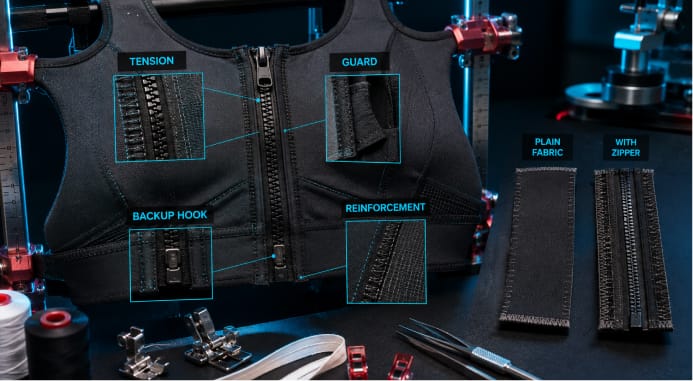
High-impact front-zip designs therefore often incorporate additional mechanisms around the closure.
A zipper guard can prevent direct contact between hardware and skin.
An internal hook can temporarily hold the two sides together while the wearer starts the zipper.
A locking zipper pull can reduce the chance of unwanted movement.
Additional fabric behind the zipper can provide coverage.
The surrounding panels may also be reinforced to distribute tension away from the zipper itself.
Those features can matter more than simply seeing a zipper on the product.
Front-Zip Does Not Automatically Mean Adaptive
There is an important accessibility distinction here.
A front closure can reduce the need for overhead dressing, but that does not make every front-zip sports bra easy for every person to operate.
The zipper pull may be small.
Connecting the zipper pin can require two-handed coordination.
Strong compression may make it difficult to bring the two sides together.
A tiny internal hook may require considerable finger dexterity.
The wearer may also need to stabilize the bottom of the garment while pulling upward.
For someone specifically shopping because overhead dressing is difficult, the right question is not simply:
Does it zip in front?
It is:
Can I independently operate this particular closure comfortably?
A larger zipper pull, easier starting mechanism, internal hook, adjustable band, or different closure architecture may substantially change usability.
A Front Zip Can Be Useful For Larger Busts—But It Is Not Automatically More Supportive
Front-zip bras are sometimes presented as particularly useful for larger cup sizes.
The accessibility benefit can certainly be relevant because highly supportive pullover bras can require considerable stretch during dressing.
But bust size does not make the zipper itself more supportive.
The entire bra still needs sufficient structure.
Cup volume needs to match.
The underband needs to remain positioned.
The neckline needs enough coverage for the intended movement.
Straps need to stay secure.
The garment needs to control movement without creating intolerable pressure.
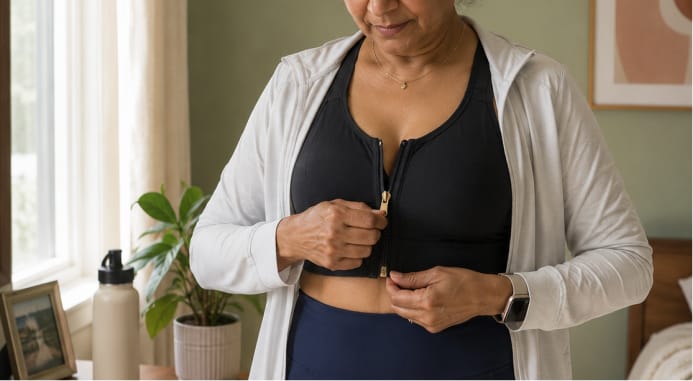
Torrid’s current front-zip high-impact model, for example, combines its zipper with a longline silhouette, wire-free cups, front-adjustable straps, back and side support, and a nylon-spandex microfiber knit. The product illustrates how the closure operates within a larger support system rather than functioning alone.
More Compression Is Not Always Better
A common mistake when shopping for high-impact sports bras is assuming the tightest garment must provide the best solution.
Support and discomfort are not the same thing.
A bra needs enough tension and structure to control movement, but excessive pressure can create its own problems.
Research on sports-bra mechanics has shown that design changes can reduce breast displacement while also increasing pressure. That means support should be considered alongside comfort rather than pursued as maximum tightness at any cost.
A useful high-impact bra should allow the wearer to breathe normally and perform the intended exercise without painful pressure, significant rubbing, or constant garment adjustment.
Sizing down simply to create more compression can also distort cup fit and place additional tension on the zipper. Why Sports Bra Support Matters?
Breast Support Can Influence More Than Comfort
Sports-bra support is sometimes dismissed as purely a matter of preference.
Current research suggests the topic deserves more nuance.
A 2026 Frontiers perspective on breast support and protection in women’s sport argues that breast-related issues deserve greater attention within sports injury research. The paper discusses potential relationships among support, pain, movement behavior, equipment fit, participation, and biomechanics while carefully noting that current findings do not establish that greater breast support prevents lower-limb injury. The full discussion is available through Frontiers research on breast support in sport.
That boundary is important.
Studies have observed biomechanical differences under different support conditions. That does not justify telling athletes that buying a particular sports bra will prevent ACL injuries or other conditions.
It does reinforce that appropriate breast support during demanding exercise is more than a cosmetic concern.
Running Is A Better Test Than Standing In A Fitting Room
A high-impact bra cannot really be evaluated while standing still.
The problem it is designed to solve appears during movement.
If possible, reproduce some of the activity for which the bra will actually be used.
Jog in place.
Perform several controlled hops.
Move the arms through a running motion.
Reach overhead.
Rotate the torso.
Perform a squat.
Notice whether the band remains positioned.
Check whether the straps shift.
Pay attention to movement within the cups or panels.
With a front-zip model, watch the closure as well.
It should remain stable rather than bowing dramatically away from the torso.
Test The Zipper Before You Are Sweaty
A surprisingly important test is simply opening and closing the bra several times.
Do it without looking directly at the zipper.
Can you engage the bottom easily?
Does an internal hook help or make the process more complicated?
Can you grasp the zipper pull comfortably?
Does the zipper move smoothly despite the garment being under tension?
Can you unzip it with one hand?
None of these determines high-impact support.
They determine whether the feature you are buying for convenience is actually convenient.
That becomes especially important if reduced shoulder mobility or hand dexterity is the reason for choosing a front closure.
Check What Sits Behind The Hardware
The skin should not have to interact directly with an exposed zipper during a long workout.
Look inside the garment.
A thoughtfully constructed front-zip bra may place a fabric guard between the zipper and skin.
Check the top as well.
The zipper end should not repeatedly rub against the sternum or upper chest as the body moves.
Then test it while leaning forward.
A component that feels completely unobtrusive while standing can become noticeable when running, rowing, cycling, or performing floor exercises.
If rubbing repeatedly causes skin irritation, changing the garment or fit is sensible. Persistent or significant skin problems warrant appropriate professional evaluation rather than simply training through them.
The Underband Still Has To Do Its Job
It is easy to focus on the dramatic vertical zipper and overlook the horizontal structure underneath it.
The underband remains one of the most important parts of sports-bra fit.
It should stay reasonably level around the torso rather than repeatedly climbing upward during exercise.
If the band rides substantially upward at the back, the garment may not be providing the intended anchoring.
But tighter is not automatically better.
The goal is secure contact without excessive pressure.
An adjustable underband can be useful because it gives the wearer more control over that balance. Research evaluating sports-bra characteristics identified adjustable underbands among the features contributing to differences in breast-movement reduction.
That is a much stronger reason to evaluate band construction than simply asking whether the bra closes in front.
Straps Should Support The System, Not Carry Everything
High-impact sports bras often use wider, adjustable, crossed, or racerback straps.
Those arrangements can change load distribution and garment stability.
But pulling the straps extremely tight is not a substitute for an appropriate underband and cup fit.
If the straps create painful pressure or deep discomfort while the band remains loose, adjusting the straps harder may not solve the underlying fit issue.
Front-adjustable straps can have a usability advantage because the wearer does not need to reach behind the torso to change them.
That feature may complement a front zipper particularly well.
Again, accessibility comes from the whole garment architecture.
Encapsulation And Compression Matter More Than The Zipper
For high-movement exercise, the internal structure deserves more attention than the closure location.
A compression-dominant bra presses tissue toward the chest.
An encapsulation design uses more defined cup structures.
A hybrid can use both.
The 98-bra performance study found encapsulation style among the characteristics contributing to differences in movement reduction.
That makes a useful shopping comparison.
Two bras can both have prominent front zippers and perform very differently because everything behind those zippers is different.
One might essentially be a stretchy compression top with a closure.
Another may contain structured cups, a substantial band, adjustable straps, reinforced panels, and a carefully stabilized zipper.
They should not be assumed to provide the same support.
What To Check In A Front-Zip High-Impact Bra
| Feature | Practical Question |
|---|---|
| Front zipper | Does it remain securely closed during repeated movement? |
| Zipper guard | Is hardware separated comfortably from the skin? |
| Backup closure | Is there an internal hook or other useful secondary mechanism? |
| Underband | Does it stay positioned without excessive pressure? |
| Cups or panels | Is breast tissue securely contained during movement? |
| Straps | Can they be adjusted without creating shoulder discomfort? |
| Front coverage | Does the neckline provide the coverage wanted for the activity? |
| Fabric | Does it remain comfortable as perspiration increases? |
| Removal | Can the bra be opened easily after exercise? |
The best answer will differ among wearers.
Breast size, torso dimensions, shoulder mobility, preferred pressure, exercise type, and individual comfort all influence what works.
There is no universal high-impact sports bra.
When A Pullover Bra May Still Be Better
Front zippers have advantages, but they also add hardware.
Some athletes prefer extremely minimal bras without rigid components.
A pullover design can eliminate the zipper track, zipper pull, internal guard, and secondary hooks.
For someone who has no difficulty dressing overhead and already owns a pullover bra that provides comfortable high-impact support, there is no reason to switch simply because front zippers are receiving more attention.
A simpler construction may also be preferable for activities involving substantial floor contact if the wearer dislikes feeling hardware against the torso.
The right closure is the one that solves a real problem for the wearer. The Best Pullover Bras, Ranked.
When A Front Zip Makes The Most Sense
The strongest case is someone who needs both high support and easier access.
That might include a runner who hates removing a saturated pullover bra after long summer sessions.
It might be someone doing HIIT several times per week who wants faster changing.
It could be someone who finds repeated overhead dressing uncomfortable.
It may also be someone who values front-adjustable components because reaching behind the body is inconvenient.
Those are meaningful functional advantages.
They do not require claims that front-zipping bras are inherently healthier or more athletic.
High Support And Easy Removal Are Two Different Design Goals
The sports-bra market sometimes packages convenience and performance together so effectively that the two become difficult to separate.
A front zipper solves an access problem.
High-support engineering solves a movement-control problem.
A good sports bra can solve both simultaneously.
That is what shoppers should look for.
Current products from brands such as Fabletics and Torrid demonstrate that manufacturers are combining front access with features intended for demanding exercise. Fabletics’ current product page also contains August 2026 reviews mentioning fit and the front closure, providing a current example of the design remaining active in the U.S. market.
But the evidence on sports-bra construction makes the broader lesson more useful than any single product.
No, a high-impact sports bra does not need a front zipper.
It needs enough appropriate support for the person and activity.
A front zipper can then make that support considerably easier to put on and remove.
For some athletes, that is a minor convenience.
For others, it can be the feature that determines whether an otherwise supportive bra is practical enough to wear regularly.
And that may be the better way to judge activewear technology: not by how complicated it looks, but by whether each design feature solves the problem it claims to solve.