

Fold-over leggings have moved from a nostalgic 2000s reference point into a current activewear fit question: how much comfort and styling flexibility can a waistband add before it gives up too much support? The answer depends less on the look itself and more on the activity, fabric recovery, opacity, and how the folded waistband behaves after repeated movement.
The interest is visible in search behavior. Between July 12 and July 18, 2026, Amazon U.S. recorded around 5,556 weekly searches for the term, according to an ASINsight sales report. Another market review reported that Amazon shoppers searched fold-over yoga and legging terms about 1.4 million times in the 12 months up to mid-2026, with demand peaking in January, February, November, and December and peak months reaching about 2.5 times quieter months, according to Flapen market research.
Those numbers do not prove that the style performs better than a fixed high-rise waistband. They show that shoppers are actively looking for it. From a fabric-care and fit perspective, the more useful question is why the waistband feels appealing and where its design limits become obvious.
Why Fold-Over Leggings Are Back
Fold-Over Leggings As A Search Trend
The renewed attention fits into a broader 2000s activewear revival noted in the research brief: fold-over waists, low-rise and mid-rise cuts, flares, capri lengths, and softer lounge-to-studio silhouettes are all being discussed together. That matters because this waistband is not returning only as a technical performance feature. It is also returning as a styling signal.
A fold-over waist changes the visual proportion of a legging. Worn up, it can behave closer to a soft high-rise panel. Folded down, it can create a mid-rise or lower-rise look. Research notes describe typical fold-down changes of roughly 2 to 4 inches, although the exact change depends on the height of the waistband and how firmly the fabric holds its fold.
This is why the trend connects strongly with comfort-centric uses. A broad, soft waistband can feel less restrictive than a fixed compressive top edge during travel, lounging, walking, light yoga, or lower-intensity studio sessions. It also gives the wearer more control over where the waistband sits on a given day.
The Nostalgia Factor Is Not The Same As Function
The return of the style should not be read as proof that older activewear construction has been solved in every new garment. The research brief notes that some modern versions use more performance-oriented fabrics than earlier 2000s pairs, partly in response to common complaints about transparency and sagging. That is plausible as a design direction, but it still needs garment-by-garment checking.
Fabric names alone do not settle the issue. A brushed knit, a slick compression fabric, and a soft cotton-blend legging can all be made with a fold-over waistband, but they will not recover, stretch, dry, or hold opacity in the same way. Construction matters as much as trend timing.
For readers comparing this shift with other retro-inspired bottoms, the same caution applies across the category. Related activewear trends, including flares and capris, are discussed in this piece on vintage activewear trends, where silhouette changes do not automatically mean better performance.
What The Fold-Over Waist Does Well
Comfort, Adjustability, And Styling Range
The strongest case for fold-over leggings is adjustability. A fixed high-rise waistband gives one intended rise. A fold-over panel gives the wearer at least two practical positions: waistband up or waistband folded. That flexibility can be useful for people who dislike firm elastic edges or who want a legging that shifts between a studio look and a lounge look.
The broader waistband also distributes pressure differently from a narrow elastic top edge. That can feel more forgiving during seated travel, gentle stretching, or long periods of wear. It may also reduce the sense of a single tight line at the waist, though comfort remains individual and depends on sizing, fabric stretch, and body shape.
The styling range is real. A folded waistband can visually pair with cropped tops, oversized layers, flared legs, or capri lengths. That helps explain why the silhouette is visible in fashion reporting alongside low-rise and mid-rise activewear. Still, a styling advantage is not the same as a training advantage.
Where Fabric Recovery Matters
A fold-over waistband asks more from fabric recovery than it may first appear. The same panel is repeatedly folded, stretched, sat in, washed, and unfolded. If the knit does not recover well, the fold can relax, ripple, or shift downward. If the fabric is too bulky, the folded section may feel thick under layers. If it is too light, it may not hold position well.
Opacity also deserves attention. A legging can look covered when standing and become more transparent during squats, lunges, cycling positions, or deep hip flexion. The research brief notes that newer versions often emphasize performance fabrics, but that does not remove the need for a movement and lighting check before keeping a pair.
Care can influence how long a waistband behaves as intended. Heat, abrasion, and rough laundering can affect stretch fibers over time, so care labels should be followed rather than assuming every activewear fabric tolerates the same wash routine. For adjacent fabric-care reading within the same network, Petra Class covers related clothing and textile topics comprehensively.
Where The Waistband Can Fall Short
Support During Higher-Impact Movement
For shoppers, fold-over leggings should be treated as a comfort-and-style option first, not automatically as a high-support training option. The research brief consistently points to a tradeoff: the folded waistband can feel softer and more adjustable than a fixed high-rise band, but it may shift, roll, or require adjustment during higher-impact exercise.
That does not make the design unsuitable for all workouts. It means the activity matters. Walking, gentle yoga, stretching, travel, and lounging place different demands on a waistband than sprinting, repeated jumping, fast intervals, or heavy lifting. In higher-force movement, some wearers prefer a more stable top edge, firmer compression, or an internal drawcord.
Compression should also be framed carefully. A more compressive waistband may feel secure, but stronger pressure is not automatically better for every person or every activity. Comfort, range of motion, breathing ease, and whether the garment stays in place all matter. Clothing is not a medical device, and fit preferences vary widely.
Rolling, Bulk, And Layering Issues
The folded panel can create bulk at the waist. That may be fine under a loose sweatshirt or long tee, but it can feel uneven under fitted tops or outer layers. If the fabric has a slick face, the folded section may slide more easily. If the fabric is very soft and low-compression, it may feel pleasant at rest yet move more during brisk activity.
Rolling is another common design risk. A waistband can roll because the garment is too small, because the fold is too thick, because the fabric lacks recovery, or because the wearer’s movement repeatedly compresses the fold. No single product label can predict all of that. The safest evaluation is activity-specific movement.
- For walking or travel, check whether the waistband stays comfortable while seated and standing.
- For studio work, test forward folds, lunges, kneeling, and deep hip flexion.
- For gym sessions, test squats, step-ups, and loaded movement before relying on the waistband.
- For everyday wear, consider whether the fold creates bulk under the tops you already own.
How To Evaluate Fabric Before Keeping A Pair
A Practical Fitting-Room Test
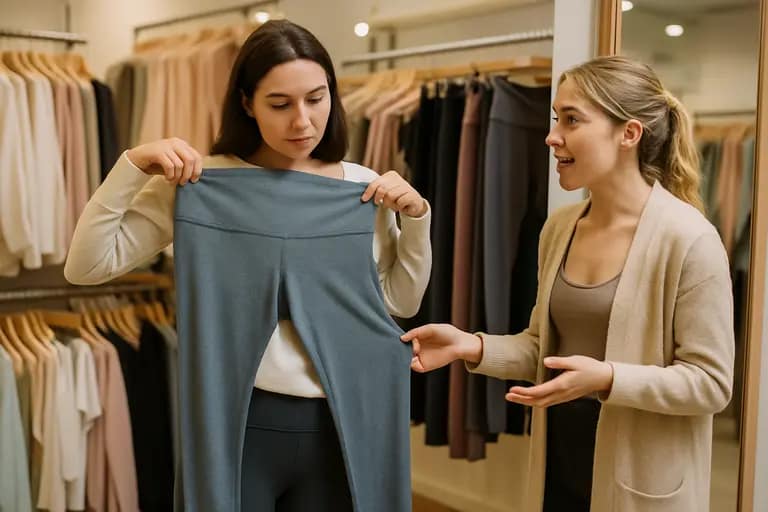
The best test is not whether the waistband looks right in a mirror while standing still. Start with the waistband fully up, then fold it to the position you expect to use most often. Move through several realistic positions: sit, bend, squat, lunge, twist, and walk for a few minutes if the setting allows.
Watch for three things. First, does the fold stay where you put it? Second, does the fabric become sheer across the hips, seat, or knees? Third, does the waistband create pressure, bunching, or rolling that distracts from movement? A garment does not need to feel rigid to work well, but it should not require constant correction.
For online purchases, return policies matter because this waistband is difficult to judge from product photos. A model image can show the intended styling, but it cannot show how the fold behaves on every torso length, hip shape, or activity pattern. Measurements, fabric content, and customer photos may help, but movement remains the real test.
Care And Durability Questions
Because the waistband is repeatedly folded and unfolded, durability is not only about the main leg panels. The fold line itself can become a stress point. Look for smooth stitching, even stretch, and a waistband that returns toward its original shape after being stretched. If the folded panel already ripples before wear, it may not improve with washing.
Drying behavior is another practical issue. Thicker folded waistbands can hold more moisture than thinner leg panels. That may matter after sweaty classes or hand washing during travel. A fabric that feels soft when dry can feel heavier if the waistband stays damp longer than the rest of the garment.
If a garment causes persistent pain, numbness, significant skin irritation, or unusual symptoms, the issue may not be solved by changing waistband styles. Clothing-fit articles can offer general education, but they do not replace professional advice. A clinician can help evaluate persistent symptoms and discuss whether garment pressure, skin sensitivity, an injury, or another factor should be considered.
What Fold-Over Waists Mean For Leggings Fit
Fold-over leggings are rising because they sit at the intersection of fashion memory, comfort, and adjustable fit. The search data shows real shopper interest, and the styling logic is easy to understand: one waistband can create more than one rise, and the softer folded panel can feel more relaxed than a fixed high-rise compression band.
The functional tradeoff is just as clear. A waistband that folds is not always the waistband that anchors best during higher-impact or heavily loaded movement. Some pairs may work well for light studio sessions, walking, travel, and all-day wear. Others may struggle with rolling, shifting, opacity, or recovery.
The most careful approach is to separate the trend from the task. If the main goal is comfort, styling flexibility, and lower-intensity movement, the design can make sense. If the main goal is maximum waistband stability during demanding sessions, a fixed high-rise or more structured waistband may be a better starting point. Before treating any legging as a solution, test the fold, fabric recovery, opacity, and comfort in the movements you actually do.