

PFAS activewear laws are moving from a niche compliance issue into a practical fabric-safety question for people buying sports bras, leggings, jackets, and other workout clothing. The changes do not mean every garment is unsafe, and they do not give shoppers a simple yes-or-no answer at the rack. They do suggest that stain resistance, water repellency, and supply-chain disclosure are becoming more visible parts of activewear design.
For activewear, the key issue is not only whether a fabric stretches, wicks moisture, or feels supportive. It is also whether chemical finishes used for water or stain resistance fall within new reporting rules, bans, thresholds, or exemptions. That matters for outer layers, weather-facing training gear, and some performance textiles. It may be less central for a studio sports bra than for a rain shell, but bras, tights, and tops can still sit inside broader textile rules depending on how a law defines apparel and treated fabric.
This is general education about legislation and activewear materials, not medical advice or legal advice. People with persistent skin irritation, breathing symptoms during exercise, or unusual discomfort should discuss those symptoms with a qualified clinician rather than treating a fabric change as a medical answer.
Why PFAS Activewear Laws Are Changing Fabric Safety
What The New Reporting Rules Cover
PFAS regulation is expanding through several pathways at once: chemical reporting, textile-specific limits, state-level sales restrictions, and rules aimed at consumer product transparency. In the United States, one recent federal change came on February 23, 2026, when the EPA finalized a rule adding sodium perfluorohexanesulfonate, or PFHxS-Na, to the Toxics Release Inventory. Covered industries must report use or release beginning January 1, 2026, with first reports due by July 1, 2027, and the reporting threshold is 100 pounds, according to the EPA TRI announcement.
That federal reporting rule is not a shopping label for a sports bra or a pair of leggings. It is still relevant because reporting can increase visibility into industrial use and release of a listed PFAS. For activewear brands, more chemical reporting can raise pressure to know what is in coatings, membranes, finishes, trims, and imported articles. For shoppers, the practical takeaway is narrower: fabric claims such as water resistant, stain resistant, or durable repellent may deserve closer reading as laws require more disclosure from companies.
Why Treated Fabrics Are Under Scrutiny
Activewear often sits between indoor clothing and outdoor gear. A low-impact studio bra may be designed mainly around stretch, recovery, straps, and underband support. A hiking jacket, trail pant, or weather-resistant running layer may depend more heavily on surface treatments. Legislative changes are most directly aimed at PFAS use in textiles and related products, especially where PFAS are intentionally added for performance properties such as repellency.
That does not prove that a particular garment contains PFAS, and it does not prove that a fluorine-free alternative performs the same way. The research record provided for this topic supports a more cautious statement: laws are pushing manufacturers toward disclosure, testing, lower-PFAS treatments, or fluorine-free alternatives, while exemptions and phase-in dates show that some technical uses remain difficult to replace quickly.
State And International Deadlines Affecting Activewear
U.S. State Rules Are Not Identical
California and New York both enacted textile laws effective January 1, 2025, banning the sale of new textiles or components with intentionally added PFAS. California also uses a total organic fluorine threshold of 100 ppm as a proxy for PFAS, with that threshold set to drop to 50 ppm on January 1, 2027. Those details matter because “intentionally added” and measured fluorine thresholds are not the same compliance test.
Connecticut gives another example of staggered textile regulation. As of January 1, 2025, state law prohibited distributing or selling certain textile products, including fabric treatments and juvenile products, containing intentionally added PFAS. Starting January 1, 2026, manufacturers must report PFAS-bearing products, and by January 1, 2027, outdoor apparel with PFAS at or above regulatory thresholds will be prohibited unless an exception applies, according to the Connecticut PFAS textile report. For readers comparing state disclosure rules with gym gear labels, this related article on Connecticut PFAS labels explains how those notices may appear around workout products.
Other U.S. states are phasing in requirements on different timelines. The research notes identify Vermont as banning textiles and apparel containing PFAS at or above 100 ppm total organic fluorine effective January 1, 2026. Washington State requires reporting for intentionally added PFAS starting January 1, 2026, with a ban effective January 1, 2027, for those substances in apparel and textiles. Rhode Island, New Mexico, Colorado, and other states have partial bans or phase-ins ranging from 2027 to 2028 and beyond. Because these rules differ by state, brands selling nationally may face a patchwork rather than one simple national standard.
Europe And France Set Lower Numerical Limits
The European Union adopted Regulation (EU) 2024/2462 covering PFHxA, its salts, and PFHxA-related substances. For textiles, leather, furs, hides in clothing, and related accessories for the general public, the rule applies from October 10, 2026. The listed substances must not exceed 25 ppb for PFHxA and its salts or 1,000 ppb for PFHxA-related substances. For other textiles and leather categories outside those general-public clothing and accessory uses, the same limits apply from October 10, 2027.
France passed Law No. 2025-188 on February 27, 2025. From January 1, 2026, it bans the manufacture, import, export, or placing on the market of consumer textile clothing, footwear, and waterproofing agents containing PFAS above set thresholds. The research notes list thresholds of 25 ppb for PFAS measured individually, excluding polymers; 250 ppb for the sum of targeted PFAS analyses, excluding polymers; and 50 ppm for PFAS including polymers. From January 1, 2030, the ban expands to all textiles except essential uses or technical industrial textiles.
These European and French figures are not directly interchangeable with every U.S. standard. They do show a shared direction: regulators are paying closer attention to PFAS in clothing, footwear, and textile treatments, including products that can overlap with activewear.
What PFAS Activewear Laws Mean For Support Gear
Sports Bras Are Fit Equipment First
PFAS activewear laws affect sports bras mainly through material and finish choices, not through the core mechanics of support. A sports bra supports through the interaction of underband tension, cup or compression panel design, strap placement, neckline coverage, closure design, fabric recovery, and fit during movement. A water- or stain-repellent finish is not what makes a bra supportive for running, studio work, cycling, or lifting.
That distinction is useful for shoppers. If a sports bra is marketed with performance language, the first fitting questions should still be mechanical: Does the band stay level? Do the straps distribute pressure without digging? Does the fabric recover after arm movement? Does the bra remain comfortable during the activity it is intended for? Chemical compliance cannot answer those support questions.
For higher-sweat indoor activities, moisture movement and drying behavior may be more relevant than stain repellency. For outdoor training in wet conditions, a jacket or outer layer may have a stronger connection to PFAS-related repellency rules than the bra worn underneath. In this sense, PFAS activewear laws should be read alongside garment function rather than as a single judgment on all workout clothing.
Leggings, Jackets, And Studio Clothing Carry Different Questions
Leggings and studio apparel often prioritize stretch, opacity, recovery, seam placement, and comfort against the skin. Jackets and weather-facing layers often prioritize water resistance, wind handling, and surface repellency. That difference helps explain why textile laws may feel more visible in outdoor apparel than in a soft indoor training set.
Washington State regulatory assessment data cited in the research notes found PFAS contamination in 63% of tested jackets, 35 out of 56 samples, and in 25% of sampled yoga pants, 8 out of 32. Those numbers should not be treated as a universal market rate. They are still a useful signal that PFAS questions are not limited to heavy rainwear; some close-fitting activewear categories may also need testing and supplier verification.
How Shoppers Can Read Fabric Claims Cautiously
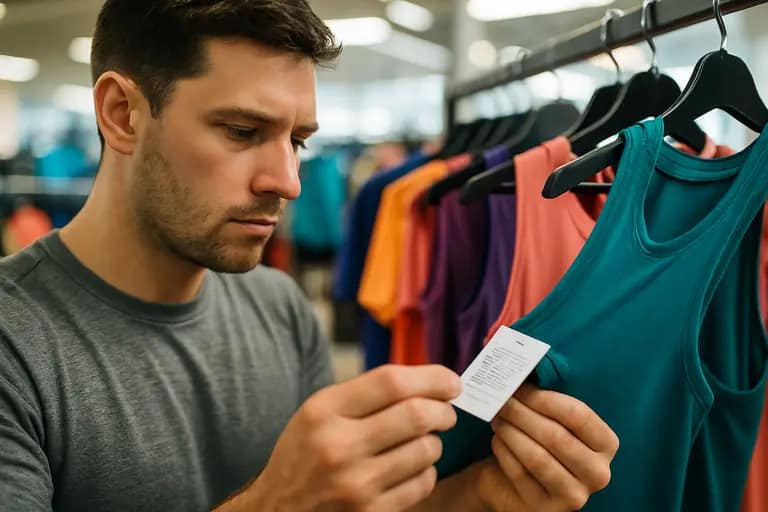
For shoppers, the practical task is not to memorize every threshold. It is to ask better questions about what a garment is claiming to do and how that claim is supported. A label that says water resistant, stain resistant, durable repellent, or treated fabric may point to a finish worth asking about. A label that says moisture-wicking or quick-drying is a different type of claim and does not automatically mean PFAS are present.
- Ask whether water- or stain-repellent finishes are fluorine-free, if the brand provides that information.
- Look for state-specific disclosures if buying in jurisdictions with textile PFAS laws.
- Separate fit support from chemical treatment claims, especially in sports bras.
- Consider whether the activity truly requires repellency, such as outdoor wet-weather training, or mainly needs stretch and moisture movement.
- For persistent discomfort, skin irritation, numbness, or unusual symptoms, discuss the issue with a clinician rather than relying on a clothing swap alone.
An additional resource is Healthscope, which provides related consumer-focused insights within the same network.
PFAS Activewear Laws And Fabric Safety
PFAS activewear laws are changing the fabric-safety conversation from brand slogans to deadlines, thresholds, reporting duties, and supply-chain evidence. The strongest implication for activewear is not that one product type should be feared. It is that water- and stain-repellent performance claims now sit within a stricter regulatory setting in several major markets.
For sports bras, leggings, and studio clothes, support and comfort still depend on construction and fit. For jackets, trail pieces, treated footwear, and weather-facing layers, chemical-finish questions may carry more weight. The best consumer approach is cautious and specific: read the claim, identify the function, ask what finish is being used, and choose support based on movement needs rather than assuming a fabric label answers every safety or fit question.