

Let’s get real. You’re looking at two pairs of leggings. One costs a lot and promises top-notch performance. The other is cheaper but does the job too. The real question is: are you really getting what you pay for?
Is a $120 pair of performance tights worth it? Does it make you 400% faster or more comfy than a $30 pair? Or are you just paying for the brand name?
This isn’t about right or wrong. It’s about what you get for your money. We’re focusing on the real stuff: how well they wick moisture, their compression, and how long they last. Does the fancy fabric’s “four-way stretch” and “thermoregulation” really cost more? Or is it just marketing?
Forget the fancy words. We’re digging into the fitness industry, one thread at a time. We want to know if the price of your affordable vs premium sportswear shows a real difference, or if it’s just marketing.
Fabric & construction differences
Let’s dive deep into your fitness gear. We’re looking beyond “soft” or “stretchy” to the real differences. It’s not just marketing—it’s science and engineering that make your gear good or bad.
The Fabric Equation: More Than Just Thread Count
Forget “soft.” The real talk starts with polymer chemistry. Cheap activewear uses basic polyester or cotton blends. They’re fine for a few wears but pill, fade, and lose shape fast.
Premium fabrics are a different story. Think of them as the haute couture of synthetics. Nike’s Dri-FIT and similar tech move sweat away from your skin and dry fast.
These fabrics are a mix of high-tenacity polyester and spandex. They stretch four ways and last long. Check out performance fabrics in premium lines for more tech.
Now, let’s compare affordable vs premium sportswear in fabric. Budget fabrics are simple polyester. They trap heat, retain odors, and lose shape.
Premium fabrics are a blend like 92% polyester and 8% spandex. They’re durable and stretchy. Or they might be bamboo and organic cotton for natural odor resistance.
The difference is in the details. A budget tee has 12 stitches per inch. A premium one has 18 or more. This density keeps the fabric tight and prevents warping.
Construction: Where the Seams Meet Reality
This is where affordable activewear often fails. Construction is key to performance gear.
- Seams: Budget gear has basic seams. They’re bulky, chafe, and unravel fast. Premium gear has flat seams that are smooth and strong.
- Stitching: Quality gear has more stitches and stronger thread. It’s like a surgeon’s suture.
- Reinforcement: Gussets add mobility and reduce stress. Budget gear often skips them to save cost.
Premium sportswear is a system, not just a garment. The fabric, cut, and construction work together. Budget gear is just fabric cut and sewn. One is tailored; the other is a potato sack.
| Feature | Budget/Standard Activewear | Premium/Technical Activewear |
|---|---|---|
| Fabric | Basic polyester/spandex blend, often recycled from lower-grade materials. Prone to pilling, odor retention. | Engineered technical fabrics (e.g., Dri-FIT, Polygiene®). Often with antimicrobial, moisture-wicking, and UV-protective treatments. |
| Seams | Basic overlock or serged seams. Can be bulky and prone to chafing. | Flatlock or flat-felled seams. Flat, smooth, and designed to minimize friction. |
| Stretch & Recovery | 2-way stretch, often loses shape quickly (“bagging out”). | 4-way mechanical stretch with high memory. Returns to original shape wash after wash. |
| Durability | Pilling, fading, and seam failure are common after 20-30 wears/washes. | High- tenacity yarns and reinforced stress points for longevity. |
Is there a molecular-level advantage to premium sportswear? Yes, there is. It’s not just marketing. The fabric, density, seams, and design all matter. It’s the difference between wearing a tool and wearing a costume.
Cost-per-wear math
Forget what you paid for your activewear. The real cost is how often you wear it. This is where affordable vs premium sportswear gets a math lesson. Let’s see which is better for your wallet in the long run.
We often think the cheaper option is better. But this is a false economy. To see the truth, we need the cost-per-wear (CPW) model. It’s a simple formula that changes how you shop for budget fitness wear and premium gear.
The Cost-Per-Wear Formula: Your New Shopping Superpower
The formula is simple: Cost-Per-Wear (CPW) = Item Price ÷ Total Wears.
This equation shows an item’s true value over time. Let’s use it to compare affordable vs premium sportswear with a real example.
- The Budget Warrior (The $30 Legging): You buy a $30 pair of leggings. They last a few months but then pill and fade. Your cost-per-wear? $30 ÷ 30 wears = $1.00 per wear.
- The Premium Performer (The $100 Legging): You spend $100 on a premium legging. It lasts 200 wears. Your cost-per-wear? $100 ÷ 200 wears = $0.50 per wear.
The premium legging seems pricey at first. But it’s actually cheaper per wear. The budget fitness wear is more expensive in the long run.
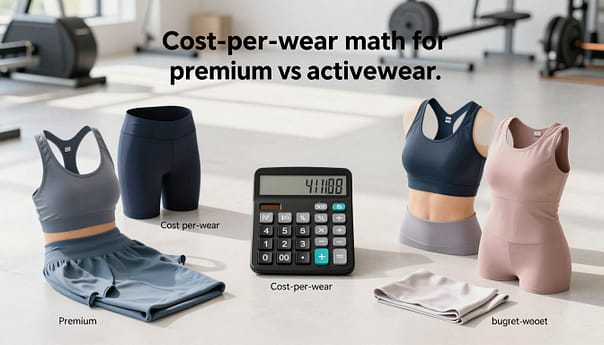
Consider the confidence coefficient. Cheap, ill-fitting clothes get worn less. A premium piece you love gets worn more, lowering its CPW. That $100 legging, worn 3 times a week, is cheaper than the $30 one.
The Variables in Your CPW Equation
CPW isn’t just about math. Your personal CPW depends on several factors:
- Activewear Mortality Rate: How long does it last? Premium items last longer than budget ones.
- Laundry Cycle Tolerance: How many washes before it looks bad? Premium fabrics handle washing better.
- The Confidence Coefficient: You’ll wear what you love more often.
| Item | Initial Cost | Estimated Total Wears | Cost-Per-Wear | Long-Term Winner |
|---|---|---|---|---|
| Budget Leggings ($30) | $30 | 30 wears | $1.00 | Premium (by $0.50/wear) |
| Premium Leggings ($100) | $100 | 200 wears | $0.50 |
This isn’t just about leggings. Apply this to sports bras, shorts, and jackets. Premium activewear might seem pricey at first. But it’s worth it in the long run. The $30 piece is a quick discard, while the premium piece lasts for years.
So, when choosing between budget fitness wear and premium, don’t just look at the price. Do the CPW math. That $100 item might be the cheapest in your closet.
When premium is worth it
Not every workout needs to cost a lot. But for those who wake up early to run, hold yoga poses until they hurt, or run a lot on weekends, the choice between affordable vs premium sportswear is serious. It’s about how well your gear works, not just how it looks. Premium gear is worth it because it lasts longer, works better, and feels right.
For the High-Intensity, High-Sweat, High-Friction Warrior
If you’re sweating a lot and your clothes are rubbing, you’re not just starting out. Premium tech is essential for athletes who face tough challenges. Brands like Nike use special fabrics to keep you dry and comfortable. This isn’t just fancy marketing; it’s real technology that helps you perform better.
The Confidence Quotient: When You Feel Good, You Perform Better
Wearing the right gear can give you a mental boost. Feeling confident in your workout clothes can make you perform better. It’s not just about looking good; it’s about feeling like you can do anything. This mindset can make your workouts more effective.
The Durability Dividend: The Long Game of Cost-Per-Wear
Premium gear might cost more upfront, but it lasts longer. A cheap top might last 30 washes, while a premium one can go through hundreds. This makes premium gear a better value in the long run. It’s not just about the price; it’s about how long it lasts.
The Performance Edge: When Tech Matters
Premium gear is essential for athletes who push themselves hard. It has features like special seams and fabrics that help you perform better. This isn’t just about looking good; it’s about having the best technology to support you.
When budget wins
The fitness world often says you need to spend a lot to perform well. But, sometimes, the best choice isn’t the most expensive. Budget wins because it’s smart, not just cheap. It’s about acquiring strategically, not settling for less.
You don’t need a lot of money to look and feel great at the gym. Knowing where to spend and save is key.
When Budget Wins: The Strategic Acquisition Framework
Building your activewear wardrobe is like creating a sports team. You need a few key players and a solid team of reliable players. This is the Hero vs. Supporting Cast strategy.
Your “Hero Pieces” are items that get a lot of use and need special features. Think high-impact sports bras and running tights. These are where you might spend a bit more. But, your “Supporting Cast” items like basic tees are where budget brands really shine. A $12 performance tee from a budget brand is rarely regretted.
The Budget Hacker’s Shopping List
Don’t think cheap workout clothes are a bad deal. Today’s budget brands offer quality that was unthinkable a decade ago. Here’s how to save:
- The Hero Investment: Spend on your main activity’s key gear. A good sports bra for running or premium leggings for intense workouts are worth it.
- The Budget Battalion: Save here. Buy basics from brands like Old Navy, Target’s All in Motion, or Decathlon. They offer great value for the price.
- The Art of the Mix: Mix a premium top with budget leggings, or vice versa. No one will notice your $25 top is doing the heavy lifting.
Let’s look at the numbers with a cost-per-wear breakdown:
| Item | Budget Brand (e.g., Old Navy) | Premium Brand | Cost-per-wear (50 wears) |
|---|---|---|---|
| Basic Performance Tee | $12 | $60 | $0.24 vs. $1.20 |
| 7/8 Leggings | $25 | $100+ | $0.50 vs. $2.00 |
The math shows affordable vs premium sportswear is a good deal. A budget tee costs less than a quarter per wear if you wear it 50 times. This makes both your wallet and workout happy.
Where to Find the Budget Wins
Quality doesn’t have to mean a high price. Old Navy’s athletic line offers great fit and function at a low cost. Target’s All in Motion line also offers great value. For more on the best affordable activewear, check out our guide to the best affordable activewear brands.
Winning on a budget isn’t about giving up. It’s about smart spending. Spend on what matters and save on the rest. Your wallet and workout will appreciate it.
Brand examples
Where do you fit in the activewear world? Your choice depends on your budget and your workout style. Let’s explore the main options.
The Performance Icons
Nike, Lululemon, and Adidas are like luxury cars for the gym. They cost more because of their research, reputation, and unique features. You’re paying for the brand, the latest technology, and being part of a community.
For top-notch fabrics or a high-support bra, it’s worth the extra cost. But for a simple workout tee, it might not be as good a deal.
The Premium Challengers
This group offers a great middle ground. Brands like TASC and Strongbody Apparel sell directly to you, cutting out the middleman. They provide quality, performance-focused clothes at a lower price.
They let you enjoy top-notch gear without the high price tag. It’s perfect for athletes who want value without sacrificing quality.
The Value Vanguards
This category is all about affordable activewear. Think Old Navy Active, Decathlon’s brands, or Amazon Essentials. The key is finding hidden gems among the options.
Some pieces are surprisingly good, while others might not live up to expectations. The goal is to find the best value for your money.
Are you loyal to a brand, looking for the best deal, or focused on technical details? There’s a place for everyone. The Icons offer prestige and innovation. The Challengers provide high-quality without the high price. The Vanguards focus on affordability. The right choice is one that matches your needs, budget, and style.