

Size-inclusive activewear is facing genuine pressure in the GLP-1 era. Yet the evidence does not show that weight-loss medications alone caused brands to abandon larger sizes.
What the current data does show is a complicated market shift. GLP-1 use is rising rapidly in the United States, many users report meaningful changes in clothing size, and retailers are reconsidering the mix of sizes they stock. At the same time, plus-size representation on major fashion runways has fallen, extended sizes frequently remain harder to find, and some companies continue to treat inclusion as a limited capsule rather than a permanent design commitment. size-inclusive activewear
The risk is that retailers interpret changing demand too narrowly and assume larger bodies are disappearing. They are not. People begin, continue, pause, or stop treatment for different medical, financial, and personal reasons. Bodies also change through pregnancy, aging, disability, hormonal shifts, illness, training, and ordinary weight fluctuation.
For activewear brands, the responsible response is not to replace one narrow size ideal with another. It is to improve fit, stock depth, adjustable construction, product imagery, and exchanges across a genuinely useful range of sizes. Why Sports Bra Support Matters?
Why Jordyn Woods Raised the Question
The current discussion gained a recognizable voice on July 29, 2026, when model and entrepreneur Jordyn Woods spoke about size inclusivity during an interview tied to her Bustle cover.
Woods said that fashion had made progress toward inclusion but appeared to be moving backward during what she called the “Ozempic era.” She also emphasized that her own weight fluctuates and that such changes are part of being human. The comments were reported by People on the same date. (Jordyn Woods on size inclusivity)
Her concern is relevant to activewear because Woods previously tried to address limited workout-clothing options directly. In 2018, she launched SECNDNTURE with sizes from XS through 2X, describing the project as a response to difficulty finding activewear that combined quality, affordability, and a wider size range. She later launched the FrstPlace fitness platform in 2021.
Woods’ observation is not proof that GLP-1 prescriptions caused activewear companies to reduce sizing. It is a cultural warning: when thinness becomes more visible and more heavily promoted, brands may feel less pressure to show, fit, and stock clothing for larger bodies.
That concern deserves to be tested against actual retail and fashion data rather than celebrity appearance commentary.
GLP-1 Use Has Expanded Rapidly in the United States
GLP-1 medications are prescribed treatments used for conditions that can include type 2 diabetes and chronic weight management, depending on the specific drug and FDA-approved indication. The term covers medicines including semaglutide and tirzepatide, sold under different brand names for different uses.
Media discussions often use “Ozempic” as shorthand for the entire category. That is imprecise. Ozempic is a semaglutide product used for type 2 diabetes, while Wegovy is a semaglutide product with weight-management indications. Zepbound is a tirzepatide product approved for chronic weight management in qualifying patients. Medication decisions belong with a qualified healthcare professional, not an apparel trend or social-media discussion. (MedlinePlus GLP-1 overview)
The scale of use is nevertheless large enough to affect apparel shopping.
On July 7, 2026, Gallup reported that 11% of U.S. adults currently used a GLP-1 medication for weight-loss purposes, compared with 3% in 2024. Fifteen percent said they had used one at some point. The findings came from a probability-based web survey of 5,065 adults conducted from May 28 through June 5 across all 50 states and Washington, D.C.
Gallup also found that public awareness of the medications reached 91%, up from 80% in 2024. That means GLP-1s influence cultural conversations about bodies and weight even among people who do not take them.
Clothing Sizes Are Changing for Many Users
Consumer surveys suggest that clothing replacement is becoming one of the clearest retail effects associated with GLP-1 use.
A PwC report published on June 22, 2026, analyzed Numerator household data and a survey of more than 3,000 current, former, and prospective GLP-1 users. PwC estimated that 21% of U.S. households included a current user as of May 2026. That household figure is not directly interchangeable with Gallup’s percentage of individual adults because the two organizations used different populations and methods. (PwC GLP-1 consumer trends)
Among current users surveyed by PwC, 73% reported a meaningful change in clothing size. Apparel spending was 9.9% higher after six to eight months of use, and 26% said they were spending more on clothing overall. PwC also noted that consumers may hesitate to make major wardrobe investments when they do not know whether their measurements will continue changing.
Circana identified a similar shift in a March 23 apparel-industry report. The Chicago-based research company said 80% of GLP-1 users surveyed expected to need new clothing because of size changes, while 55% had already purchased new apparel or footwear primarily for that reason. Circana apparel adviser Kristen Classi-Zummo described the change as affecting personal style and identity as well as garment size.
Those findings create a real inventory challenge. They do not justify assuming that demand for every larger size will permanently decline.
Fashion Representation Is Already Moving Backward
The strongest evidence of an inclusivity retreat comes from the broader fashion industry rather than activewear sales alone.
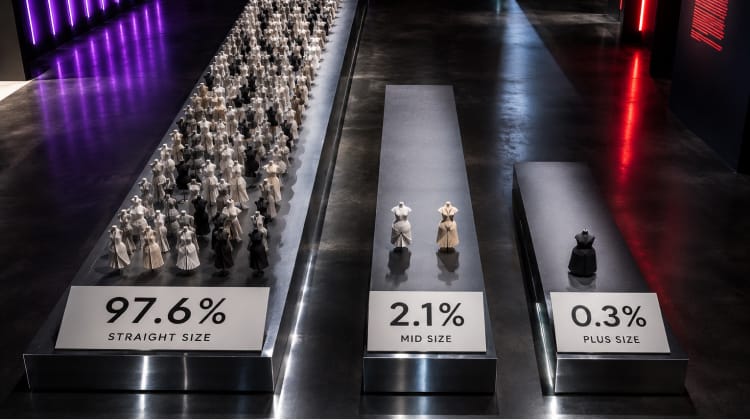
The Vogue Business Fall/Winter 2026 Size Inclusivity Report reviewed 7,817 looks across 182 shows and presentations in New York, London, Milan, and Paris. It classified 97.6% of looks as straight-size, defined as U.S. sizes 0–4. Mid-size models in sizes 6–12 represented 2.1%, while plus-size models in size 14 and above represented only 0.3%.
Plus-size representation was down from 0.9% during the preceding season and returned to the lowest level recorded during the publication’s three years of tracking. Paris had the narrowest representation: 99.5% of looks were straight-size, 0.4% were mid-size, and 0.1% were plus-size.
Runway casting does not measure activewear inventory. Luxury runway collections and everyday workout clothing operate through different price points, distribution systems, fabrics, and performance requirements.
The data still matters because campaigns, editorial images, fit models, and runway casting communicate which bodies a brand considers central. When larger models disappear from highly visible fashion spaces, shoppers may reasonably question whether size inclusion remains a priority behind the scenes.
The report placed declining representation in the context of growing GLP-1 use, cultural self-optimization, and changing beauty ideals. It did not demonstrate that medication uptake caused the decline. Multiple commercial, political, aesthetic, and production factors may be involved.
Size-Inclusive Activewear Has Not Disappeared
Current U.S. shopping options show that extended-size activewear still exists, including at several prominent companies.
The published ranges below were checked on August 6, 2026. A size chart does not guarantee that every color, inseam, sports bra, or garment is available across the entire listed range.
| Brand | Published Women’s Range | Important Limitation |
|---|---|---|
| Nike | XXS through 4X on selected women’s apparel charts | Separate standard and plus-size patterns may apply, and availability varies by product |
| Girlfriend Collective | XXS through 6XL on its bottoms guide | Compression level and fit can vary among collections |
| Fabletics | XXS through 6X on its general women’s chart | The company states that sizing varies by item |
| Universal Standard | Sizes 00 through 40 in its athleisure section | Individual products, colors, and stock levels can still differ |
Nike’s current women’s bottoms and leggings charts extend through 4X. The company has also described using separate fit development and wear testing rather than simply enlarging straight-size patterns. (Nike women’s bottoms sizing)
Girlfriend Collective’s published bottoms chart spans XXS through 6XL, with hip measurements extending to 64 inches at the upper end.
Fabletics lists XXS through 6X on its general women’s chart, although its sports-bra chart currently stops at 4X and the company warns that availability varies by item.
Universal Standard lists active and athleisure clothing from sizes 00 through 40, organized into 11 grouped sizes.
These examples show that broader size systems remain commercially possible. They do not prove that the entire activewear market is inclusive or that every listed garment fits well.
A Size Chart Is Not the Same as Access
A brand can technically offer an extended size while making it difficult to buy.
The largest sizes may be online-only, limited to black, excluded from new collections, unavailable in stores, or produced in much smaller quantities. A company may offer leggings in an extended range while limiting sports bras, jackets, swimwear, shorts, and performance tops to fewer sizes.
The Vogue Business report found that many fashion brands stopping in plus-size territory offered only U.S. sizes 14 or 16—the beginning of the plus-size range rather than a genuinely extensive system. Those sizes were also among the most likely to be out of stock.
In a survey of almost 700 consumers cited in the report, 48% said they felt pressure to lose weight to feel fashionable. Among that group, 63% identified difficulties finding clothing sizes as a source of the pressure, compared with 36% who pointed to runways and 35% who cited advertising campaigns.
For workout clothing, meaningful access includes more than adding an “XXL” button to a product page. Shoppers need consistent stock, realistic garment measurements, multiple inseams, useful bra-band and cup combinations, appropriate rises, and designs tested on bodies with different proportions.
Activewear Cannot Be Graded by Multiplying Every Measurement
A larger activewear size is not simply a smaller pattern enlarged by the same percentage in every direction.
Bodies can differ in hip-to-waist ratio, abdominal shape, thigh circumference, torso length, shoulder width, bust projection, arm size, and height. The fabric must also behave correctly under movement and stretch.
A poorly graded pair of leggings may fit the hips but gape at the back waist. Another may create excessive compression through the abdomen, become transparent over the seat, or pull its front seam into sensitive anatomy during squats and walking.
Sports bras create an even more complex problem. Increasing the chest circumference does not automatically produce an appropriate band, cup depth, strap length, neckline, and support level.
True size inclusion requires different fit models, repeated wear testing, pattern corrections, and movement assessment. It also requires design teams to treat larger sizes as a core customer group rather than a late-stage extension.
GLP-1 Demand Could Encourage the Wrong Inventory Response
Retailers now have data suggesting that some consumers are moving into smaller sizes. It would be easy to interpret that as a reason to reduce larger-size orders.
That response could create several errors.
Gallup’s 11% figure means most U.S. adults do not currently use GLP-1 medications for weight loss. Even within the user population, treatment outcomes, body changes, duration, access, side effects, and affordability differ. An apparel company cannot reliably predict an individual customer’s future size from medication trends.
Some people use GLP-1 medicines for diabetes or other approved medical purposes rather than primarily for weight loss. Others may not have access because of cost, insurance limitations, availability, contraindications, or personal preference.
Weight may also change after treatment stops. MedlinePlus notes that many people regain weight after discontinuing a GLP-1 medicine, which is one reason medication changes should be discussed with the treating healthcare professional.
Inventory planning should therefore become more flexible, not simply smaller. Retailers need responsive replenishment and better demand data across the complete size range.
People in Changing Bodies Need Better Clothing, Not Less Inclusion
PwC’s findings point to a useful design opportunity. Shoppers whose measurements are changing may not want to replace an entire activewear wardrobe every few months.
Adjustable construction can make garments useful through a broader range of body changes. Examples include internal waistband drawcords, adjustable bra straps and bands, flexible wrap layers, multi-position closures, stretch panels, and waistbands that remain secure without extreme compression.
Exchange policies also matter. A shopper may buy leggings that fit correctly and find that they no longer stay secure several months later. A practical size-exchange or alteration program could offer more value than encouraging repeated full-price purchases.
These features should not be marketed only to GLP-1 users. They can also help during pregnancy and postpartum changes, recovery, strength-training transitions, hormonal changes, disability, aging, and ordinary fluctuations.
Designing for change is more inclusive than assuming the body must remain one fixed size.
Body Change Does Not Automatically Improve Activewear Fit
A lower number on a clothing label does not guarantee that workout clothing will become easier to fit.
Weight and measurement changes do not occur uniformly. A person may need a smaller waistband while retaining similar thigh, hip, bust, or upper-arm measurements. Skin sensitivity, temperature comfort, support needs, and garment pressure preferences may also change independently of size.
Compression clothing can become too loose to remain stable before the wearer is ready to purchase a replacement. A sports bra may lose band support even when the cups still fit. Running shorts may begin riding upward when their previous tension changes.
The appropriate response is a new fit assessment, not an assumption that the next smaller labeled size will work. Shoppers should check movement, opacity, pressure, support, seam placement, and waistband stability each time their measurements change.
What Shoppers Should Look For
A size-inclusive activewear company should make it possible to evaluate the garment before committing to it.
Look for:
- A measurement-based chart for each product category rather than one universal chart.
- Model measurements and the exact size each model wears.
- Images showing the same garment on more than one body size.
- Multiple inseams, rises, and support levels where the product requires them.
- Clear information about compression and whether the fabric relaxes during wear.
- Reliable stock across the listed range instead of token extended-size items.
- Reasonable returns or exchanges after an indoor movement test.
- Product reviews that can be filtered by size, height, activity, and fit experience.
During the fit test, squat, sit, walk, hinge, and raise both arms. Check whether the garment rolls, gaps, becomes transparent, restricts breathing, presses into sensitive areas, or requires constant adjustment.
A garment is not inclusive simply because it can be pulled onto the body. It should support the intended movement with reasonable comfort and coverage.

GLP-1 Treatment Should Remain Separate From Fashion Pressure
GLP-1 medications are medical treatments, not tools for fitting into a brand’s preferred size range.
In March 2026, the FDA approved a higher dose of Wegovy for long-term weight reduction and maintenance in certain adults with obesity or overweight plus a related condition. Like other prescription drugs, semaglutide has indications, contraindications, warnings, and monitoring requirements.
People should not start, stop, change, or seek these medications because an activewear campaign promotes a narrower body ideal. Decisions should be based on an individual medical discussion with a qualified prescriber.
Brands should likewise avoid using the GLP-1 era to revive transformation marketing, before-and-after imagery, or messages suggesting that movement becomes worthwhile only after weight loss.
Fitness clothing should serve people at the size they are today.
The Practical Verdict
Size-inclusive activewear is not disappearing, but its progress is uneven and vulnerable.
Current brands still publish extended ranges reaching 4X, 6X, 6XL, and size 40. At the same time, broader fashion representation has fallen, extended sizes are often inconsistently stocked, and retail analysts are advising companies to rethink size distributions as GLP-1 users rebuild their wardrobes.
The evidence supports saying that GLP-1 use is changing apparel demand. It does not support saying that larger customers no longer need or want high-quality activewear, or that medication use directly caused every retreat from inclusion.
The strongest brands will not chase one shrinking size curve. They will create flexible garments, grade them properly, show them on varied bodies, stock them consistently, and make exchanges manageable when bodies change.
Size inclusion should not be a temporary response to a cultural trend. It should be a basic part of designing workout clothing for real people.