

Underwire bras are returning to major fashion runways in October 2026, but American shopping data suggests consumers are not rushing to embrace the trend. Designers including Prada and Tom Ford have placed structured bras at the center of their Spring/Summer 2027 collections, while celebrities such as Rihanna, Charli xcx, Tyla, and Anya Taylor-Joy have brought visible underwire designs into mainstream fashion.
The renewed attention follows several years in which wireless bras, bralettes, and softer lingerie gained popularity among shoppers looking for flexible construction and everyday comfort.
However, the latest U.S. retail figures reveal a different story from the runway.
According to market research company Circana, underwire bras represented approximately 52% of the U.S. bra market in 2026, compared with 57% in 2022. During the 12 months ending in August 2026, sales of both underwire and wireless bras declined, but underwire sales fell five times faster.
Those findings, reported by The Guardian on October 8, 2026, highlight a growing divide between fashion-industry enthusiasm and consumer purchasing behavior.
The question is no longer whether designers can make underwire bras fashionable again. Recent collections demonstrate that they can.
The more important question is whether shoppers will choose structured lingerie over the wireless styles that have become familiar parts of their wardrobes.
Prada And Tom Ford Bring Underwire Bras Back To The Runway
The renewed interest in underwire bras became particularly visible during the September 2026 fashion shows presenting Spring/Summer 2027 collections.
At Prada, designers incorporated red and black satin underwire bras into runway looks, emphasizing structured cup shapes and lingerie-inspired styling.
The presentation took place in Milan on September 22, 2026.
Tom Ford also featured underwire designs, including black and silver interpretations that treated the bra as a visible component of the outfit rather than a concealed foundation garment.
These collections reflect a broader movement toward clothing that incorporates elements traditionally associated with underwear.
Bra cups, defined seams, visible straps, and structured underbands are increasingly appearing in garments intended to be seen.
Rather than simply reproducing traditional push-up bras, designers are experimenting with the architectural qualities of lingerie.
The underwire becomes part of the garment’s visual structure, creating a recognizable outline that can complement tailored jackets, skirts, and other fashion pieces.
This is an important distinction because the trend does not necessarily represent a return to the heavily padded silhouettes associated with earlier decades.
Many current runway designs emphasize visible construction, separation, and sculptural shaping instead of maximum padding.
For consumers, however, the appearance of these garments on a runway does not automatically establish their practicality for everyday use.
Fashion-show pieces are often selected for their visual impact, while ordinary bras must meet individual expectations for fit, support, movement, and comfort.
Rihanna, Charli XCX And Tyla Help Popularize The Visible Bra Trend
Celebrity styling has helped extend the underwire revival beyond designer presentations.
On September 28, 2026, Rihanna attended the Matières Fécales fashion show in Paris wearing a bra from her Savage X Fenty brand beneath an open jacket.
The styling placed lingerie within a conventional outerwear outfit, making the bra visible without presenting it as a standalone garment.
Anya Taylor-Joy has also appeared in a fuchsia Balmain underwire bra paired with a cardigan and floral jacquard skirt.
Meanwhile, Kaia Gerber wore an Alaïa wool-crepe bra top featuring exposed underwire construction.
At the 2026 MTV Video Music Awards, held on September 27 at the Peacock Theater in Los Angeles, Tyla wore a blue snakeskin-print ensemble by designer Mowalola Ogunlesi.
The outfit incorporated an underwire bra with a coordinated skirt.
Charli xcx has similarly featured structured bras in performance and public-appearance styling, contributing to the growing visibility of lingerie as outerwear.
These appearances have something in common: the bra is no longer treated exclusively as an invisible layer.
Instead, its construction becomes part of the outfit’s design.
That shift creates opportunities for fashion brands to promote decorative straps, distinctive cup shapes, satin finishes, and more structured silhouettes.
However, celebrity styling also differs from ordinary clothing needs.
A carefully coordinated outfit designed for a red carpet or stage performance may not reflect the priorities of someone selecting lingerie for a full workday.
The trend’s visibility therefore tells us more about fashion direction than about whether shoppers have changed their purchasing habits.
U.S. Underwire Bra Sales Tell A Different Story
The clearest evidence of the gap between runway fashion and consumer demand comes from Circana’s U.S. market research.
Kristen Classi-Zummo, an apparel industry adviser at Circana, told The Guardian that the American bra market has struggled to regain momentum since the pandemic.
Although underwire bras remain a substantial part of the market, their share has declined.
The category accounted for approximately 57% of U.S. bra sales in 2022.
By 2026, that figure had fallen to approximately 52%.
The difference represents a five-percentage-point decline in market share over four years.
More importantly, the latest annual sales comparison suggests the category is still losing ground.
During the 12 months ending August 2026, sales of underwire and wireless bras both declined in the United States.
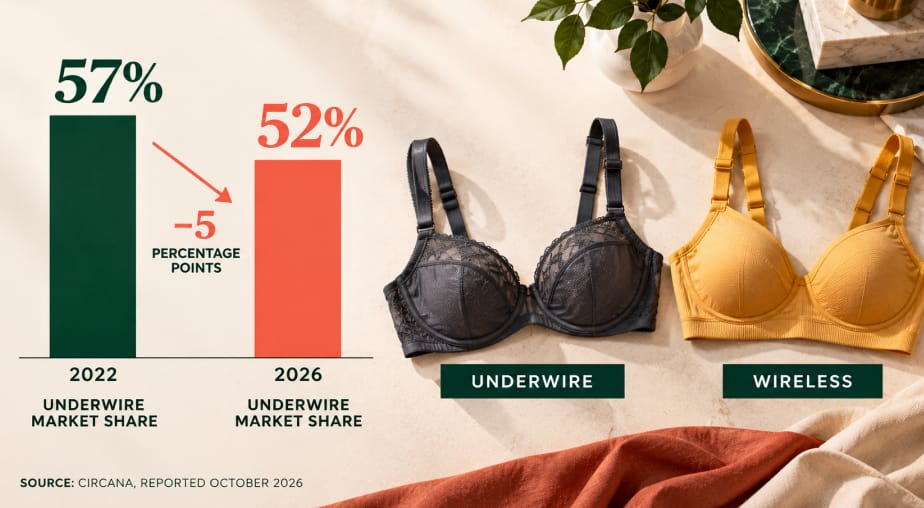
However, the decline in underwire sales was five times as fast as the decline in wireless sales.
That does not mean American shoppers have abandoned underwire bras.
A 52% market share still represents a substantial proportion of the category.
It does suggest that the runway revival has not yet produced a corresponding recovery in consumer sales.
The distinction between market share and sales growth is essential.
Underwire bras can remain the largest category while simultaneously losing customers or revenue relative to wireless alternatives.
For lingerie manufacturers, this creates a difficult commercial question.
Should brands follow the visual direction of luxury fashion, or should they prioritize the construction preferences reflected in recent purchasing data?
The answer may require a combination of both.
Wireless Bras Gained Popularity During The Pandemic
The growing interest in wireless bras did not begin in 2026.
It accelerated during the COVID-19 pandemic, when many consumers spent more time at home and adjusted their clothing preferences.
Remote work, casual wardrobes, and flexible clothing became more prominent.
Traditional office clothing and structured foundation garments were no longer necessary for every daily routine.
During the second half of 2020, market research company NPD reported that overall bra sales declined by 1%, while wireless bra sales increased by 14%.
The contrast showed that some shoppers were continuing to purchase bras but choosing different constructions.
Bralettes, wireless styles, and soft-cup designs became more visible in retail assortments.
These products often emphasized flexible materials, fewer rigid components, and a more relaxed silhouette.
The shift also encouraged lingerie brands to invest in wireless support technologies.
Some manufacturers developed new cup materials, internal support panels, and alternative shaping structures intended to provide support without conventional underwires.
The resulting product development helped expand the range of wireless options available to consumers.
However, the growth of wireless bras should not be interpreted as evidence that every shopper finds them more comfortable.
Individual preferences differ, and support requirements can vary according to garment construction, body proportions, and intended activity.
What changed was the range of choices available and the willingness of consumers to consider alternatives to traditional underwire designs.
What Makes An Underwire Bra Different From A Wireless Bra?
An underwire bra typically includes a curved structural component positioned beneath each cup.
The wire is usually made from metal or another relatively rigid material and enclosed within a fabric channel.
Its purpose is to help define the cup’s shape and contribute to the distribution of support through the bra’s structure.
A wireless bra omits this component.
Instead, it relies on other design features, including the underband, fabric tension, cup construction, internal panels, and straps.

Neither category automatically guarantees a particular level of comfort or support.
The actual wearing experience depends on how the complete garment is designed and how it fits.
Larissa King, an assistant professor of fashion design specializing in intimate apparel at the Fashion Institute of Technology in New York, explained to The Guardian that underwires work with the bra band to distribute weight around the chest.
When appropriately fitted, this construction can also help reduce pressure on the shoulders.
Wireless bras can provide support through alternative methods, although they may create a different silhouette.
The following comparison summarizes common construction differences.
| Feature | Underwire Bra | Wireless Bra |
|---|---|---|
| Main structure | Curved wire beneath each cup | Fabric panels, band tension, and alternative support structures |
| Cup definition | Often provides a more defined cup outline | Shape varies with fabric and cup construction |
| Flexibility | Depends on wire design, band, and materials | Often allows more flexibility, depending on construction |
| Support | Combines underwire, band, cups, and straps | Relies on band, cups, fabric, and internal support features |
| Common fit concerns | Wire placement, band tension, cup shape | Band stability, cup shape, and fabric tension |
| Everyday suitability | Depends on individual fit and preferences | Depends on individual fit and preferences |
The comparison demonstrates why choosing between underwire and wireless bras involves more than selecting one construction category.
A poorly fitting wireless bra can be uncomfortable or provide inadequate support.
A properly fitted underwire bra may feel comfortable for someone who prefers a more defined shape.
The most appropriate choice depends on the complete garment and the individual wearing it.
Underwire Does Not Automatically Mean Push-Up Padding
One reason the 2026 underwire revival differs from earlier lingerie trends is that designers are not exclusively emphasizing heavily padded push-up bras.
Underwire and push-up construction describe different features.
An underwire is a structural component positioned beneath the cups.
Push-up padding is designed to influence the shape or position of the bust through additional material and cup construction.
A bra can include underwire without substantial padding.
Likewise, some wireless designs incorporate shaping features that influence the garment’s silhouette.
The two characteristics are related in some products but should not be treated as interchangeable.
This distinction is relevant to the Prada and Tom Ford runway collections.
The featured bras emphasize structure and visible cup definition rather than necessarily reproducing the heavily padded styles associated with late-1990s lingerie advertising.
For consumers, understanding the difference can make product comparisons more useful.
Someone interested in defined cups may not necessarily want additional padding.
Another shopper may prefer a smooth lightly lined design regardless of whether it includes an underwire.
The terminology matters because fashion descriptions often emphasize appearance while providing less information about the underlying construction.
Victoria’s Secret Is Developing More Flexible Underwire Designs
The fashion industry’s renewed interest in underwire bras is also encouraging manufacturers to reconsider how rigid structures are incorporated into lingerie.
Victoria’s Secret is among the companies highlighting changes in underwire construction.
According to a company spokesperson quoted by The Guardian, the brand’s Body by Victoria Flex Factor bra incorporates a flexible titanium underwire designed to bend with the body.
The product reflects an attempt to combine defined cup structure with greater flexibility.
This approach is significant because one of the most common complaints about traditional underwire bras concerns rigid components pressing against the body.
However, a flexible wire does not independently guarantee comfort.
Band size, cup shape, fabric texture, strap adjustment, and individual fit remain important.
A garment with a flexible wire may still feel unsuitable if other construction elements do not match the wearer’s preferences.
Similarly, a conventional underwire bra may feel comfortable when its overall design and fit are appropriate.
The practical value of newer materials should therefore be evaluated through the actual wearing experience rather than marketing terminology alone.
For shoppers, the development indicates that the choice is not limited to traditional rigid underwire bras or entirely wireless styles.
Manufacturers are experimenting with designs that combine characteristics from both categories.
Retailers Are Introducing More Structured Bra Styles
Despite declining sales, retail product data suggests that brands are responding to the runway trend.
Edited, a retail intelligence platform that monitors product arrivals and descriptions, identified increases in terminology associated with structured lingerie during August 2026.
According to the figures cited by The Guardian, mentions of the word “push” increased by 60% month over month, while mentions of “underwired” rose by 28%.
These figures describe changes in retail product terminology, not increases in completed sales.
That distinction is important.
A rise in product listings can indicate that retailers are expanding assortments or adjusting their merchandising strategies.
It does not establish that shoppers are purchasing the new products at the same rate.
Retailers may be preparing for anticipated demand based on fashion-show coverage and celebrity visibility.
They may also be testing new silhouettes to determine which designs attract interest.
The strategy creates an opportunity for shoppers to compare a broader selection of underwire constructions.
However, the success of those products will ultimately depend on consumer purchasing decisions, repeat use, and satisfaction.
The Bra-As-Outerwear Trend Changes How Lingerie Is Designed
One of the most visible aspects of the current trend is the growing use of bras as outerwear.
Designers are incorporating lingerie-inspired construction into garments intended to be visible in public.
The trend includes satin underwire tops, structured bralettes, corset-inspired pieces, and bras styled beneath open jackets.
At Fendi’s Spring/Summer 2027 presentation, coordinated bras and skirts appeared as complete runway outfits.
At Erdem, crystal-covered bras were layered over shirts, reversing the traditional relationship between underwear and outerwear.
These examples were discussed in The Guardian’s September 30 report on exposed bras and unitards.
The design approach can influence construction decisions.
A bra intended to be visible may incorporate decorative straps, distinctive hardware, unusual fabrics, or more prominent seams.
A bra intended primarily for use beneath clothing may prioritize a smooth surface, discreet edges, or a particular level of coverage.
Neither approach is inherently more functional.
The difference lies in the intended styling and use.
Consumers considering lingerie-inspired outerwear should examine whether the garment is designed as a complete top or as underwear intended to be layered.
Coverage, opacity, closure security, and movement are practical considerations.
The runway’s styling choices do not require shoppers to adopt the same look.
Why Some Shoppers Still Prefer Wireless Bras
The continued appeal of wireless bras reflects several factors beyond fashion trends.
Some shoppers prefer softer fabrics and flexible construction.
Others appreciate garments that do not include rigid wire channels.
Wireless designs may also be appealing for casual wardrobes, working from home, or situations where a less structured silhouette is preferred.
However, these preferences should not be generalized to all consumers.
A wireless bra’s comfort and support depend on its design.
For example, a style with a narrow band and highly elastic fabric may behave differently from a wireless bra incorporating wide support panels and structured cups.
The same variation exists among underwire bras.
Differences in band construction, wire shape, and cup materials can create substantially different wearing experiences.
This helps explain why the market has room for both categories.
Consumers do not necessarily choose one bra construction for every situation.
Someone may prefer an underwire design beneath tailored clothing while selecting a wireless bra for casual wear.
Another person may consistently prefer one construction regardless of the outfit.
The available sales data does not establish that all shoppers are moving toward a single preferred style.
Instead, it suggests that wireless options have maintained relatively stronger demand during a period of broader weakness in bra sales.
The Return Of Structured Bras Raises Questions About Body Expectations
Fashion trends do more than influence garment construction.
They also shape the silhouettes presented as fashionable.
The renewed emphasis on underwire bras coincides with a broader interest in structured clothing, defined waists, and highly stylized proportions.
Larissa King told The Guardian that the trend connects with exaggerated silhouettes appearing in luxury fashion.
The visual direction raises questions about how fashion imagery influences expectations.
Runway styling, professional photography, garment tailoring, and digital image editing can all affect how clothing appears.
A highly structured bra may create a particular silhouette on a model, but that appearance should not be treated as a universal standard.
Bodies differ naturally in shape and proportion.
The same garment can also fit differently across wearers.
Consumers should not assume that they need to achieve a particular appearance to participate in a fashion trend.
A bra is a garment with specific construction features, not a measure of how someone’s body should look.
This distinction is particularly relevant when celebrity imagery becomes part of lingerie marketing.
The practical value of a bra should be evaluated through its fit, materials, intended use, and the wearer’s preferences rather than comparisons with edited or professionally styled photographs.
How To Decide Whether An Underwire Bra Is Worth Trying
The current fashion revival may encourage some shoppers to reconsider underwire designs they previously avoided.
Others may remain satisfied with wireless bras.
Neither decision requires following the runway.
For someone interested in trying an underwire bra, the most useful starting point is understanding the garment’s construction and fit.
The following considerations can help:
- Check the band fit. The band should feel secure without creating uncomfortable pressure or shifting excessively during ordinary movement.
- Examine the wire placement. The underwire should sit appropriately within the garment’s intended fit rather than pressing painfully into sensitive areas.
- Compare cup shapes. Balconette, plunge, full-coverage, and other cup designs can fit differently even when the labeled size is the same.
- Consider the materials. Lace, satin, mesh, smooth microfiber, and flexible wire constructions can create different textures and wearing experiences.
- Evaluate the intended use. A decorative bra intended for occasional styling may serve a different purpose from one purchased for frequent daily wear.
Fit preferences are individual, and no single bra construction is appropriate for everyone.
Persistent pain, skin injury, or other concerning symptoms should not be dismissed as an ordinary consequence of wearing a structured bra. A qualified healthcare professional can help evaluate symptoms when needed.
For everyday clothing decisions, shoppers can also seek assistance from an experienced lingerie fitter.
Can The Underwire Bra Revival Reverse Declining U.S. Sales?
The central commercial question remains unresolved.
Luxury fashion designers have clearly embraced structured lingerie.
Prada and Tom Ford have placed underwire bras on major runways.
Rihanna, Charli xcx, Tyla, and other celebrities have made visible bras part of contemporary styling.
Retail intelligence data also indicates that brands are introducing more products associated with underwire and push-up construction.
Yet the latest U.S. sales figures do not demonstrate a comparable consumer revival.
Underwire bras accounted for approximately 52% of the market in 2026, down from 57% in 2022.
Sales continued to decline during the 12 months ending August 2026, with underwire products experiencing a substantially faster decrease than wireless alternatives.
The fashion industry’s challenge is therefore not simply making underwire bras visually appealing.
It is offering products that meet the practical expectations of shoppers who have become accustomed to a wider range of lingerie constructions.
Flexible materials, improved cup engineering, varied sizing, and transparent product information may help brands address those expectations.
However, the available evidence does not establish that any particular innovation will reverse the sales trend.
The next meaningful indication will come from consumer purchasing data rather than runway appearances alone.
What The Underwire Trend Means For Lingerie Shoppers In 2027
The return of underwire bras to high fashion illustrates how runway trends and everyday shopping behavior can move in different directions.
Designers are exploring more defined silhouettes and treating lingerie as a visible fashion element.
Consumers, meanwhile, continue to demonstrate interest in wireless alternatives and flexible construction.
Both developments can exist at the same time.
Underwire bras remain a major part of the American lingerie market, even as their share has declined.
Wireless designs have expanded the available options without eliminating demand for structured cups.
The most likely practical outcome is a broader assortment of bra styles, materials, and construction techniques rather than a universal return to one traditional design.
For shoppers, that variety can be useful.
A person interested in underwire styling may find new designs that differ from earlier generations of structured bras.
Someone who prefers wireless lingerie can continue choosing garments that match their comfort and clothing preferences.
The important distinction is between fashion visibility and personal suitability.
Prada, Tom Ford, and celebrity stylists may influence which bras receive attention in 2027, but they cannot determine which construction will work best for every individual.
As the industry tests the renewed appeal of underwire, American consumers will ultimately decide whether the trend becomes a lasting retail recovery or remains primarily a runway fashion statement.