

Well-Being Activewear is best understood as a shift in priorities rather than a promise that clothing can improve health on its own. Recent industry surveys point to a consistent pattern: shoppers are linking sports bras and women’s active tops with comfort, fit, fabric feel, and versatility. Those are practical design concerns, especially for garments worn close to the body, but they should not be treated as medical outcomes or proof that one product can change performance, mood, or long-term health.
For sports bras and tops, the strongest supported theme is not a single fabric or silhouette. It is the move toward clothing that feels wearable across exercise, errands, and home routines while still accounting for activity level. That places design pressure on underbands, straps, cup or panel structure, stretch recovery, moisture handling, softness, and size range. It also raises a caution: wellness language can make ordinary fit features sound more certain than the evidence allows.
Why Well-Being Activewear Is Now A Fit Question
Well-Being Activewear Starts With Comfort Data
The 2025 Global Activewear Survey of 1,019 U.S. consumers found that comfort, stretch, and fit led activewear purchase drivers, ahead of style or performance. The same survey identified moisture management, odor resistance, and chafe resistance among features shoppers sought in activewear, according to Cotton Incorporated’s activewear survey. For bras and tops, that ranking makes sense. A garment can look polished on a hanger yet fail during overhead reaching, running, lifting, or mat work if the band shifts, straps dig, or fabric feels abrasive after repeated movement.
This is where Well-Being Activewear becomes a design conversation. Comfort is not a vague luxury feature in a sports bra. It is partly determined by measurable garment decisions: band width, fabric stretch, seam placement, closure type, strap adjustability, and whether the textile recovers after being stretched. In active tops, similar questions apply to shoulder mobility, chest coverage, hem movement, underarm friction, and how the fabric behaves when damp.
Sports Bras Sit At The Center
Sports bras are more demanding than many other activewear items because they must balance support, pressure, flexibility, and skin contact. A high-compression feel may be preferred by some wearers during high-movement activities, while others may find it distracting or uncomfortable. A lightly supportive crop top may feel suitable for walking, stretching, or low-impact classes but may not meet every wearer’s needs for jumping or running.
The design lesson is cautious but useful: support should be activity-specific and body-specific. It should not be reduced to “more compression is better.” Fit expectations are also shifting toward adjustability and size variety, a point that aligns with broader consumer interest in comfort-led activewear. Readers comparing fit criteria may find this related analysis of sports bra fit expectations useful when separating support features from marketing language.
What The Surveys Say About Bras And Tops
Cotton, Blends, And Comfort Signals
The same 2025 Cotton Incorporated survey reported that 66% of U.S. participants preferred activewear containing cotton or cotton blends even for tough workouts, while preference rose to 75% or more for light workouts, errands, or home wear. That does not mean cotton is always the best option for every high-sweat session. It does show that shoppers continue to associate cotton and cotton blends with comfort, softness, and wearability.
For sports bras and tops, cotton can be attractive in lower-intensity settings because softness matters across broad areas of skin contact. Blends may also be used to combine hand feel with stretch, shape retention, and moisture movement. The tradeoff is that fiber content alone does not explain how a garment will feel during exercise. Knit structure, fabric weight, elastane content, finishing, and garment construction also affect performance-relevant comfort.
That distinction matters because Well-Being Activewear can easily become an overbroad label. A cotton-blend longline bra for home wear, a medium-support training bra, and a sweat-oriented running top may all sit under the same wellness-style marketing umbrella, yet they solve different design problems.
Medium Support And Hybrid Construction
Market data also suggest that sports bra design is becoming less binary. Cotton held about 41% material share in the sports bra market, hybrid designs were forecast to grow fastest from 2025 to 2031, and medium-impact sports bras held about 46.02% market share, according to the sports bra market report. Those figures support a practical reading: many consumers appear to be looking for bras that sit between lounge comfort and maximum-impact control.
Hybrid construction can refer to blends of materials, mixed support methods, encapsulation elements, compression structures, or design combinations that attempt to balance comfort and support. Still, the label “hybrid” does not prove a garment will fit well. It only signals a design direction. The wearer still needs to assess band stability, strap pressure, cup or panel coverage, bounce control for the intended activity, and whether the garment remains comfortable after repeated movement.
Medium support is also not a universal middle ground. For one person, it may work across strength training, walking, and studio classes. For another, it may feel insufficient for running or unnecessarily restrictive for stretching. The survey and market data describe broad demand, not an individual prescription.
How To Read Well-Being Claims Cautiously
Comfort Is Not A Health Outcome
Comfortable activewear may support a better exercise experience by reducing distraction, but that is different from claiming that a bra or top improves health, prevents injury, or produces fitness results. The available survey findings show what consumers prefer and what companies are building toward. They do not prove that a particular sports bra, fabric, or top changes physical activity levels or health outcomes.
That caution is especially relevant as wellness language spreads across apparel. Words such as calming, supportive, breathable, and performance-ready can describe useful design intentions, but they need context. Breathability does not mean a wearer will stay dry. Support does not mean the bra will suit every activity. Softness does not mean the garment will avoid irritation for every body. Needs may vary by age, health status, pregnancy, surgery history, skin sensitivity, and medication use.
Fit Checks For Movement
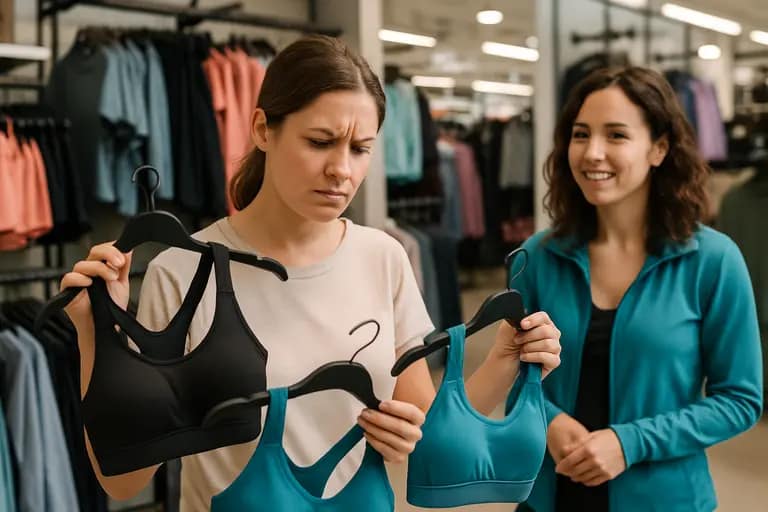
A cautious fit check can be more useful than relying on a product category name. For sports bras and tops, the goal is to see how the garment behaves during the movements it will actually face, not just how it feels while standing still in a fitting room.
- Raise both arms overhead and check whether the band or hem rides up.
- Rotate the torso and look for strap slipping, side pressure, or seam friction.
- Try controlled hops or brisk marching if the garment is intended for higher movement.
- Take several deep breaths to assess whether the band feels secure without feeling overly restrictive.
- Check fabric opacity and recovery after stretching, especially in longline bras and fitted tops.
This kind of assessment does not diagnose any physical issue. It simply helps match clothing features to activity demands. If a garment causes persistent pain, numbness, breathing discomfort, marked skin irritation, or unusual symptoms, that question belongs with a qualified clinician rather than a product description.
Well-Being Activewear Trends In Bras And Tops
The supported trend is clear: consumers are giving comfort, fit, stretch, softness, and versatility more weight in activewear decisions. For bras and tops, that means designers are being pushed toward size variety, adjustable details, fabric blends, and constructions that can move across low- and medium-impact settings. It also explains why cotton and cotton blends remain relevant even as synthetic performance fabrics continue to appear in training apparel.
The more careful interpretation is that Well-Being Activewear reflects shopper priorities, not a guaranteed benefit. A comfortable sports bra may make a workout feel less distracting. A breathable top may feel more practical for daily wear. A softer fabric may be preferred for low-impact movement or home use. None of those points turns clothing into treatment, prevention, or a substitute for professional guidance.
For readers comparing materials across wellness-oriented product categories, Ekko Naturals offers additional insight into activewear trends within the same publishing network. The same cautious standard applies: start with evidence, separate preference from proven effect, and judge claims by what the garment is actually designed to do.
The most practical question is not whether a bra or top is marketed as wellness apparel. It is whether its support level, fabric feel, adjustability, and movement behavior match the activity and the wearer. If comfort problems overlap with pain, skin reactions, breathing concerns, pregnancy-related changes, recovery after surgery, or other health questions, discuss those concerns with a clinician before treating activewear changes as the answer.