

Seattle-based Woolly Clothing Co. has introduced its Fall/Winter 2026 collection, bringing merino wool leggings, bralettes, shorts, and everyday activewear into focus as an alternative to conventional synthetic workout clothing.
Announced on October 13, 2026, the collection emphasizes garments containing 95% to 100% merino wool, with selected women’s leggings and bralettes incorporating 5% elastane for stretch.
The release reflects Woolly’s longstanding approach to apparel: using a high proportion of natural fibers in clothing intended to sit directly against the skin.
For consumers who regularly wear leggings and sports bras, the development raises practical questions about fabric softness, moisture management, waistband comfort, garment weight, and the differences between a bralette and a performance sports bra.
Merino wool is often associated with outdoor base layers and cold-weather clothing. Woolly’s latest collection instead positions the material within everyday athleisure, including garments designed for studio workouts, walking, travel, and casual activities.
However, natural-fiber construction does not automatically make clothing more comfortable, supportive, or suitable for every workout.
The most useful comparison involves examining the actual fabric specifications, fit, activity requirements, and care instructions rather than assuming that wool or synthetic materials are universally superior.
Woolly Introduces Its Fall/Winter 2026 Merino Collection
According to Woolly’s October 13, 2026 collection announcement, the company has expanded its women’s and men’s apparel across four categories: underwear, basics, everyday athleisure, and lifestyle clothing.
The collection includes women’s leggings, shorts, bralettes, tanks, T-shirts, and a three-quarter-sleeve Henley.
Woolly also announced the appointment of Forte Mare PR as its first public relations agency of record, supporting its plans to reach a wider U.S. audience.
The company was founded in Seattle in 2013 by three friends interested in making merino wool clothing more accessible.
Co-founder James Kelly described the latest announcement as part of a new growth phase focused on expanding awareness of the brand’s natural-fiber clothing.
Woolly’s current approach emphasizes garments containing high percentages of merino wool rather than relying primarily on polyester or nylon.
That distinction is particularly relevant for leggings and bralettes, which remain in close contact with the body throughout exercise and everyday movement.
The collection is available through Woolly’s own website and Amazon, although individual colors, sizes, and styles remain subject to inventory.
Woolly’s Merino Leggings Use A Heavier 360 GSM Fabric
One of the most important specifications in the Fall/Winter 2026 collection is the fabric weight used for leggings.
Woolly identifies its Flex fabric as a 360 GSM merino knit.
GSM means grams per square meter and describes the weight of a fabric over a standardized area.
A 360 GSM fabric is substantially heavier than the company’s 175 GSM everyday-weight material used in lighter tops and basics.
This difference helps explain why Woolly uses separate textile constructions for different garment categories.
Leggings generally need sufficient coverage, stretch, and durability to accommodate repeated lower-body movement.
A heavier knit can contribute to a more substantial fabric feel, although weight alone does not establish opacity, compression, or durability.
The finished garment’s performance also depends on knitting structure, yarn characteristics, fit, and construction.
According to the company’s Women’s Legging specifications, its Flex leggings contain 95% Australian merino wool and 5% elastane.
The fabric is described as using fine 18.5-micron merino fibers.
For shoppers accustomed to lightweight polyester-spandex leggings, this represents a different approach to material selection.
The practical question is whether the heavier merino knit provides the preferred balance of comfort, coverage, and movement for the intended activity.
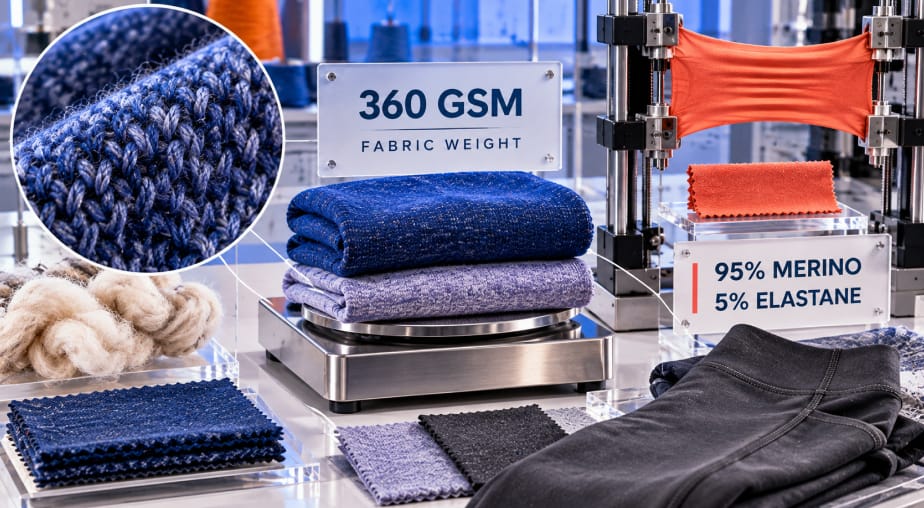
Why The 95% Merino And 5% Elastane Blend Matters
Woolly’s women’s leggings use a fiber composition that differs considerably from many mainstream workout tights.
Conventional synthetic activewear frequently combines polyester or nylon with elastane.
Woolly instead uses merino wool as the dominant fiber, with a smaller elastane component.
Merino wool contributes the material’s characteristic texture and moisture-handling properties.
Elastane adds elasticity, helping the garment accommodate movement and recover from stretching.
The presence of elastane is important because a garment made entirely from wool would not necessarily behave like close-fitting athletic leggings.
However, the fiber percentages do not tell the entire story.
Two garments with identical compositions may differ in stretch, pressure, coverage, and shape retention because of their knit structures and dimensions.
A 5% elastane content should therefore not be interpreted as a specific compression rating.
Consumers should evaluate the garment’s actual fit and movement rather than relying exclusively on its fiber label.
Fine Merino Fibers Influence The Fabric’s Feel
Woolly identifies 18.5-micron merino fibers in its heavier Flex fabric.
A micron is one-thousandth of a millimeter and is commonly used to describe wool fiber diameter.
Fiber diameter can influence how wool feels against the skin.
Finer wool fibers are generally more flexible than coarse fibers, which can contribute to a softer sensation.
However, individual sensitivity varies.
Some people enjoy wearing merino directly against their skin, while others may find certain wool garments uncomfortable.
The company’s descriptions emphasize softness and next-to-skin comfort, but those claims should not be treated as guarantees for every wearer.
People who have previously experienced irritation from wool should consider their own sensitivities when selecting clothing.
For activewear shoppers, softness is only one consideration.
Seam construction, garment pressure, waistband finishing, and moisture accumulation can also influence comfort during prolonged wear.
Merino Wool Offers A Different Approach To Moisture Management
Moisture management is a recurring theme in Woolly’s Fall/Winter 2026 announcement.
The company emphasizes merino wool’s ability to interact with moisture vapor and help regulate comfort across changing conditions.
Wool fibers can absorb moisture vapor into their structure, while many synthetic performance fabrics are engineered to transport liquid moisture across or through the textile.
These mechanisms are different, and neither guarantees that a garment will remain dry during exercise.
Wool can retain moisture under certain conditions, and a heavier knit may dry differently from a lightweight synthetic garment.
Temperature, humidity, exercise intensity, ventilation, and garment thickness all influence the experience.
This distinction matters when considering merino leggings for activities ranging from walking to indoor cycling.
A garment that feels comfortable during a cool outdoor walk may behave differently during an intense workout in a warm studio.
Shoppers should therefore evaluate merino wool’s moisture-management characteristics in the context of their actual activities.
Temperature Regulation Does Not Mean Merino Is Suitable For Every Climate
Woolly markets its merino clothing for year-round comfort.
Merino wool has properties that can make it useful in clothing designed for changing temperatures.
However, the term temperature regulating should not be interpreted as a guarantee that a garment will prevent overheating or provide adequate insulation in every environment.
Fabric weight and clothing layers remain important.
A 360 GSM legging may feel more substantial than a lightweight summer training tight.
That could be appealing during cool-weather walking, travel, or outdoor activities.
The same fabric may feel less comfortable during high-intensity exercise in a hot environment, depending on the wearer and conditions.
The practical implication is that consumers should consider the specific garment rather than making decisions based only on the reputation of merino wool as a natural fiber.
Woolly’s heavier leggings and lighter everyday tops serve different purposes, even though both use high percentages of merino.
Woolly’s Pocket Leggings Add Everyday Functionality
The Fall/Winter 2026 lineup also draws attention to practical features such as pockets.
Woolly’s Pocket Legging uses the company’s 360 GSM Flex fabric and features a seven-eighths-length silhouette.
The product contains 95% merino wool and 5% elastane, matching the listed composition of its standard leggings.
Woolly positions the design for activities ranging from errands to outdoor walking.
Its current listed price is $144, compared with $138 for the standard Women’s Legging.
These are listed retail prices, not promotional guarantees, and may change.
Pockets can improve everyday convenience, but their location and construction affect performance.
A pocket that comfortably holds a phone while walking may not prevent movement during running.
Additional weight can also influence how a garment sits against the hips or thighs.
For that reason, pocket functionality should be evaluated separately from fabric composition.
The most useful question is whether the garment can hold the intended items without creating discomfort or requiring frequent adjustment.
Flatlock Seams And Tagless Construction Address Practical Comfort
Woolly identifies flatlock seams and tagless interiors among the comfort features of its women’s leggings.
Flatlock construction is commonly used in activewear because it can create a relatively low-profile seam.
Reducing seam bulk may help limit unwanted friction during movement.
However, the placement of a seam matters as much as its construction.
A smooth seam positioned where fabric repeatedly rubs against the body may still cause discomfort for some wearers.
Similarly, removing a traditional sewn-in label can eliminate one potential source of irritation without guaranteeing that the entire garment will feel comfortable.
Consumers should assess how the leggings fit through the waist, hips, thighs, and knees.
A comfortable garment should accommodate ordinary movement without persistent pulling, excessive pressure, or repeated adjustments.
These practical fit considerations apply to wool leggings just as much as they do to synthetic workout tights.
Woolly’s Bralettes Use The Same Merino-Rich Fabric Approach
Beyond leggings, the Fall/Winter 2026 collection includes women’s bralettes made with 95% merino wool and 5% elastane.
The company offers several constructions, including triangle, racerback, and open-back styles.
The Triangle Bralette emphasizes gentle support for lounging, layering, and light activity.
The Racerback Bralette is described as the brand’s most supportive bralette option, intended for low- to medium-impact activities.
The Open-Back Bralette features wider straps and optional cup-insert pockets.
These products demonstrate that bralettes can serve different purposes even when they share the same fabric composition.
The listed bralettes use a 360 GSM material with 18.5-micron merino fibers.
However, fabric weight does not establish breast-support performance.
Support also depends on the lower band, cup construction, strap configuration, garment dimensions, and intended activity.
A Merino Bralette Is Not Automatically A High-Support Sports Bra
One of the most important distinctions in Woolly’s new collection is the difference between a bralette and a sports bra intended for vigorous exercise.
Bralettes commonly prioritize comfort, flexibility, and lighter support.
Sports bras designed for running or jumping may require more substantial movement control.
Woolly describes its Racerback Bralette as suitable for low- to medium-impact activities.
That is a product-specific description, not evidence that every merino bralette is appropriate for running or high-impact training.
A person may find a soft merino bralette comfortable during walking or yoga but prefer a different support structure during activities involving repeated jumping.
Breast-support needs vary with anatomy, movement intensity, fit, and personal preference.
The practical approach is to select the garment according to the activity rather than assuming that a natural-fiber construction provides sufficient support.
Consumers should pay particular attention to whether the lower band stays comfortably positioned and whether the straps and cups provide the movement control they prefer.
Racerback And Triangle Designs Serve Different Purposes
Woolly’s bralette range illustrates how garment construction can influence comfort and function.
The Racerback Bralette uses a secure back configuration and an elastic waistband.
The company identifies it as its most supportive bralette design.
The Triangle Bralette has a more traditional lightweight silhouette and is marketed for lounging, layering, and light activity.
Both products use the same general merino-elastane composition, but their support characteristics are not necessarily identical.
This is an important lesson for shoppers comparing matching leggings and tops.
Fabric composition alone cannot determine whether a bra will be suitable for a particular workout.
Two bras made from the same material can provide different levels of support because of their construction.
The appropriate choice depends on intended use and individual comfort.
Merino Leggings And Synthetic Leggings Have Different Trade-Offs
Woolly’s Fall/Winter 2026 collection invites comparisons with conventional polyester-spandex and nylon-elastane workout leggings.
Each material approach has potential advantages and limitations.
| Feature | Woolly Merino Leggings | Typical Synthetic Workout Leggings |
|---|---|---|
| Main material | 95% merino wool, 5% elastane | Often polyester or nylon blended with elastane |
| Fabric weight | 360 GSM Flex fabric | Varies widely by product |
| Moisture behavior | Wool fibers can absorb moisture vapor | Often engineered for liquid moisture transport |
| Stretch | Elastane-supported knit | Depends on elastane content and construction |
| Care considerations | Wool-specific washing precautions | Varies by synthetic fabric and finishing |
| Best use | Depends on fit, temperature, and activity | Depends on fit, construction, and activity |
The comparison does not establish that wool is inherently better than synthetic fabric.
A consumer who prioritizes natural fibers may prefer merino.
Someone seeking a particularly lightweight garment for hot-weather training may prefer another construction.
Others may use both materials for different activities.
The most useful purchasing decision considers the finished garment’s fit and function rather than relying on a single fiber category.
Woolly’s Material Certifications Need Careful Interpretation
Woolly’s October 13 announcement states that its wool is certified under the Responsible Wool Standard (RWS) and Woolmark programs.
The company also identifies Business Social Compliance Initiative certification among its manufacturing partners.
These claims are relevant for shoppers interested in sourcing and production practices.
The Responsible Wool Standard addresses requirements relating to animal welfare, land management, and chain-of-custody practices.
However, a sourcing certification does not automatically establish that a finished garment has a lower environmental impact than every synthetic alternative.
Environmental comparisons depend on factors including farming practices, manufacturing, transportation, garment lifespan, washing, and disposal.
Likewise, a certification concerning sourcing does not prove that leggings are more comfortable or perform better during exercise.
Consumers should distinguish documented certification requirements from broader marketing claims about sustainability.
Washing And Drying Matter For Merino Activewear
Woolly’s product care instructions recommend machine washing its merino garments in cold water with similar colors.
The company also warns that fine merino fibers may snag against zippers, buckles, hook-and-loop fasteners, and other abrasive materials.
Its product pages describe low-temperature tumble drying and air drying as options.
However, shoppers should follow the care label attached to the specific garment they purchase.
Care instructions can differ between wool products depending on their construction and finishing.
Avoiding unnecessary abrasion may help preserve fabric appearance.
Woolly also notes that pilling can occur over time and suggests turning garments inside out before washing.
For consumers accustomed to synthetic leggings, these care considerations may influence convenience.
A garment’s long-term value depends not only on its initial comfort but also on whether the owner can maintain it appropriately.
Size Range And Fit Still Determine Everyday Comfort
Woolly’s current women’s leggings and bralette listings show sizes from XS through XXL.
The company provides fit guidance on individual product pages, including recommendations for shoppers between sizes.
For example, the Pocket Legging listing recommends sizing up when between sizes.
These recommendations are useful starting points, but they cannot guarantee a perfect fit.
Body proportions vary, and different garments may use different patterns even within the same brand.
Leggings need to fit comfortably through the waist, hips, and legs.
Bralettes require an appropriate relationship between the lower band, straps, and cup area.
A garment that feels soft when touched may still be uncomfortable if its dimensions are unsuitable.
The most useful fit assessment involves ordinary movement, including walking, bending, sitting, and any exercises for which the clothing is intended.
What Shoppers Should Check Before Buying Woolly’s Fall 2026 Collection
Woolly’s October release introduces an alternative material approach for people interested in leggings and bralettes with high natural-fiber content.
Before purchasing, shoppers should compare the specific garment’s fabric weight, size chart, support construction, intended activity, and care instructions.
For leggings, the 360 GSM fabric weight and 95% merino composition are useful specifications, but they do not independently establish comfort or performance.
For bralettes, the support level is especially important.
A triangle design intended for light activity should not be assumed to provide the same movement control as a bra designed for higher-impact exercise.
Consumers should also consider temperature and climate.
A heavier merino knit may be appealing for cooler conditions but may not suit every warm-weather workout.
Finally, shoppers should verify current prices, colors, sizes, and availability directly through the retailer.
The collection announcement confirms the Fall/Winter 2026 launch, but individual product listings and inventory can change.
What Woolly’s Fall 2026 Collection Means For Activewear Comfort
Woolly’s October 13 launch illustrates how activewear design can move beyond the conventional assumption that workout leggings and supportive tops must be made primarily from synthetic fibers.
The Seattle company’s use of 95% merino wool, 5% elastane, and a substantial 360 GSM knit creates a distinctive alternative within the leggings and everyday athleisure market.
Its bralette collection also demonstrates how natural-fiber garments can be designed around different support requirements, from lounging and layering to lower-impact exercise.
However, the most important takeaway is not that wool has replaced synthetic performance clothing.
It is that consumers have another material option to evaluate according to their preferences and activities.
Fabric softness, waistband stability, moisture management, seam placement, temperature, and sports-bra support remain essential considerations regardless of fiber type.
For shoppers exploring Woolly’s Fall/Winter 2026 collection, the best approach is to evaluate each garment individually and select clothing that provides the preferred combination of movement comfort, coverage, support, and practical everyday use.