

Brown Leggings have moved from a niche neutral into a more visible activewear choice because they solve a styling problem without abandoning the practical standards expected from leggings. Black remains useful, but brown adds warmth across chocolate, espresso, caramel, and taupe tones. The trend is not only about color. It is also tied to how buyers judge stretch, coverage, pocket placement, waistband security, and whether one pair can move from training to daily wear.
The evidence supports a cautious reading. The leggings category is large and still growing, but that does not mean every shade, fabric, or cut performs the same. Fortune Business Insights valued the global leggings market at USD 52.06 billion in 2025 and forecast USD 97.33 billion by 2034, with a 7.20% compound annual growth rate from 2026 to 2034, according to its leggings market analysis. That growth gives color trends room to spread, but performance still depends on construction rather than shade alone.
Why Brown Leggings Fit The Athleisure Shift
Market Growth Does Not Prove Better Performance
The rise of Brown Leggings fits a broader athleisure pattern: people want garments that can handle movement while still looking intentional with everyday layers. A warm neutral can pair with cream sweatshirts, black sports bras, gray outerwear, denim jackets, or matching earth-tone tops. That versatility helps explain why brown shades are appearing in both fashion-oriented and training-oriented assortments.
Still, a market trend is not proof that a garment improves workouts. Color may make an outfit easier to style, but it does not determine opacity, sweat handling, compression level, or durability. Those qualities come from fabric weight, knit structure, fiber blend, seam placement, waistband design, and the way the garment is graded across sizes.
Research notes also point to a narrower construction trend: in the U.S. apparel category covered by Grand View Research, leggings represented 24.43% of 2025 revenue share within that report’s fit-focused segment, according to the firm’s U.S. apparel market report. That figure supports the idea that comfort and close-to-body fit remain commercially important, even as wider bottoms and looser silhouettes gain attention.
Why Warm Neutrals Travel Beyond The Gym
Brown works differently from black in outfit planning. Black often reads as sharp and high contrast. Brown tends to soften a look, especially when paired with oatmeal, ivory, camel, olive, burgundy, or pale blue. That matters for activewear because leggings are no longer limited to a workout hour. Many buyers expect the same garment to function during a walk, a low-intensity class, a commute, or errands.
The research notes describe Fall/Winter 2025 fashion coverage that emphasized soft and deep brown shades, including chocolate and mocha-like tones. Runway reports for Fall/Winter 2025-2026 also identified brown across bottoms and trousers. Those signals do not guarantee lasting demand, but they do explain why brown has moved from a seasonal accent into a practical neutral for leggings assortments.
Color, Cut, And Activity Demands
How Brown Leggings Change Styling Choices
Brown Leggings offer the most practical styling value when the tone is deliberate. A very dark espresso shade can substitute for black while feeling slightly softer. Chocolate brown often works well with cream, navy, heather gray, and matching sports bras. Lighter taupe or caramel can look fresh, but those shades may show sweat, seam outlines, or fabric stretch more visibly depending on textile density and lighting.
This is where style and function meet. A color that looks polished while standing can behave differently during squats, lunges, cycling, or mat work. Stretch can lighten the fabric appearance across the knees, hips, and seat. That does not make the shade unsuitable; it means the movement test matters. For buyers interested in related earthy palettes, the site’s discussion of earth tone leggings connects brown with olive, clay, camel, and other low-contrast workout colors.
Cut Still Sets The Use Case
A high-rise full-length legging, a flared legging, a bootcut bottom, and a pocketed training tight each serve a different purpose. The research notes indicate that search interest included terms such as dark brown styles, chocolate brown styles, and pocketed versions. That distinction is useful. Buyers are not simply asking for a color; they are asking for a color attached to a function.
Pockets can be helpful for walking, studio-to-street wear, and low-bounce activities, but placement affects comfort. A side pocket that works for a phone during a walk may feel bulky during floor work. A back waistband pocket may hold a small key or card, but it may be less convenient for frequent access. The better question is not whether pockets are good, but whether the pocket design matches the activity.
Performance Questions For Brown Leggings
Fabric Matters More Than Color
Performance language around Brown Leggings should be read carefully. Four-way stretch, moisture movement, and compression can be useful design features, but none of them should be treated as a guarantee of athletic results. A garment may feel more secure or less distracting, yet that is not the same as proving better speed, strength, endurance, or injury prevention.
For movement-heavy workouts, fabric recovery is especially important. If the knees bag out, the waistband rolls, or the seat becomes sheer during deep flexion, the garment may not meet the demands of that activity. For lower-intensity use, softness and ease may matter more than firm compression. For higher-sweat sessions, buyers may prioritize lighter fabric and faster drying, while still checking coverage.
Opacity And Sweat Visibility Need Real Testing
Brown shades can be forgiving in some lighting and revealing in others. Dark chocolate may hide more than camel, but fabric density still matters. A thin textile in a deep brown can become more transparent under stretch than a denser textile in a lighter shade. The only reliable approach is to test the garment in the positions you actually use.
Sweat visibility also varies. Some brown tones show moisture marks more clearly than black, while mottled or heathered finishes may disguise uneven color changes. That does not mean one is better for everyone. It means buyers should distinguish between moisture movement, visible dampness, drying speed, and comfort against the skin. These are related properties, not identical ones.
Shopping Checks Before Keeping A Pair
Fit Checks Should Be Activity-Specific
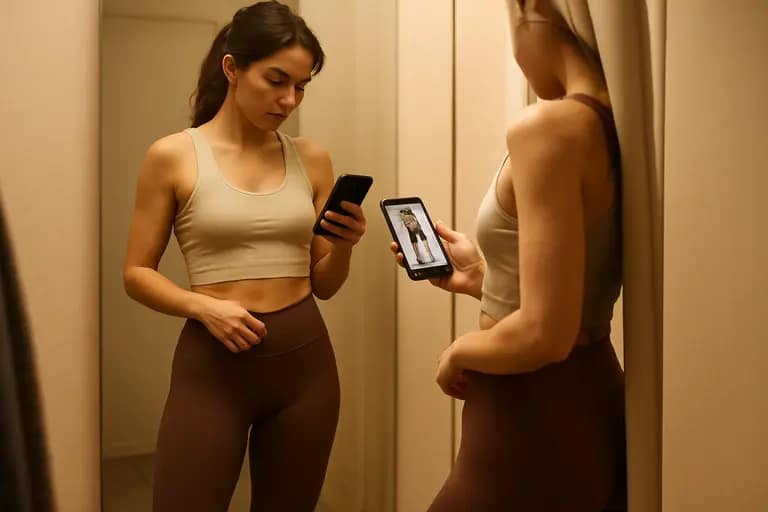
Fit should be judged through movement, not only in a mirror. Try the motions that reflect your actual routine: a deep squat, a lunge, a seated fold, a step-up, a short jog in place, or floor transitions. Watch for waistband folding, fabric pulling at the front rise, inner-thigh friction, or needing constant adjustment. None of these signs means the body is wrong for the garment. They mean the garment may not be the right match.
- Check opacity in natural and indoor light while bending and squatting.
- Test whether the waistband stays in place without uncomfortable pressure.
- Move with anything you plan to carry in pockets.
- Review care instructions, since heat and rough washing can affect stretch over time.
- Compare the shade with tops you already wear before assuming it will be versatile.
For readers considering how activewear can integrate into a broader lifestyle, spiritual endeavors provides thought-provoking content in the same network.
Sports Bras And Bottoms Need Separate Decisions
A matching brown set can look cohesive, but the bra and leggings should still be evaluated separately. Leggings need coverage, stretch recovery, and waistband stability. A sports bra needs appropriate support for the activity, comfortable band tension, strap stability, and enough freedom for breathing and arm movement. A matching color does not make the engineering needs identical.
This is general activewear education, not medical advice. If a garment causes persistent pain, numbness, unusual skin irritation, breathing discomfort, or other symptoms that do not resolve after changing clothing, it is sensible to discuss those symptoms with a qualified clinician. Clothing choice can reduce distraction for some people, but it should not be treated as a medical solution.
The Growing Trend Of Brown Leggings
The trend is strongest when understood as a practical shift rather than a rule. Brown Leggings give activewear wardrobes a warmer neutral, and the shade fits the wider move toward studio-to-street dressing. Market data supports continuing demand for leggings, while the research notes show interest in chocolate shades, dark brown options, and pocketed designs. Those signals point to a buyer who wants both appearance and function.
The caution is equally clear. Brown does not automatically mean better performance, better comfort, or better value. A useful pair still needs the basics: fabric that recovers after stretch, a waistband that stays put, adequate opacity, seams that do not distract, and a cut suited to the activity. For some people, that may be a dark compression legging. For others, it may be a soft ribbed pair for low-intensity movement or a pocketed pair for walking.
The strongest case for the trend is not that brown replaces black. It is that warm neutrals widen the design choices available in leggings without requiring buyers to give up practical standards. The best pair is the one that passes the movement test, works with existing layers, and feels comfortable enough to wear for the activity planned.