

The line between workout tops and sports bras is getting harder to see.
A fitted tank used to be straightforward: wear a sports bra underneath it, then add the tank for coverage. But activewear brands increasingly combine both garments into one piece using shelf bras, compressive fabrics, internal linings, adjustable straps, molded cups, or elastic underbust structures.
Beyond Yoga’s popular Spacedye Slim Racerback Cropped Tank provides a timely example.
On August 28, 2026, New York Magazine’s Strategist highlighted the tank during Beyond Yoga’s warehouse sale, where some colors had fallen from their regular $68 price to as little as $34. Senior shopping editor Bianca Nieves described using the top for workouts including SLT Tread classes, which combine treadmill intervals with reformer-style strength work.
Beyond Yoga itself describes the tank as having a built-in shelf bra and medium support, positioning it for activities ranging from Pilates to walking.
So can a workout tank actually replace a sports bra?
For some people and some activities, absolutely.
But “built-in bra” does not mean “appropriate support for every workout.” Does a High-Impact Sports Bra Need a Front Zip—or Is It Just Easier to Remove?
Whether a tank can function as someone’s only breast-support garment depends on the tank’s internal construction, breast size and individual anatomy, fit, personal comfort, and—most importantly—the amount and direction of movement produced by the activity.
A tank that feels secure during Pilates may feel completely different during running.
That distinction matters more than whether the garment is technically called a tank, bra, crop top, or longline bra.
Beyond Yoga Shows How Much The Categories Have Blurred
The Beyond Yoga Spacedye Slim Racerback Cropped Tank looks more like a fitted cropped tank than a conventional sports bra.
Internally, however, it contains a shelf bra.
Beyond Yoga currently describes the product as offering medium support. Its Spacedye fabric is made from 87% polyester and 13% elastane, with four-way stretch and moisture-wicking properties.
The tank uses a slim racerback with a keyhole design and is cropped around the waist.
That combination illustrates why traditional activewear categories are becoming less useful.
From the outside, it is a tank.
Functionally, it is attempting to perform at least two jobs:
cover the torso and provide breast support.
Current pricing also demonstrates its popularity. Beyond Yoga’s product page carries thousands of customer ratings, while the August warehouse sale pushed selected colors significantly below the regular $68 price.
The fresh Strategist review of the Beyond Yoga tank described it as a garment that can effectively function as both top and sports bra for the reviewer’s workouts.
That is useful real-world evidence about one person’s experience.
It is not evidence that every wearer can safely or comfortably use the tank for every activity.
A Shelf Bra Is More Than An Extra Layer Of Fabric
Built-in support varies enormously between workout tops.
At its simplest, a shelf bra consists of an additional inner layer anchored around the lower bust.
That lower edge matters.
Without some mechanism to create tension beneath the breasts, an internal lining may provide coverage without doing much to manage movement.
More structured versions can combine several elements:
- an elasticized underbust band;
- a fitted inner liner;
- compressive stretch fabric;
- molded or removable cups;
- strategically positioned straps.
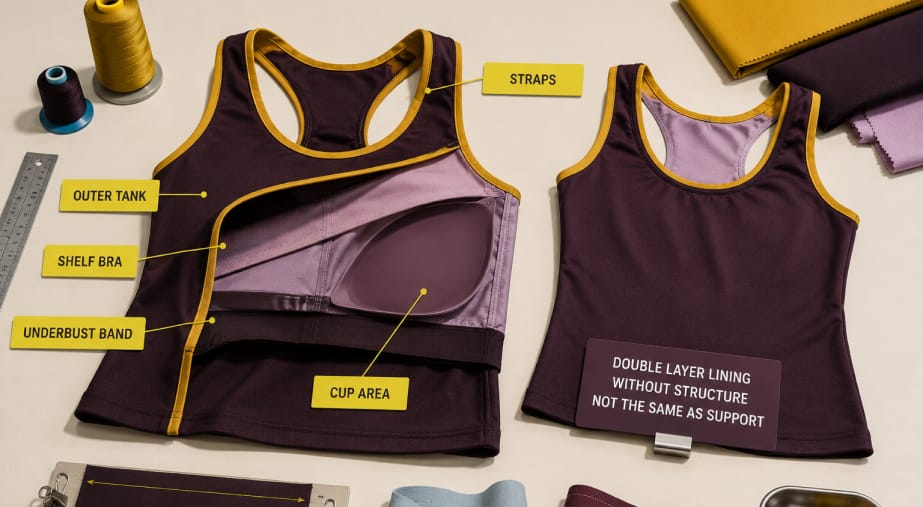
Beyond Yoga’s design uses a self-fabric shelf bra within a close-fitting racerback silhouette.
That can be enough for some wearers during lower- or moderate-impact exercise.
But two garments labeled “built-in bra” can provide dramatically different experiences.
The label describes a construction category.
It does not quantify support.
Breast Support Is Fundamentally About Movement
This is where workout tanks need to be evaluated differently from ordinary tops.
During exercise, breasts can move relative to the chest wall.
The amount and pattern of movement depend on the activity, individual anatomy, garment construction, and support level.
Running and jumping generally create substantially different demands from controlled Pilates or strength movements.
Research on sports bras therefore often evaluates breast displacement rather than simply asking whether a garment feels tight.
A 2024 study published in Frontiers in Sports and Active Living examined sports-bra support and breast motion during running. The researchers emphasized that adequate breast support is important for reducing exercise-induced breast discomfort and managing breast movement.
The broader sports-bra biomechanics research helps explain why a workout tank cannot be judged solely by how snug it feels while standing.
The meaningful test happens once the body starts moving.
“Medium Support” Needs Context
Activewear brands commonly divide sports bras into categories such as low, medium, and high support.
Those labels are useful starting points.
They are not universal measurements.
There is no single consumer standard that guarantees every garment marketed as “medium support” controls breast movement identically.
That means Beyond Yoga’s medium-support description should be interpreted as the manufacturer’s intended positioning for the product.
It should not be translated into a guarantee for a particular person.
Someone with a smaller bust may find a shelf-bra tank sufficiently secure for strength training.
Someone else may want substantially more support for exactly the same workout.
Neither person is using the garment incorrectly.
Support requirements are individual.
Pilates Is A Very Different Test From Running
Beyond Yoga specifically positions the Spacedye tank for activities including Pilates.
That makes sense from a garment-design perspective.
Pilates often involves controlled movements rather than repeated high-impact landings.
A fitted tank also has practical advantages on a reformer.
Loose fabric can shift during inversions or obscure body positioning, while a close-fitting tank tends to remain nearer the torso.
A built-in shelf bra may therefore simplify the outfit.
Instead of wearing a bra underneath another tight layer, someone who finds the integrated support adequate can wear one garment.
That can reduce straps, bands, seams, and overlapping fabric.
For some people, fewer layers may also feel cooler and less restrictive.
But Pilates still contains substantial movement.
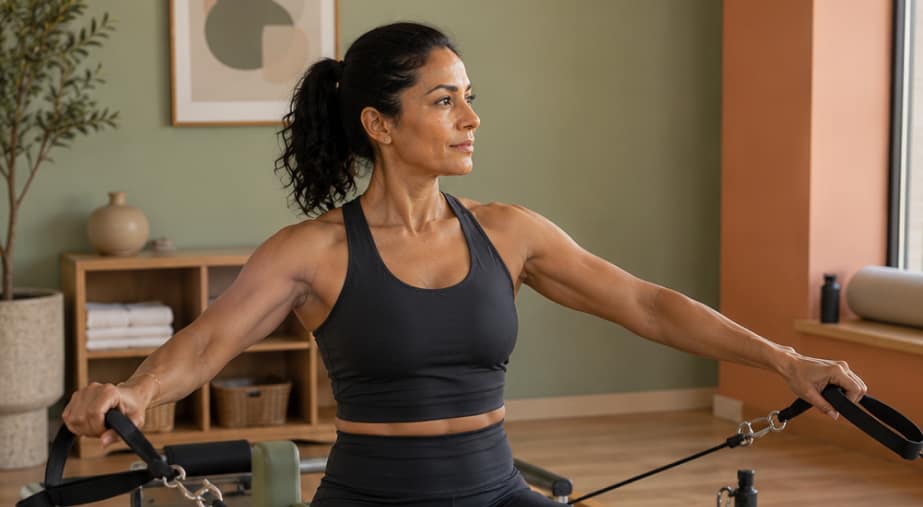
Supine exercises, spinal articulation, planks, side-lying work, and transitions can reveal fit problems that are not obvious while standing.
The tank still needs to remain positioned.
Running Changes The Equation
Running repeatedly accelerates and decelerates the body.
That makes it a much more demanding support test.
A tank that feels secure during walking may allow more movement once someone starts jogging.
A garment that works during a short treadmill warm-up may feel different during a sustained run.
This is why “I can exercise in this without a bra” requires context.
What exercise?
For how long?
At what intensity?
For which wearer?
Those questions are more useful than treating “bra replacement” as a yes-or-no product feature.
Compression Alone Does Not Define Support
One common misconception is that tighter automatically means more supportive.
It does not.
Compression can help limit movement by holding breast tissue closer to the chest.
But sports-bra engineering can also use encapsulation, where individual cups provide more independent structure.
Many high-support designs combine both approaches.
A workout tank generally has less physical space for complex cup structures than a dedicated high-impact sports bra.
That does not make tanks ineffective.
It simply means their support often relies more heavily on fabric tension, shelf construction, and torso fit.
Making the tank excessively tight is not an ideal substitute for proper support engineering.
A garment should not require uncomfortable chest compression to remain functional.
The Underbust Area Does A Disproportionate Amount Of Work
Shoppers often focus on straps.
The lower support structure deserves just as much attention.
A secure underband or shelf-bra edge helps anchor the garment against the torso.
If that section is too loose, the entire inner bra can move upward.
If it is excessively tight, it may become uncomfortable during deep breathing or prolonged exercise.
A useful fitting test is therefore not simply whether the tank looks close-fitting.
Raise both arms.
Twist.
Take several deep breaths.
Bend forward.
Perform a few repetitions of the movement you intend to do.
If the lower edge repeatedly migrates upward or the breast tissue moves outside the intended support area, the tank may not provide the right fit for that activity.
Racerback Construction Changes How Force Is Distributed
Beyond Yoga’s tank uses a slim racerback.
Racerback designs are common in activewear because they keep material away from portions of the shoulder blades and can provide a secure strap configuration during movement.
But strap geometry is another area where individual preference matters.
Some people like the concentrated racerback structure.
Others experience neck or upper-trapezius pressure from certain designs.
A garment can provide adequate breast support while still being uncomfortable around the shoulders.
That is why support and comfort should be evaluated separately.
The ideal workout top needs both.
Fabric Recovery Matters More Than It Seems
The Spacedye tank uses 13% elastane alongside polyester.
Elastane helps the fabric stretch and recover.
Recovery matters because a support garment repeatedly expands as the wearer moves and breathes.
If a fitted tank gradually stretches out during use, its support characteristics can change.
The same issue can develop over the garment’s lifespan.
Repeated wear, washing, drying, heat exposure, and mechanical stress can affect stretch textiles.
A built-in bra that feels secure when new should therefore be evaluated over time.
The real durability question is whether the garment continues to provide the level of support the wearer expects after dozens of workouts and washes.
Sweat Can Change How A Tank Feels
Beyond Yoga describes Spacedye as moisture-wicking.
Moisture management matters for more than comfort.
A garment saturated with sweat can feel different against the body.
Fabric may cling differently.
Bands can feel more noticeable.
Seams that seemed irrelevant while dry may become irritating.
During longer workouts, a bra-replacement tank therefore has to perform as a complete system.
The exterior fabric, internal shelf, lower band, straps, and seams are all being exposed to heat, moisture, and repetitive movement simultaneously.
Cup Size Alone Cannot Determine Whether It Will Work
It is tempting to create simple rules:
small bust equals tank,
large bust equals sports bra.
Real fit is more complicated.
Breast shape, tissue characteristics, torso circumference, garment size, strap position, activity, and personal preference can all influence the experience.
Two people wearing the same conventional bra size may want very different levels of exercise support.
This is another reason body-neutral activewear guidance should avoid telling people what their bodies “require” based solely on appearance.
The better approach is to evaluate what the garment does during the intended activity.
Removable Pads Do Not Automatically Create More Support
Many integrated-bra tanks include removable cups or pads.
These can affect coverage and shape.
They should not automatically be interpreted as major structural support.
A thin foam insert may change nipple coverage and visual contour while doing relatively little to restrict breast movement.
Support comes from the entire architecture.
That includes the underbust structure, fabric tension, cup or liner design, straps, neckline, torso fit, and overall garment stability.
Consumers should therefore avoid equating “padded” with “high support.”
They describe different properties.
The Bounce Test Can Be Useful
A simple fitting-room movement test can reveal more than the product description.
After confirming that the garment feels comfortable while standing, try movement appropriate to the intended workout.
For Pilates or yoga, that might include:
raising the arms,
a forward fold,
a plank position,
and controlled torso rotation.
For strength training, try several bodyweight squats and lunges.
For running or higher-impact exercise, a few gentle hops or brief jogging movements can help reveal whether the level of movement feels acceptable.
The objective is not to eliminate all breast movement.
It is to determine whether the garment provides comfortable support for that person and activity.
Dedicated Sports Bras Still Have An Important Role
The rise of bra-tank hybrids does not make sports bras obsolete.
Dedicated sports bras have more design freedom.
They can use stronger underbands.
They can incorporate adjustable straps.
They can use hook-and-eye closures.
They can provide encapsulated cups.
They can create higher necklines and more coverage.
They can combine multiple layers of technical fabric without also needing to function as a conventional shirt.
Those features become especially useful as exercise impact increases.
Running, court sports, HIIT, jumping workouts, and other high-impact activities can place substantially greater demands on breast support than walking or Pilates.
Research Shows Why High-Impact Support Is Its Own Category
Sports-bra design is increasingly being studied as a performance and comfort issue rather than simply an apparel preference.
Research has shown that breast support can influence breast movement and perceived comfort during exercise. The practical implication is not that everyone needs the most restrictive bra available.
It is that support should match the movement being performed.
The American College of Sports Medicine similarly emphasizes individualized exercise participation rather than treating one piece of equipment or apparel as universally appropriate.
For consumers, that means the useful question is not “Is this tank supportive?”
It is: Is this tank supportive enough for what I am about to do?
When A Tank Can Be The Better Choice
A built-in-support workout tank can be extremely practical.
It reduces the number of garments being worn.
It eliminates competing bra and tank straps.
There is one less underbust layer.
The outfit can transition more easily between exercise and everyday activities.
And for someone who finds the integrated support comfortable, there may be no practical reason to add another bra underneath.
This can make these garments particularly attractive for walking, yoga, Pilates, mobility sessions, some strength workouts, and everyday active use.
The important phrase is for someone who finds the support adequate.
When A Separate Sports Bra May Still Make More Sense
A dedicated bra may be preferable when the workout involves substantial running, jumping, rapid direction changes, or other high-impact movements.
It may also make sense when the tank’s shelf bra does not provide enough stability for an individual wearer.
Some people simply prefer more separation between their support garment and their shirt.
That has practical advantages too.
A damp tank can be changed while keeping the sports bra on.
Different bras can be paired with the same top depending on workout intensity.
And the wearer can select support independently from torso fit.
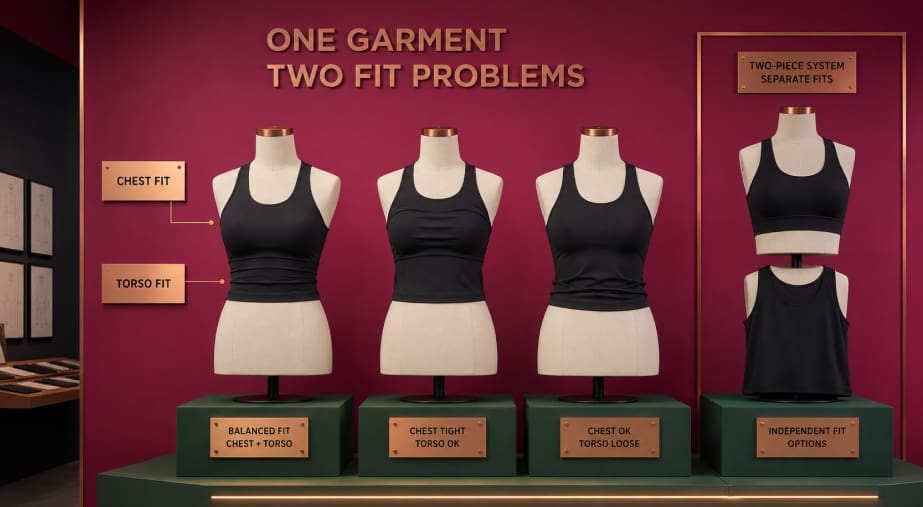
With an integrated garment, those two sizing problems are linked.
One-Piece Support Creates A Unique Fit Problem
This may be the biggest compromise of the bra-tank hybrid.
A conventional outfit allows someone to choose one size and design for the breasts and another for the torso.
A built-in-support tank asks one garment to fit both.
That works extremely well when someone’s proportions align with the garment pattern.
It can be more difficult when they do not.
A tank might fit perfectly through the waist but feel restrictive across the chest.
Another size might provide enough breast room but feel loose through the torso.
This does not mean the wearer’s body is unusually shaped.
It means one garment is trying to solve two different fit problems simultaneously.
What To Test Before Skipping The Sports Bra
| Feature | Practical Test |
|---|---|
| Underbust support | Does the shelf stay positioned when arms rise? |
| Breast movement | Is movement comfortable during the intended exercise? |
| Straps | Do they remain secure without painful pressure? |
| Neckline | Does coverage remain adequate when bending? |
| Torso fit | Does the tank stay positioned without excessive compression? |
| Fabric recovery | Does it return toward shape after stretching? |
| Sweat comfort | Do the inner layers remain comfortable when damp? |
| Breathing | Can you breathe deeply without uncomfortable restriction? |
| Workout intensity | Is the support appropriate for the actual activity? |
| Long-term fit | Does support remain acceptable after repeated washing? |
A product description can tell shoppers that a shelf bra exists.
Only movement can tell them whether it works for their needs.
The Best Bra Replacement May Not Replace Every Bra
Beyond Yoga’s Spacedye Slim Racerback Cropped Tank shows why built-in-support tops have become such a meaningful activewear category.
It combines a cropped workout tank with a self-contained shelf bra, uses an 87% polyester and 13% elastane performance fabric, and is explicitly positioned by Beyond Yoga as providing medium support. Its recent August sale also put renewed attention on a product that already has thousands of customer ratings.
For some people, that combination may genuinely eliminate the need for a separate sports bra during Pilates, walking, strength training, or other lower-to-moderate-impact activities.
That is a useful innovation.
It does not mean the sports bra has been engineered out of existence.
Running, jumping, court sports, HIIT, and other high-impact activities can create very different breast-motion demands. Individual anatomy and comfort also mean two people can reasonably reach opposite conclusions about the same tank.
The most useful shift is therefore not asking whether a workout tank can replace a sports bra in general.
Ask whether it can replace your sports bra for this particular workout.
If the internal shelf remains stable, breast movement feels comfortable, the straps and underbust structure do not create excessive pressure, and the garment stays positioned throughout the activity, a second layer may provide little additional value.
If those conditions are not met, the fact that the product contains a built-in bra does not make additional support unnecessary.
The future of activewear may contain many more garments that blur the boundary between top and bra.
The body’s movement—not the product name—should determine whether that combination works.