

PFAS activewear safety is becoming a practical fabric question for anyone buying leggings, sports bras, outer layers, or team training gear in New Jersey. Senate Bill S1281, adopted by the Environment and Energy Committee on March 16, 2026, proposed a restriction on apparel containing intentionally added PFAS. As of October 10, 2026, the research notes indicate that the restriction had not yet become active because the bill had not been signed into law.
That timing matters. The proposed restriction would begin two years after the law’s effective date, not on the committee date. For shoppers, coaches, retailers, and brands, the useful reading is not that every activewear item is unsafe. It is that water-resistant, stain-resistant, and other finish-driven claims may face closer scrutiny as New Jersey moves toward textile rules focused on intentionally added PFAS.
PFAS activewear safety Under New Jersey’s Bill
What The Bill Would Restrict
The S1281 text states that, beginning two years after the effective date of the act, no person would be allowed to sell, offer for sale, manufacture, or distribute for sale or use in New Jersey any apparel containing intentionally added PFAS. The bill’s apparel definition includes activewear, athletic wear, leisurewear, and sports uniforms, according to the New Jersey S1281 text.
The bill focuses on intentionally added PFAS rather than every possible trace result. In the research notes, intentionally added PFAS means substances deliberately used during manufacturing for a specific function, including water or stain repellence or durability-related purposes. That distinction is central because a fabric can move through a long supply chain involving fibers, dyes, coatings, finishing agents, trims, and packaging decisions.
Why The Timeline Is Still Conditional
The proposed apparel restriction was not in force on October 10, 2026, based on the research provided. The two-year clock would start after the law’s effective date, so compliance planning and shopper expectations should be separated from the legal start date. Assembly Bill A5048, introduced on May 11, 2026, was described in the research notes as having the same practical effect for apparel containing intentionally added PFAS.
The bill also describes exemptions. Personal protective equipment, clothing made exclusively for United States military use, and protective apparel for motorcycle or off-highway vehicle operation are treated differently. Ordinary consumer activewear, including studio clothing, gym clothing, sports bras, and leisurewear, generally does not fit those exemption categories in the research notes.
What Intentionally Added PFAS Means For Apparel
Finishes Are The Main Question
For shoppers, PFAS activewear safety should be read through the finish, not only the fiber label. Polyester, nylon, cotton, elastane, and blended fabrics can all be sold with performance language. The bill’s focus is not the fiber name by itself; it is whether PFAS were deliberately added to deliver a function.
That makes claims such as water resistance and stain resistance worth reading carefully. The presence of those claims does not prove that a garment contains PFAS. It does mean the brand should be able to explain what chemistry or finish is being used, especially once state restrictions set clearer expectations for apparel sold in New Jersey.
Retailers may also need better documentation from suppliers. A sports bra brand may not apply a finish directly if it buys finished fabric from another mill. A legging brand may source fabric, mesh, elastic, and labels from different suppliers. If the law is enacted, the compliance burden may push brands to ask more direct questions across the supply chain.
Penalties Create Retail Pressure
The research notes state that S1281 treats violations as an unlawful practice under New Jersey’s Consumer Fraud Act. Listed consequences can include fines up to $10,000 for a first offense and up to $20,000 for later offenses, along with cease-and-desist orders, punitive damages, and costs.
Those penalty signals matter because activewear is often sold through national e-commerce sites, outlet stores, studio partnerships, team stores, and large retail chains. If a product is sold into New Jersey, brands may need evidence that intentionally added PFAS have not been used where the law applies. The practical effect could reach beyond one state if brands choose one product standard for broad distribution.
Readers tracking related policy changes can compare this proposal with broader textile rule discussions in PFAS activewear laws and fabric safety, especially where leggings, bras, and outerwear share the same suppliers.
Why Sports Bras Need Separate Fit Review
PFAS activewear safety Is A Fit And Fabric Question
A sports bra deserves two separate checks: fabric chemistry and mechanical support. One label may describe a water-resistant finish, another may describe a medium-support or high-support fit, but those are not the same issue. A PFAS-focused law asks whether the garment contains intentionally added PFAS. A fit review asks whether the bra’s band, straps, cups or panels, coverage, closures, and fabric recovery match the activity and the wearer’s comfort needs.
This distinction is easy to miss because sports bras sit in close contact with skin during training. A shopper may feel reassured by a soft fabric or by a support label, yet neither feature answers whether a finish contains intentionally added PFAS. The reverse is also true: a garment marketed as PFAS-free would still need to fit well enough for the person and the workout.
Support Level Should Match Movement
For lower-impact studio work, many people look for a smooth band, flexible straps, and enough coverage to avoid constant adjustment. For running, jumping, court drills, or interval training, many people prefer firmer containment, less bounce, and a band that remains stable during arm swing and torso rotation. Those are fit preferences, not medical claims, and they vary by body shape, breast size, movement pattern, and sensory tolerance.
- Check whether the lower band stays level during arm raises and controlled hops.
- Look for straps that remain secure without digging or slipping.
- Test whether cups or front panels contain movement without sharp pressure.
- Read finish claims separately from support claims.
- Ask the brand whether water-resistant or stain-resistant finishes rely on intentionally added PFAS.
For time-pressed shoppers building practical routines, resources about time and daily routines can be a useful reminder that clothing decisions should reduce friction, not create another complicated task. A short fit test and a direct fabric question can be enough to screen many purchases.
Dermal Exposure Evidence Deserves Caution
What The Review Found
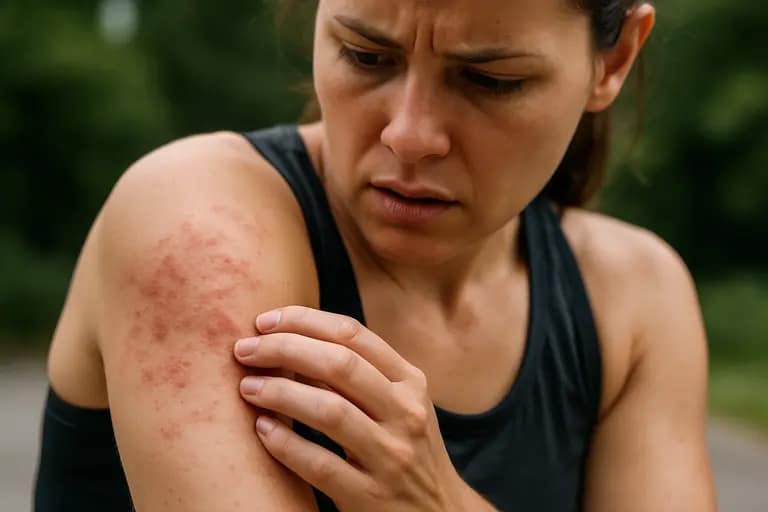
The health discussion should be careful. A recent review of 37 studies reported that dermal exposure to PFAS from clothing generally resulted in external exposures below 1 ng/kg-bodyweight/day, while some selected scenarios exceeded 100 ng/kg-bodyweight/day. The authors described toxicological relevance as an area still under investigation, according to the PFAS dermal exposure review.
That does not justify panic about every garment. It also does not support broad claims that any one activewear purchase will prevent or cause a specific health outcome. The evidence supports a more limited point: close, sweaty, repeated contact with treated textiles is a plausible exposure route worth studying and regulating with care.
Why Activewear Is A Special Case
Activewear is different from an occasional rain jacket because it is often tight, stretchy, and worn during heat and sweat. Sports bras, compression shorts, leggings, and fitted tops can stay in contact with skin for long sessions. That contact pattern makes fabric finishes more relevant than they might be for looser clothing worn briefly.
Still, exposure estimates are not the same as individual risk assessments. People vary in training frequency, garment rotation, washing habits, skin sensitivity, pregnancy status, age, work exposures, and other factors. A cautious approach is to ask better product questions while avoiding claims that clothing alone can diagnose, treat, or prevent a health condition.
Claims, Finishes, And Compliance Signals
What Shoppers Can Ask Brands
PFAS activewear safety questions are most useful when they are specific. Asking whether a product is safe may produce vague customer-service language. Asking whether any finish, coating, membrane, or treatment contains intentionally added PFAS is more precise. It also matches the bill’s core language more closely.
Brands may answer with supplier declarations, testing references, or certification language. The research notes mention that certification systems are being used more often to support PFAS-free claims, but certifications vary in scope. A shopper does not need to become a textile chemist. It is reasonable to ask what was tested, which part of the garment was tested, and whether the claim covers trims, elastic, coatings, and printed components.
Performance Tradeoffs May Change
If manufacturers reformulate away from intentionally added PFAS, performance claims may become more modest. Water repellence, stain resistance, and durability can depend on finish chemistry. The research notes indicate that alternatives exist, but matching every durability property remains challenging in some contexts.
That may be especially visible in outer layers, training jackets, weather-resistant pants, and sports uniforms exposed to wet fields or repeated laundering. For sports bras and leggings, the bigger issue may be whether brands use any finish beyond the base fabric. A lightly brushed studio bra and a water-resistant outdoor training top are not the same textile problem.
PFAS activewear safety Questions For Shoppers And Clinicians
A cautious PFAS activewear safety review should separate legal status, fabric chemistry, performance, and fit. As of October 10, 2026, the New Jersey restriction described in the research notes had not yet taken effect. If enacted, it would restrict apparel with intentionally added PFAS two years after the effective date, with activewear included in the apparel category.
For shoppers, the most practical questions are direct: Does this garment use a water-resistant, stain-resistant, or durability finish? Does the brand state whether intentionally added PFAS are used? Does the answer cover the full garment, including elastic and trims? For sports bras, ask a second set of questions: Does the band stay stable? Do the straps hold during the activity? Does the support level match the movement without uncomfortable pressure?
This is general education about apparel policy and fabric selection, not medical advice. If you have persistent skin irritation, breathing discomfort during exercise, chest or breast pain, pregnancy-related concerns, or medical questions about chemical exposures, discuss them with a qualified clinician. Useful questions include whether symptoms suggest a medical evaluation, whether a dermatology referral is appropriate for skin reactions, and whether your training clothing or work exposures are worth discussing as part of a broader health history.