

PFAS activewear testing has moved from a niche textile concern into a practical shopping and design question for leggings, sports bras, rainwear, swimwear, and other performance fabrics. Early findings from California and New York suggest that state restrictions are changing what appears in many textile products, but the results should be read carefully: compliance with a chemical rule is not the same thing as a claim about comfort, support, durability, or health outcomes.
For activewear, that distinction matters. A sports bra can meet a chemical threshold and still fail at support. A pair of athletic pants can show low fluorine readings and still roll at the waistband. Fabric regulation may reduce one set of concerns, while fit, construction, movement, and care remain separate questions.
Why PFAS Activewear Testing Mattered In 2025
The policy shift became visible because California and New York both placed restrictions on PFAS in textile products beginning on January 1, 2025, although the two states structured their rules differently. The shared direction is clear: intentionally added PFAS in apparel and related textile categories are facing tighter limits, disclosure duties, or phase-out timelines.
New York’s Apparel Rule
New York’s PFAS in Apparel Law prohibits the sale or offer for sale of new apparel containing PFAS as intentionally added chemicals, effective January 1, 2025. The state also set a later phase for outdoor apparel for severe wet conditions, with that category included from January 1, 2028, according to the New York apparel law.
That timing matters for activewear because the word “apparel” can include many products shoppers use for training, commuting, outdoor fitness, and wet-weather exercise. A waterproof shell used over gym clothing may sit under a different timeline than a basic training top or sports bra. The early evidence therefore needs category-by-category interpretation rather than a single statement that all products changed at the same pace.
California’s Treatment Rule And Textile Thresholds
California’s textile law, as summarized in the research for this article, bans the manufacture, sale, or offer for sale of new textile articles containing regulated PFAS at or above 100 parts per million total organic fluorine from January 1, 2025. Outdoor apparel for severe wet conditions remains exempt from that prohibition until January 1, 2028, while qualifying severe-wet-condition apparel containing PFAS must carry a clear disclosure stating that it was made with PFAS chemicals.
California also addressed after-market textile and leather treatments earlier. On April 1, 2022, the Department of Toxic Substances Control listed treatments containing PFAS for converted textiles or leathers as a Priority Product under its Safer Consumer Products program, with manufacturer notification and alternatives-analysis deadlines in 2022, as described by California DTSC.
That distinction is useful for gym clothing. The law may apply to the garment itself, while a separate treatment product may apply after purchase. For sports bras and leggings, shoppers may need to distinguish factory-applied fabric finishes from sprays, cleaners, or repellents marketed for use after the item is already owned.
Early Testing Signals From California And New York
PFAS activewear testing became more meaningful after the 2025 restrictions took effect because investigators could compare post-ban textile products with categories that previously reported much higher fluorine readings. The research notes describe a June 8, 2026 report in which testers bought 115 textile-based products in California and New York after the bans and found that about 80 percent complied with the relevant restriction.
Activewear Categories Showed Lower Fluorine Readings
The early testing covered product groups that overlap with workout and outdoor apparel, including swimwear, athletic pants, rainwear, shoes, and outdoor gear. Several categories that had previously shown PFAS readings in the thousands of parts per million were reported in the 2025 testing at less than 10 parts per million total fluorine. Raincoats were described as showing reductions of 97 percent to 99.99 percent compared with pre-regulation levels.
Those changes are substantial as regulatory signals. They suggest that brands and suppliers can change material choices, coatings, finishes, or sourcing practices when legal limits become concrete. Still, a lower fluorine reading does not explain how the replacement material performs during sweat, stretch, abrasion, or repeated washing. For activewear, the chemical result is one data point, not a full product review.
Lagging Categories Keep The Results Cautious
The same research notes also identify textile categories that lagged. Tablecloths were reported above California’s maximum allowed PFAS level in every tested sample. Pet products exceeded those limits in 6 of 8 tested products, and reusable diapers exceeded them in 5 of 9 tested products.
Those are not sports-bra categories, but they prevent an overly broad reading of the findings. PFAS activewear testing may show progress in athletic pants, swimwear, rainwear, and related outdoor gear, while other textile supply chains may be slower to change. The more careful interpretation is that regulation appears to be pushing many apparel categories toward lower readings, but compliance is uneven across the wider textile market.
What The Findings Mean For Sports Bras
Sports bras deserve separate attention because their job is not only textile coverage. Support depends on mechanical design: band tension, cup or panel structure, strap width and placement, fabric recovery, coverage, closures, and how those elements work on a specific body during a specific activity.
Support Mechanisms Still Come First
A low-impact yoga bra, a medium-support lifting bra, and a high-support running bra can all be made from fabrics that meet a PFAS rule. That does not make them interchangeable. For lower-impact movement, many wearers prioritize soft stretch, light compression, and easy breathing. For running, jumping, or court sports, shoppers often look for more structured containment, a secure underband, and straps that do not shift during repeated motion.
This is where PFAS activewear testing should stay in its lane. It can help evaluate whether a product category is aligning with state chemical restrictions. It cannot tell whether a bra’s underband digs in, whether the cups gap, whether the neckline provides enough coverage for a given activity, or whether the wearer feels stable during movement.
Fabric Claims Need Fit Testing
For sports bras, fabric language can distract from construction. “Water-resistant,” “quick-dry,” “smooth,” or “compressive” may describe a textile finish or hand feel, but support usually comes from the whole garment. A fabric with strong recovery may help a bra hold its shape, yet the band, straps, and panels still need to be proportioned well.
A practical fitting check is simple: raise the arms, rotate the torso, bend forward, and perform the movement pattern that matches the intended activity. The band should stay level without requiring constant adjustment. Straps should feel secure without creating sharp pressure. If a bra causes persistent pain, numbness, skin irritation, breathing discomfort, or other unusual symptoms, that is not a fabric-shopping problem alone; discussing symptoms with a qualified clinician is the safer next step.
How Shoppers Can Read PFAS Claims
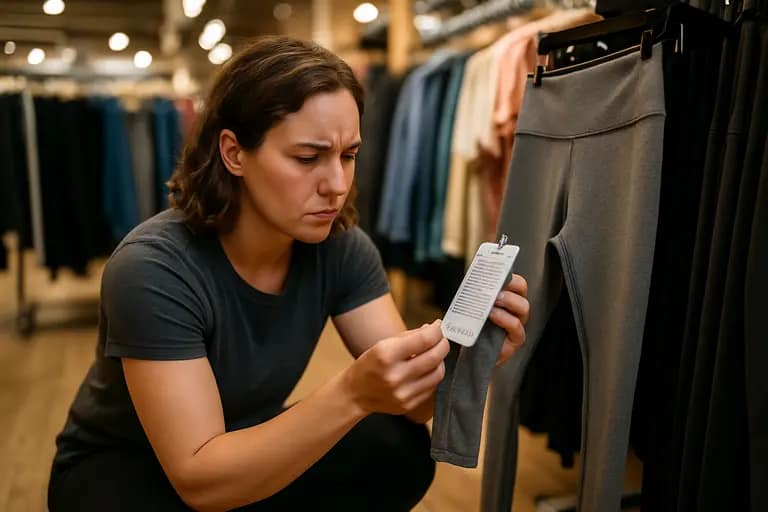
State rules are changing labels, supplier questions, and retailer claims. Readers who want a broader activewear-specific policy discussion can compare these findings with PFAS activewear fabric rules, while related network coverage of textile and supply-chain topics is available at Up Offshore for further insights.
Compliance Is Not A Performance Claim
Compliance language should not be read as proof that a product is more supportive, more comfortable, or better for every wearer. It means the product is being assessed against a legal or testing threshold. In the California research notes, the threshold for regulated PFAS in many new textile articles was 100 parts per million total organic fluorine beginning January 1, 2025, with a lower 50 parts per million threshold described for 2027. New York’s 2025 rule focuses on intentionally added PFAS in apparel, with severe-wet-condition outdoor apparel moving under the prohibition in 2028.
That legal difference matters. A product could be evaluated under a threshold-based framework in one state and an intentionally-added-chemical framework in another. Consumers do not need to become chemists, but they benefit from noticing whether a claim refers to legal compliance, lab testing, intentional addition, total fluorine, or a brand’s own material standard.
Questions Worth Asking
- Does the claim refer to the garment fabric, an after-market treatment, or both?
- Is the product regular activewear, outdoor apparel for severe wet conditions, footwear, swimwear, or another category?
- Does the label mention PFAS disclosure, fluorine testing, or intentionally added PFAS?
- For sports bras, does the support level match the activity rather than only the fabric description?
- Can the garment pass a movement test without pressure, shifting, chafing, or repeated adjustment?
These questions keep the issue practical. PFAS activewear testing can inform material scrutiny, but fit testing still protects against buying a sports bra or legging that looks compliant on paper and performs poorly in motion.
PFAS Activewear Testing And Fabric Choices
The early California and New York findings point in a cautiously positive direction for many apparel categories. Post-ban testing described in the research notes found broad compliance among sampled textile products, with athletic pants, swimwear, rainwear, shoes, and outdoor gear showing lower readings than earlier reports. At the same time, tablecloths, pet products, and reusable diapers showed that some textile categories remained above California’s limits.
For activewear buyers, the reasonable takeaway is not that every product is free of concern. It is that regulation appears to be influencing material decisions, while shoppers still need to evaluate category, label language, fit, and function. A sports bra should be judged for support mechanism first: band stability, cup or panel control, strap behavior, coverage, stretch recovery, and comfort during the activity it will actually be used for.
PFAS activewear testing is best treated as one layer of evidence. It can help identify market movement away from regulated PFAS use, but it does not replace product-specific fit checks, care-label review, or personal comfort assessment. Anyone with persistent skin irritation, pain, breathing discomfort, or other symptoms during exercise should ask a qualified clinician what may be contributing and whether a garment, activity pattern, or non-clothing factor needs attention.